Philips Wouwerman painted the same animal again and again. In a stable, at a smithy, on a beach, in the smoke of a cavalry charge, a white or grey horse stands out against darker ground and tells you where to look. The National Gallery, London, which lists twelve works connected with him, calls it his “characteristic white horse” and notes that it served both as a character and as a way of catching light in otherwise shadowy scenes. For a designer, that is a lesson in hierarchy: one bright shape, many small stories around it.
For more public-domain works to study, browse the MGD museum inspiration collection.
Who was Philips Wouwerman?
He was born in Haarlem in 1619 and died there in 1668; the Metropolitan Museum of Art, the National Gallery and the Web Gallery of Art all give those places and years. The National Gallery describes him as the son of the painter Paulus Wouwerman and says he was probably trained by his father and by Frans Hals. The Web Gallery of Art is more cautious: a contemporary source calls him a pupil of Hals, but the two share little beyond a nimble brush.
Both sources date his entry into the Haarlem painters’ guild to 1640. The National Gallery adds that his earliest dated paintings are from 1646, and that he absorbed the landscapes of Jan Wijnants and the scenes of Italian peasant life by Pieter van Laer, who came back to Haarlem from Rome in 1638.
His family worked in the same field. The Web Gallery of Art names his brother Pieter among his many imitators, and the Cleveland Museum of Art holds a landscape drawing by Jan Wouwerman (1629–1666), another painter of the family. For the Haarlem setting he worked in, see our guide to Frans Hals.
Key works by Philips Wouwerman
Cavalry making a Sortie from a Fort on a Hill (1646), National Gallery, London. Oil on canvas, 139 by 190.5 cm, signed and dated. One of his few dated works, according to the museum, with invented flags, uniforms and buildings; most dates below are museum estimates.
A Horse being Shod outside a Village Smithy (probably 1640–50), National Gallery. Oil on wood, about 46 by 62 cm.
A Man and a Woman on Horseback (about 1653–54), Metropolitan Museum of Art, New York. Oil on wood, 30.8 by 41.3 cm.
A White Horse, and an Old Man binding Faggots (1650s), National Gallery. Oil on wood, 31.8 by 26.3 cm.
The Interior of a Stable (probably 1655–60), National Gallery. Oil on canvas, 47 by 67 cm.
A Stag Hunt (about 1665), National Gallery. Oil on canvas, 75 by 104.2 cm.
A Dune Landscape with a River and Many Figures (probably 1660–68), National Gallery. Oil on wood, only 23.5 by 30.5 cm, yet full of riders, beggars, a coach, anglers and a yacht.
Composition: the pale horse as anchor
The eye goes first to the lightest large shape, usually a white or grey horse, then to the next accent of saturated colour, then out into the smaller incidents.
- Light shape on dark ground. In The Interior of a Stable, the National Gallery describes how the inside is almost too dark to read at first; the white pony is what catches the eye, and the yellow jacket of the rider beside it comes second.
- A gaze that points the way. In the National Gallery’s seashore picture, the white horse turns its head towards the open beach, and a pointing arm does the same job.
- Diagonals for energy. The 1646 battle runs down a hillside on a strong diagonal, which the National Gallery reads as adding to the instability of the fight.
- Many small stories. A dog chasing rabbits, a boy riding a goat, a boat about to meet a low bridge: the horse holds the frame together so these details can multiply.
A crowded layout survives if one element clearly outranks the rest. Wouwerman’s white horse is that element, repeated until it became a signature.
Line and drawing: studying the horse
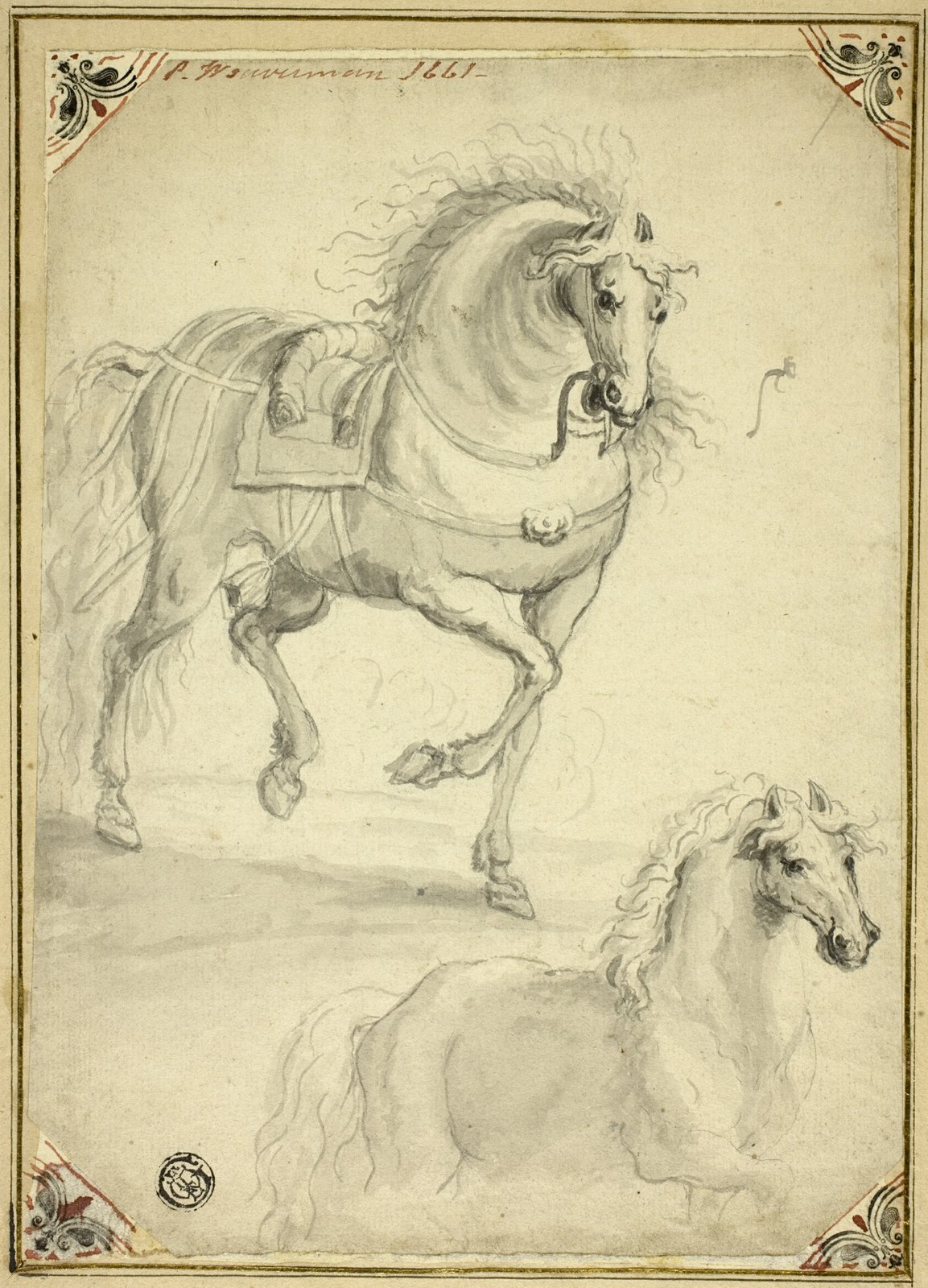
The Art Institute of Chicago’s Two Sketches of Trotting Horse shows how he built that signature. It is pen and grey ink with brush and grey wash over graphite, on a sheet about 21 by 15 cm. A saddled horse steps forward with one foreleg raised and its neck arched; below it, a second horse is roughed in from the shoulders up. The outlines are quick and broken, the mane is a tangle of curling strokes, and the volume comes almost entirely from washes laid in two or three values. An inscription in red runs along the top edge; the museum catalogues the sheet as undated.
The Metropolitan Museum of Art holds a related study, A Mounted Grey Horse Being Schooled in Piaffe, in black chalk, graphite and grey wash, which the museum dates after 1646. Piaffe is a trot performed on the spot, so the drawing records a controlled, collected movement rather than a gallop. Studies like these let the same horse reappear in a smithy, a hunt or a battle.
Measured from the museum’s scan of this impression of the Chicago drawing, the sheet runs from pale cream at #eae2bc and #e4dab4 through a warm mid tone at #beb38e to a darker olive-brown wash at #877b56. These are paper and ink as they look today, not original pigments, but they make a quiet four-step scale. To build your own set from a scan, try the MGD colour palette generator.
Palette and light in the paintings
In the paintings, colour is rationed. The National Gallery describes the 1646 battle as mostly in shadow, with details picked out in one or two flashes of colour, a horse’s rump, a red jacket, a helmet, a fallen flag, under a cold light it likens to cannon fire. In A Stag Hunt, the rider on the white horse wears red.
The recurring pairing is easy to borrow: a light neutral shape, a single red or yellow accent beside it, and a background of browns, greys and cloudy sky. The Web Gallery of Art sums up his manner as elegant draughtsmanship, sure composition, delicate colouring and a lively touch.
Format: small panels and a long afterlife in print
Many of the works above are small panels on wood, around 30 by 40 cm; the National Gallery suggests A White Horse, and an Old Man binding Faggots was probably meant to hang in a town house.
His compositions also travelled far beyond the paintings. The National Gallery notes that he was a favourite of eighteenth- and nineteenth-century collectors, and the Web Gallery of Art says his popularity continued throughout the eighteenth century. The Metropolitan Museum of Art holds an etching and engraving after Wouwerman by Charles Nicolas Cochin I, dated 1740–50, and an 1803 etching after him by Adam von Bartsch; the Art Institute of Chicago holds a 1788 brown aquatint after him by Wilhelm von Kobell and an Aubusson tapestry, about 1775, woven from an engraving by Jacques Philippe Lebas after a Wouwerman design. A related printed cotton appears in our guide to Johann Elias Ridinger.
For the wider picture of Haarlem and Amsterdam painting in this period, see Dutch Golden Age painting.
How designers can borrow Philips Wouwerman’s ideas
- Give every busy layout one bright anchor. Before adding detail, decide which single shape will be lightest. Check it by blurring the design or viewing it in greyscale.
- Pair the anchor with one accent. A pale hero element plus one small red or yellow note, as in the stable and the hunt, is enough colour for a whole composition.
- Use direction inside the image. A head turn, a pointing arm or a diagonal path can move the viewer from the focal point to the next piece of content, much as the seashore picture opens onto the beach.
- Build a repeatable motif. Wouwerman’s horse became recognisable through repetition. A brand illustration system works the same way: one character or object, redrawn in many settings.
- Work out poses on paper. The Chicago and New York studies are reference sheets. Keep a library of drawn poses for recurring figures.
- Design for reproduction. His compositions were copied in engraving, aquatint and tapestry. Test illustrations at small sizes and in one colour.
Frequently asked questions
Who was Philips Wouwerman?
A Dutch painter born in Haarlem in 1619 who joined the city’s painters’ guild in 1640 and died there in 1668. He specialised in landscapes with horses: hunts, camps, travellers and cavalry skirmishes.
Why are there white horses in so many Wouwerman paintings?
The National Gallery, London, describes the white horse as his characteristic motif, used both as an animal “character” and as a way of catching light and enlivening otherwise dark scenes.
Was Philips Wouwerman a pupil of Frans Hals?
Possibly. The National Gallery says he was probably trained by his father and by Hals; the Web Gallery of Art reports that a contemporary source calls him a pupil of Hals.
Where can I see works by Philips Wouwerman?
The National Gallery in London holds a group of his paintings. The Metropolitan Museum of Art and the Art Institute of Chicago hold the panel, drawings and prints discussed above.