Vancouver International Jazz Festival Brand Guidelines
A harbour city’s summer of jazz, from clubs to open plazas.
Aa
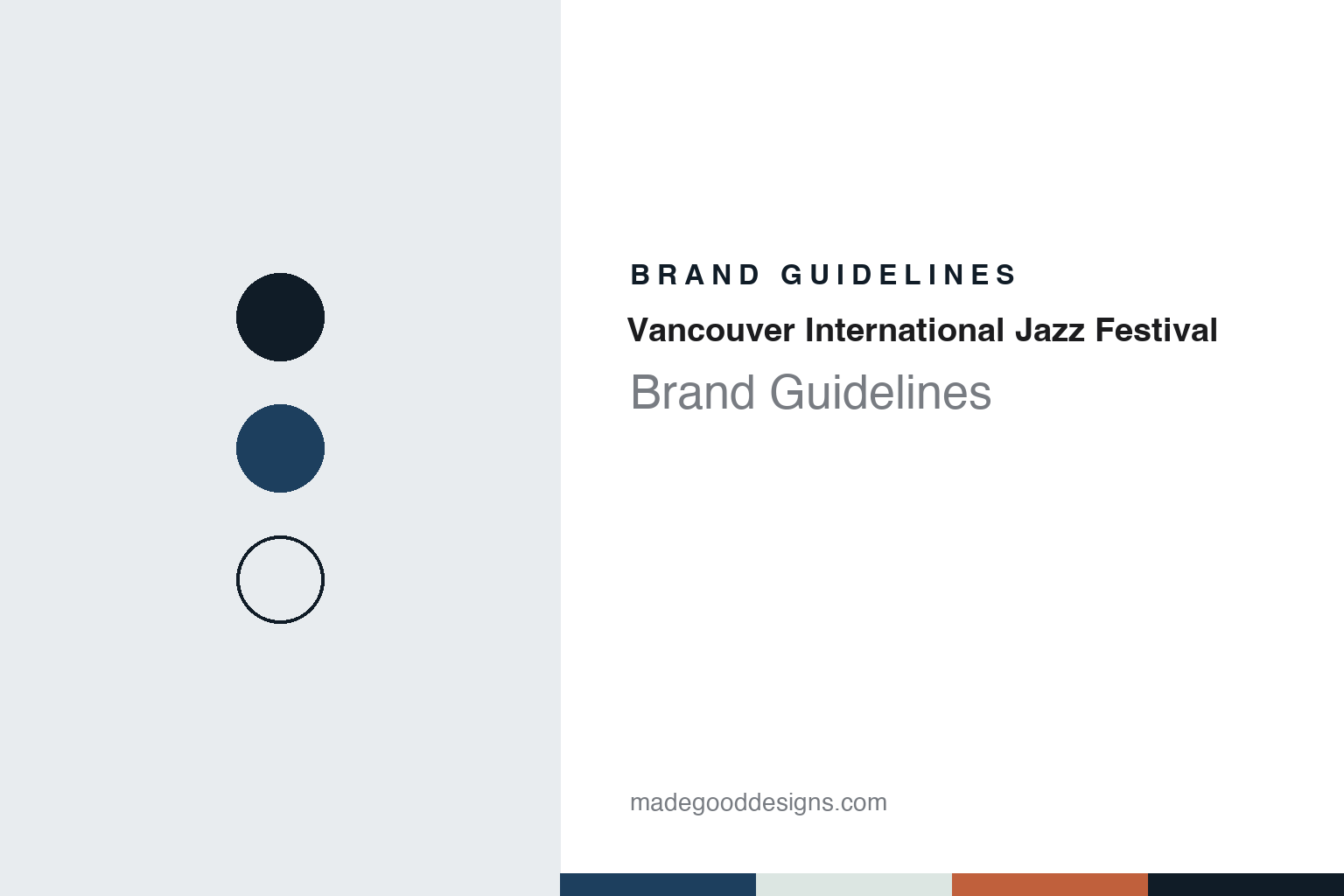
Two constants: a harbour blue, sea mist and cedar palette and an open-air sans register. Abstract homage — not a Vancouver International Jazz Festival asset; no logo, poster or artwork is reproduced.
Coastal Jazz
A society and its festival.
The Vancouver International Jazz Festival is held every summer in Vancouver, British Columbia. It is produced by the Coastal Jazz and Blues Society, usually shortened to Coastal Jazz, which says it was founded in 1985 and incorporated in 1986 as a community-based, not-for-profit, charitable arts organisation. Alongside the festival it presents concerts through the year.
English Wikipedia traces the festival to a local scene in the early 1980s centred on the community station Vancouver Co-op Radio, and to a Pacific Jazz and Blues Association formed in 1984. The first festival was held in 1985. In a 2021 history on the Coastal Jazz website, the co-founder John Orysik describes it as a weeklong regional event, held mainly in clubs around the city, with bands from British Columbia, Washington state and Oregon.
The festival expanded in 1986, when the group, by then renamed the Coastal Jazz and Blues Society, worked with Expo 86, the world’s fair held in Vancouver that year, according to English Wikipedia. Orysik’s history says that the 1986 programme reached theatres, clubs, outdoor bandstands and six venues on the Expo site, and that the line-up included Miles Davis and Wynton Marsalis. English Wikipedia calls that year the first annual international festival; the event has been held each summer since, with a gap in 2020, when no festival was held.
For many years the festival carried a bank’s name as its title sponsor and was known as the TD Vancouver International Jazz Festival; Orysik’s 2021 article still uses that form. In 2026 press coverage, including the Georgia Straight, it appears as the Vancouver International Jazz Festival, and its website runs under the Coastal Jazz name.
Colour
Clubs, theatres, an island and a plaza.
The festival spreads across the city rather than gathering on one site. CBC News described the 2018 edition as a ten-day festival of more than 300 concerts at 35 venues, “from clubs to concert halls to city parks.” Its picks that year ran from the Queen Elizabeth Theatre and the Vogue Theatre to Performance Works, Pyatt Hall, Frankie’s Jazz Club and The Ironworks, and included a project by a Vancouver cellist that Coastal Jazz had commissioned.
The dates follow the start of summer. English Wikipedia lists 24 June to 3 July for 2016, 22 June to 1 July for 2018 and 21 June to 2 July for 2024; the Vancouver Sun gave 20 June to 1 July for 2025. That year the paper reported that the percussionist and composer Susie Ibarra was one of the festival’s artists-in-residence at the New Improvisers Studio at Western Front, the artist-run centre, with performances at the Revue Stage on Granville Island.
The 2026 edition, which the Georgia Straight called the festival’s 41st, ran from 19 June to 5 July across Vancouver and the North Shore. The paper reported 33 free concerts and workshops and 32 “Pay What You Can” performances. The central free event was the Downtown Jazz Weekend on the north plaza of the Vancouver Art Gallery on 27 and 28 June, with two stages programmed side by side; there were free lunchtime concerts on the Dunsmuir patio of Bentall Centre and free workshops at Tom Lee Music Hall.
Granville Island served as a second hub. The Georgia Straight reported pay-what-you-can concerts there from 1 to 5 July at Ocean Artworks, Performance Works, Zameen Art House and the Revue Stage, with late-night sessions at the Revue Stage; ticketed concerts in 2026 included shows at The Birdhouse, the Hollywood Theatre and the Vancouver Playhouse. English Wikipedia describes a Sounds of Youth stage at the festival for big bands from local high schools, and says over 1,000 volunteers help to produce the event.
Typography
Design and documentation.
A jazz festival is rarely remembered for a single concert. Its identity is carried by a setting and a date: a converted cannery where every stage sits under one roof, a palace square turned into an open-air arena for a summer fortnight, a riverside town that fills with music in spring, a harbour city whose clubs host a festival in the dark months of winter, or a racecourse in New Orleans whose stands and paddocks become a field of stages. The setting gives the festival its look, and the calendar fixes it in the memory, whether that is a run of late-May nights, a numbered week in August or a pair of spring weekends.
Print is the second layer. Many festivals commission a new poster every year, and the run of posters becomes a record of the festival in its own right, with each edition’s artist or designer named alongside the date. Some keep the same wordmark for decades and let the artwork change; others redraw the name as the programme widens. Edition numbers and founding years often sit beside the title, so that the long count becomes part of the identity.
Behind each name stands an organisation. Jazz clubs, non-profit foundations, associations, municipal bodies and production companies keep festivals going across changes of venue, director and programme, and festival names often survive moves from one hall, park or district to another. When a festival changes its title or passes to a new organiser, the repeated elements, from the place name to the poster series, carry it across the change.
Audiences meet the identity in practical form: programme booklets, day schedules and stage maps, wristbands and festival passes, venue signs and apps that list who plays where and when. The guides in this group look at jazz festivals through those elements. The colours and typefaces shown are our own interpretation, not official assets.
Aa
An open-air sans — Coastal Jazz and its summer festival. (Specimen set in Space Grotesk, a sans STAND-IN; NOT the Vancouver International Jazz Festival logo.)
Vancouver Jazz
A festival run by its society.
Coastal Jazz is run by a small permanent team with a larger summer crew. Its board and staff page lists an executive director and two co-artistic directors, Cole Schmidt and Jeremy Page, with John Orysik as founding director emeritus, and a separate 2026 festival team for production, site, box office, artist hospitality and volunteers. In a statement quoted by the Georgia Straight in 2026, Schmidt named continuing collaborations with organisations including the Western Front, the Queer Arts Festival and Talking Stick.
The society describes a programme that runs beyond the festival. Its website names the Sounds of Youth stage, mentoring through the Vancouver Youth Jazz Orchestra and workshops by local and visiting musicians, and describes its range as jazz, blues, world, creative and improvised music. Its land acknowledgement names the Musqueam, Squamish and Tsleil-Waututh peoples.
For designers, the festival’s identity is carried as much by its places as by its name. A weekend of open-air stages on a downtown plaza, a cluster of small theatres and studios on Granville Island, theatres such as the Vogue and the Queen Elizabeth, and clubs across the city each present the same festival in a different register, from free afternoon sets to late-night improvised sessions. The pay-what-you-can label in its 2026 programme is part of that practical layer, telling audiences how to approach each show.
For a design guide, the Vancouver International Jazz Festival shows how a not-for-profit society can keep one festival name going across four decades while its venues and sponsors change. Compare the Montreal International Jazz Festival, another Canadian summer jazz festival, and Just for Laughs, another Canadian festival. For this guide we use a harbour blue, a sea mist and a cedar rust with a sans, an unofficial interpretation; no product or logo is reproduced.
Explore & save
Keep Vancouver International Jazz Festival’s identity on hand — save it to a board in the Made Good inspiration library.
Vancouver International Jazz Festival identity set
Pin the Vancouver International Jazz Festival harbour blue, sea mist and cedar palette and the open-air sans register to your own board.
Source & notes
Frequently Asked Questions
What font can I use to match the Vancouver International Jazz Festival look?
This guide describes Vancouver International Jazz Festival’s type as “An open-air sans — Coastal Jazz and its summer festival”. Its type specimen is set in Space Grotesk from Google Fonts as a stand-in; Space Grotesk is not Vancouver International Jazz Festival’s own lettering.
What colours are in the Vancouver International Jazz Festival palette?
This guide’s Vancouver International Jazz Festival palette is Harbour blue #1D3F5E, Night ink #101C27, Sea mist #DCE6E2, Cedar rust #C0603C and Paper #F5F7F6. The tones are the guide’s own unofficial interpretation, not official Vancouver International Jazz Festival hex codes.