Marc Ferrez is the photographer to study if you design in wide formats: banners, website heroes, book spreads or anything much wider than it is tall. His panoramas of Rio de Janeiro and its bay hold a long horizontal frame together with a few simple devices: a dark foreground edge, a rhythm of shapes across the middle distance, and a pale band of mountains and sky. The Instituto Moreira Salles (IMS) in Brazil, which holds his archive, says the public knows him above all for these panoramic views.
Who was Marc Ferrez?
According to the IMS chronology, Marc Ferrez was born in Rio de Janeiro on 7 December 1843 to French parents, and died on 12 January 1923. The Encyclopedia of Latin American History and Culture, in an entry by Robert M. Levine, gives the same dates and says his father was a French sculptor who came to Brazil with the French Artistic Mission of 1816. Levine writes that Ferrez studied in Paris and then apprenticed as a photographer with Franz Keller at the Leuzinger studio in Rio.
His first studio burned. The Getty, in a 2022 article by the curator Renato Menezes, dates the fire to 1873 and says Ferrez then went to Paris and bought new equipment, including tools for panoramic photography. Levine’s entry says the new equipment was made to Ferrez’s own design so that he could produce panoramic views.
Career outline and key works
The Geological Commission, 1875–76. In 1875 Ferrez joined the Geological Commission of the Empire, led by the Canadian-American geologist Charles Frederick Hartt. Pesquisa FAPESP, reporting on the 2019 IMS retrospective Marc Ferrez: Territory and Image, says he became known as the commission’s official photographer but did not join every trip. The Getty says he travelled to the north and northeast of Brazil in 1875–76 and made around 200 photographs, now in two albums in its collection. One of them, Ruinas de Palmyra (1875–76), an albumen silver print, places five small figures on a rock face to give the landscape its scale.
Navy and empire. The IMS says he served as photographer of the Imperial Navy and recorded events such as the celebrations for the end of the Paraguayan War. Levine adds that Emperor Pedro II gave him the title because he was skilled at neutralising the effects of a ship’s movement.
Panoramas of Rio, 1870s–1890s. The IMS dates panoramic views of Botafogo Bay to about 1880 and about 1885, the latter taken from the top of Corcovado, and a view of the entrance to Rio harbour to about 1875. The Metropolitan Museum of Art holds Copacabana, a negative of 1880 printed in 1983 as a platinum print, about 17 by 33 centimetres: nearly twice as wide as it is tall.
Mining and labour. The Getty Research Institute holds an 1888 photograph by Ferrez of five Black men working inside a gold mine in Minas Gerais. Menezes notes they were most likely working under slavery, which Brazil abolished that year, and that Ferrez’s images of enslaved labour show no sympathy with the anti-slavery movements of his time. FAPESP quotes the IMS curator Sergio Burgi on his documentation of enslaved people on coffee farms in the Paraíba Valley, which Burgi says exposes the system’s brutality. Together, the two views are a reminder that these were commissions with a point of view.
Rebuilding Rio, c. 1906. The IMS catalogues large 24 by 30 centimetre glass negatives of the new Avenida Central, today’s Avenida Rio Branco, dated about 1906. The IMS chronology says he became known for recording Rio’s urban changes, and it also credits him with early colour photography in Brazil and with producing films, including the comedy Nhô Anastácio chegou de viagem.
What to look at in a Marc Ferrez panorama
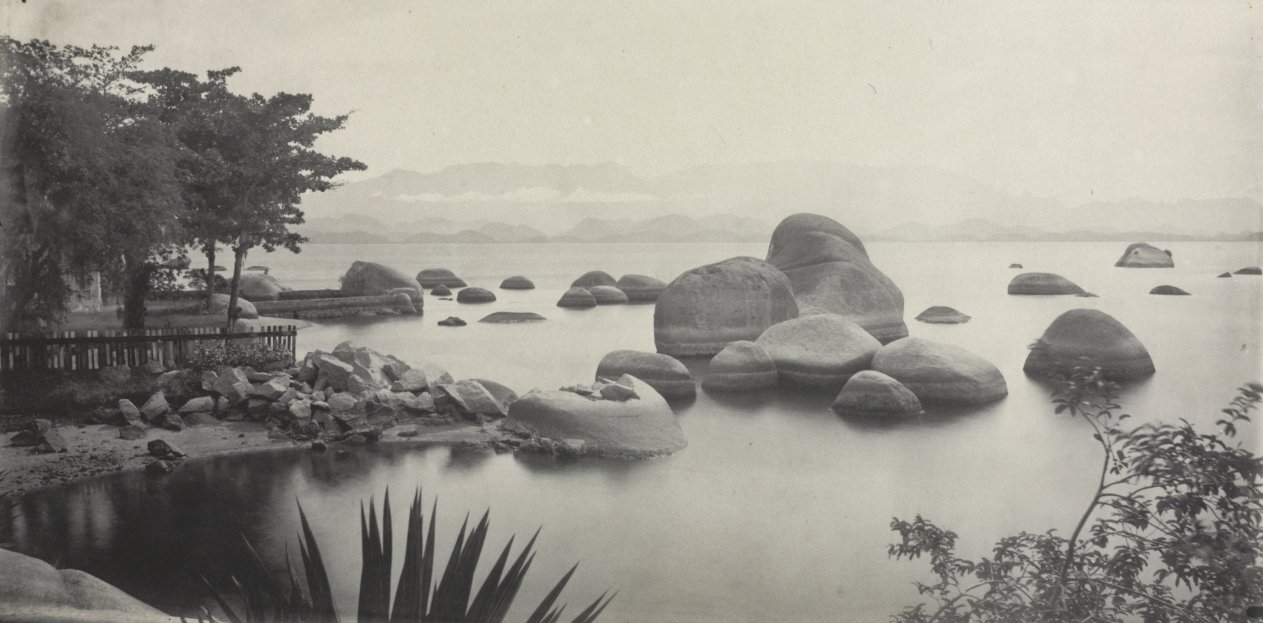
The Cleveland Museum of Art’s Paquetá, Rio de Janeiro, Brazil, catalogued as attributed to Ferrez and dated about 1890, shows the method in one sheet. The print is about 17.5 by 35.5 centimetres, a two-to-one frame. The picture is built in horizontal layers.
A dark frame at the edges. Trees and a wooden fence close the left side, a spray of palm fronds rises from the bottom edge, and a leafy branch fills the lower right corner. These dark shapes keep the eye inside a very wide picture and push the bright bay back.
Rhythm across the middle. Rounded granite boulders sit in the water at different distances, getting smaller as they recede. Like repeated shapes in a layout, they carry the eye across the full width.
A pale band behind. The hills across the bay are softened by haze into a flat grey silhouette, and the sky above is almost blank. That empty top third gives the dense middle room to breathe.
Human scale, used sparingly. The Getty points out how Ferrez placed people as measuring devices in the Geological Commission views. In Paquetá the fence plays a similar part: a small, known object that tells you how big the boulders are.
Technique: large glass negatives and the print
Ferrez worked on glass. FAPESP reports that the IMS collection includes about 4,000 large-format glass negatives among roughly 9,000 images researched for the 2019 show, and some 15,000 items in all. The IMS says he made his panoramas with special cameras on large-format negatives, a technique practised by few photographers, and describes him as a researcher of processes at a time when photography was changing fast.
Prints of his negatives exist in several processes and from several dates. The Getty’s commission album uses albumen silver prints. The Met’s Copacabana and Cleveland’s Paquetá are both catalogued as platinum prints, though the Met’s was printed in 1983. When you study a Ferrez image, check the print date: tone and contrast depend as much on the printer as on the negative.
His interest in technique extended to science. FAPESP reports his exchanges with astronomers at Brazil’s National Observatory and an unsuccessful attempt to photograph a total solar eclipse at Passa Quatro, Minas Gerais, in 1912.
The Marc Ferrez palette
Measured from the Cleveland Museum of Art’s scan of this impression of Paquetá, the main tones are a warm charcoal #444342, a middle grey #86857e, and three light, slightly creamy greys: #c2bfb3, #d6d2c3 and #dddaca. These are the colours of the scan of an old print, not of the original paper or chemistry, but they make a useful neutral scheme. Notice how much of the image sits in the light end: the dark tone is reserved for the framing edges.
To build your own palette from a public-domain photograph, try our image colour picker. For warmer tones from the same period, see our guide to vintage colour palettes.
Marc Ferrez and his contemporaries
Levine writes that photographic historians rank Ferrez with the American landscape photographers William Henry Jackson and Eadweard Muybridge. Our guide to William Henry Jackson shows a parallel career of survey expeditions and commercial views. For a later photographer who made landscape and city views in Mexico, see our guide to Hugo Brehme.
How designers can borrow from Marc Ferrez
Frame wide images from the edges. In a website hero or banner, put the darkest elements at the sides and bottom and keep the centre light. The frame holds attention inside the shape and leaves calm space for a headline.
Use repeated shapes as a guide. A row of similar objects, such as boulders, windows or product shots, receding in size, carries the eye across a long format.
Leave the sky empty. The pale upper band in a Ferrez panorama is the obvious place for type. Set a headline there in a dark tone from the image itself, such as the charcoal above.
Work in near-neutrals. His palette shows how many steps fit between charcoal and cream. A five-tone neutral scale with one accent colour is a reliable base for editorial and heritage brands.
Check your source. Ferrez prints exist from many dates and with different attributions. Use images that a museum flags public domain or CC0, and credit the museum and the attribution exactly as catalogued. You can find more cleared images in the MGD museum inspiration collection.
Frequently asked questions
Who was Marc Ferrez?
A Brazilian photographer born in Rio de Janeiro in 1843 and died in 1923. He is known for panoramic views of Rio and its bay, and for work with the Geological Commission of the Empire, the Imperial Navy and the rebuilding of Rio.
How did Marc Ferrez make his panoramas?
With special cameras on large-format glass negatives. The Getty says he bought panoramic equipment in Paris after an 1873 fire destroyed his studio, and Levine writes that it was built to his own design.
Where is the Marc Ferrez archive?
At the Instituto Moreira Salles in Brazil, which acquired the Gilberto Ferrez collection, about 15,000 images preserved by his grandson, in May 1998. The Getty holds the two Geological Commission albums.
Can I use Marc Ferrez photographs in my designs?
The Cleveland Museum of Art releases its Paquetá print under CC0. Other prints have different rights, so check each holder’s terms first.