Holland Dance Festival Brand Guidelines
The Hague’s international dance biennial, since 1987.
Aa
Two constants: an ink blue, coral and stone palette and a contemporary serif register. Abstract homage — not a Holland Dance Festival mark; no poster, logo or photograph is reproduced.
The Hague, 1987
A biennial born in a dance city.
Holland Dance Festival is an international dance festival based in The Hague. It has been held since 1987: the Dutch theatre database TheaterEncyclopedie describes it as a biennial international festival whose aim is to present a broad selection of recent developments in dance around the world. The festival says it was launched on the initiative of Nederlands Dans Theater, the company based in the city, and its 2026 edition opened with that company, a return the organisers called a “full circle moment” in festival copy published by Dance Informa in January 2026.
The early editions took place in autumn. TheaterEncyclopedie’s production records list festival performances between 13 September and 8 October 1987, including programmes by the Swedish Cullberg Ballet, an American modern dance company and a German dance-theatre ensemble. That same autumn The Hague gained a new dance house: the AT&T Danstheater on the Spui, later renamed the Lucent Danstheater, opened on 9 September 1987, according to Dutch Wikipedia, and was the home of Nederlands Dans Theater until 2015. The database records a September edition in 1989, when a New York ballet company brought a long run of repertoire, then editions in November 1991, October 1993, October 1995, and November 1999 and 2001.
The calendar has since moved to the winter. The 20th jubilee edition ran from 4 to 21 February 2026. In its own review of that edition, dated 21 February 2026, the festival reported more than 50 performances of 17 productions by 15 companies, five world premieres and about 22,000 visitors. It also reports that across its twenty editions it has presented work by more than 450 choreographers and 350 companies and makers, in close to 400 productions and about 1,700 performances.
Colour
A director, a building and a season.
The festival is led by Samuel Wuersten, its general and artistic director; the festival says he took up his post in 1994. His festival biography says he trained as a dancer at the Hamburg Ballet School and at Codarts Rotterdam, worked internationally as a dancer, teacher and choreographer before moving into artistic programming, and also founded and directs the bachelor’s and master’s dance programmes at the Zurich University of the Arts. The festival says that since his arrival he has brought more than three hundred foreign companies to the Netherlands.
For most of its history the festival’s main stage was the dance theatre on the Spui. Dutch Wikipedia says the Lucent Danstheater, with 1,001 seats, gave its last performance on 16 May 2015, and that most of the building was demolished from October 2015. From September 2015 to June 2021 the city’s dance and concert programme moved to the temporary Zuiderstrandtheater in the Scheveningen harbour area. The new education and culture building Amare, built on the Spuiplein site of the old halls, was handed over on 3 September 2021 and opened on 19 November 2021, Dutch Wikipedia says; it houses Nederlands Dans Theater, an orchestra, a conservatoire and the city’s dance and music centre, and its dance theatre seats 1,300. The festival now lists its visiting address via Amare, and its 2026 edition opened there on 4 February.
Between festivals the organisation keeps working. The festival says it programmes performances through the theatre season, alongside education projects, workshops and long-running classes for groups of all ages, including inclusive dance classes for people with and without disabilities. Its 2026 programme, as described in its own review, mixed large-scale and intimate work: the opening evening paired a world premiere with live accompaniment by the Dutch ballet orchestra; a German company closed its programme with Ravel’s Boléro performed on trampolines; a British company brought hip-hop dance theatre; and an American company gave the closing Dutch premiere. The archive also lists masterclasses, workshops and courses around the main performances.
Typography
Design and documentation.
Dance festivals usually name themselves in one of a few plain ways. Some join a place to the word for dance, as Montpellier Danse and Tanz im August do; some add the word “festival,” as the American Dance Festival and the Holland Dance Festival do; and some use a coined or borrowed name, such as ImPulsTanz, Julidans or Jacob’s Pillow, which takes its name from a rock on a Massachusetts farm.
Their calendars are just as recognisable. Many run for a few weeks in summer, as Jacob’s Pillow does in the Berkshire hills and the American Dance Festival does in Durham, North Carolina; others fill the autumn, and a biennale, as its name says, comes round every second year. Festivals are run by their own organisations rather than by the companies that perform in them: Jacob’s Pillow has its own board, and it was the American Dance Festival’s board that accepted the bid to move the festival to Duke University in 1978.
Their programmes tend to mix invited companies with teaching. The American Dance Festival runs its summer school alongside its performances, as it has done in some form since its Bennington summers of the 1930s, and Jacob’s Pillow keeps a school, an archive and residencies on the same hilltop as its stages. Performances move between theatres, studios, outdoor stages and city sites, from a free outdoor stage facing the hills to a site-specific work staged in a downtown office tower.
Visually, a festival often renews itself each edition, with a new poster, campaign image or photograph of movement, while the name and the place stay fixed. This guide sets out what can be documented about each festival — when it began, who runs it, where it happens and how it describes its programme — and treats the colours and type shown here as an unofficial interpretation, not the festival’s own identity.
Aa
A contemporary serif for a festival that keeps its name while its programme changes. (Specimen set in Fraunces, a serif STAND-IN; NOT the Holland Dance Festival logo.)
Holland Dance Festival
One name, many calendars.
For a designer, Holland Dance Festival is an identity built on a plain, descriptive name. “Holland” places it in the Netherlands, “Dance” states the art form, and “Festival” the format; the organisation shortens it to HDF in its own copy and on its pages. The name has stayed the same while nearly everything around it has changed: the season moved from autumn to February, the home stage moved from the Spui to the Scheveningen harbour and back to the Spuiplein, and the organisation grew a season programme and an education programme beside the festival itself.
Its public face is photographic. The festival’s pages present each production with performance images credited to their photographers, and its review of the 2026 edition is illustrated the same way, show by show. A Dutch-language site with an English version carries the programme, the archive and the ticket pages, so the identity has to work in two languages at once and across a long list of production titles.
That gives a design system a clear brief of its own: a frame that can hold one guest company’s photograph after another, in any colour world, without fighting it, and a type voice that reads as cultural rather than commercial. A contemporary serif sets long Dutch and English titles with some warmth; a deep ink blue and a pale stone stay quiet behind the photographs, while a coral accent marks dates and calls to action. The Hague itself suggests the tones: the city by the sea, with its harbour, dunes and civic halls around the Spui.
For a design guide, Holland Dance Festival shows how a biennial can keep one name and one city while its calendar, venues and programme change around it. Compare Nederlands Dans Theater, the Hague company that opened the 2026 edition, and Cullberg, which performed at the 1987 edition. For this guide we use a deep ink blue, a coral and a pale stone with a serif, an unofficial interpretation; no product or logo is reproduced.
Explore & save
Keep Holland Dance Festival’s identity on hand — save it to a board in the Made Good inspiration library.
Holland Dance Festival identity set
Pin the Holland Dance Festival ink blue, coral and stone palette and the contemporary serif register to your own board.
Source & notes
Frequently Asked Questions
What font can I use to match the Holland Dance Festival look?
This guide describes Holland Dance Festival’s type as “A contemporary serif for a festival that keeps its name while its programme changes”. Its type specimen is set in Fraunces from Google Fonts as a stand-in; Fraunces is not Holland Dance Festival’s own lettering.
What colours are in the Holland Dance Festival palette?
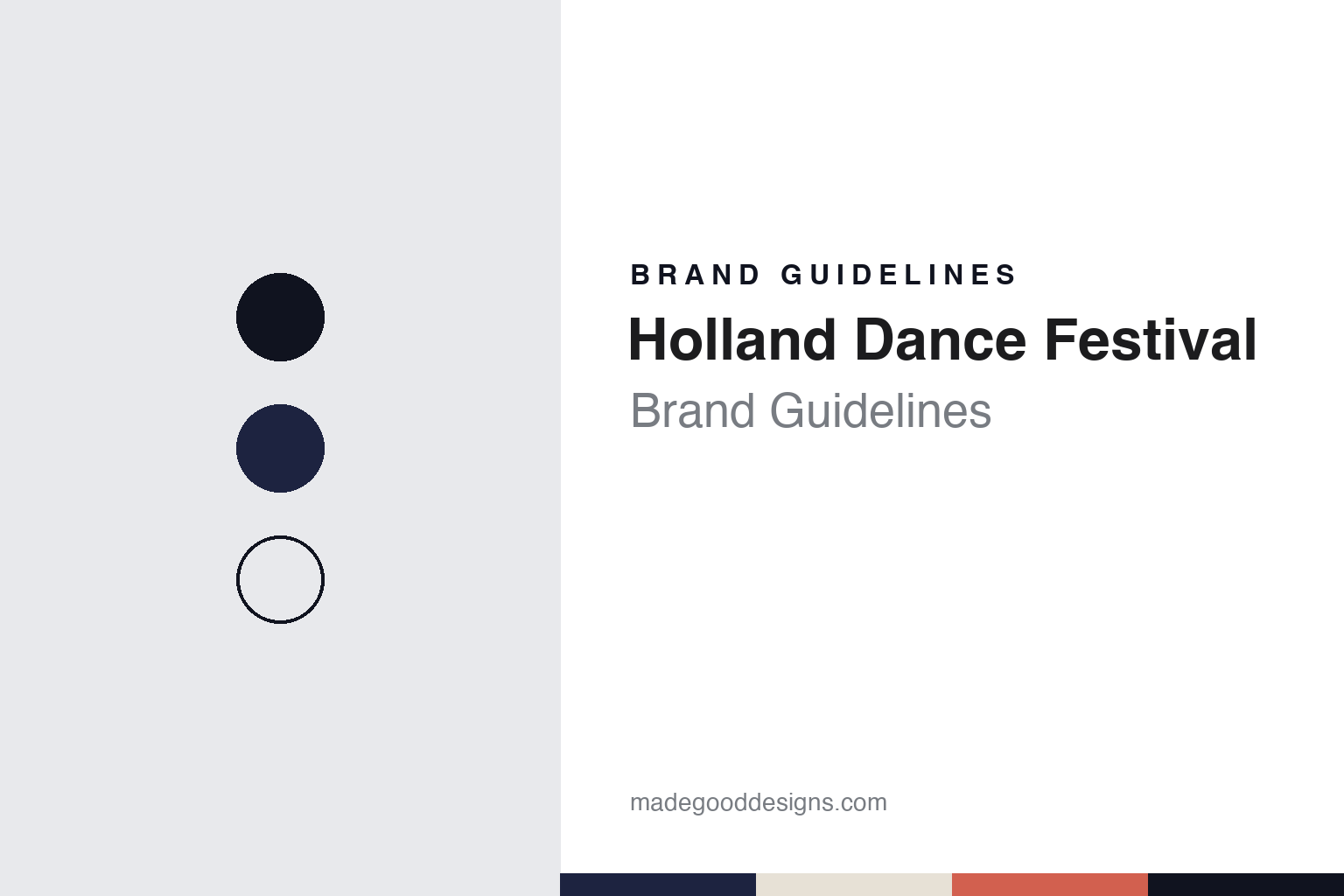
This guide’s Holland Dance Festival palette is Spui ink #1D2340, Night #10131F, Harbour coral #D2604F, Dune stone #E7E1D6 and Paper #F8F6F2. The tones are the guide’s own unofficial interpretation, not official Holland Dance Festival hex codes.
When was Holland Dance Festival founded?
Holland Dance Festival was founded in 1987, in The Hague, Netherlands.
Where is Holland Dance Festival based?
Holland Dance Festival is based in Amare, Spuiplein, The Hague.