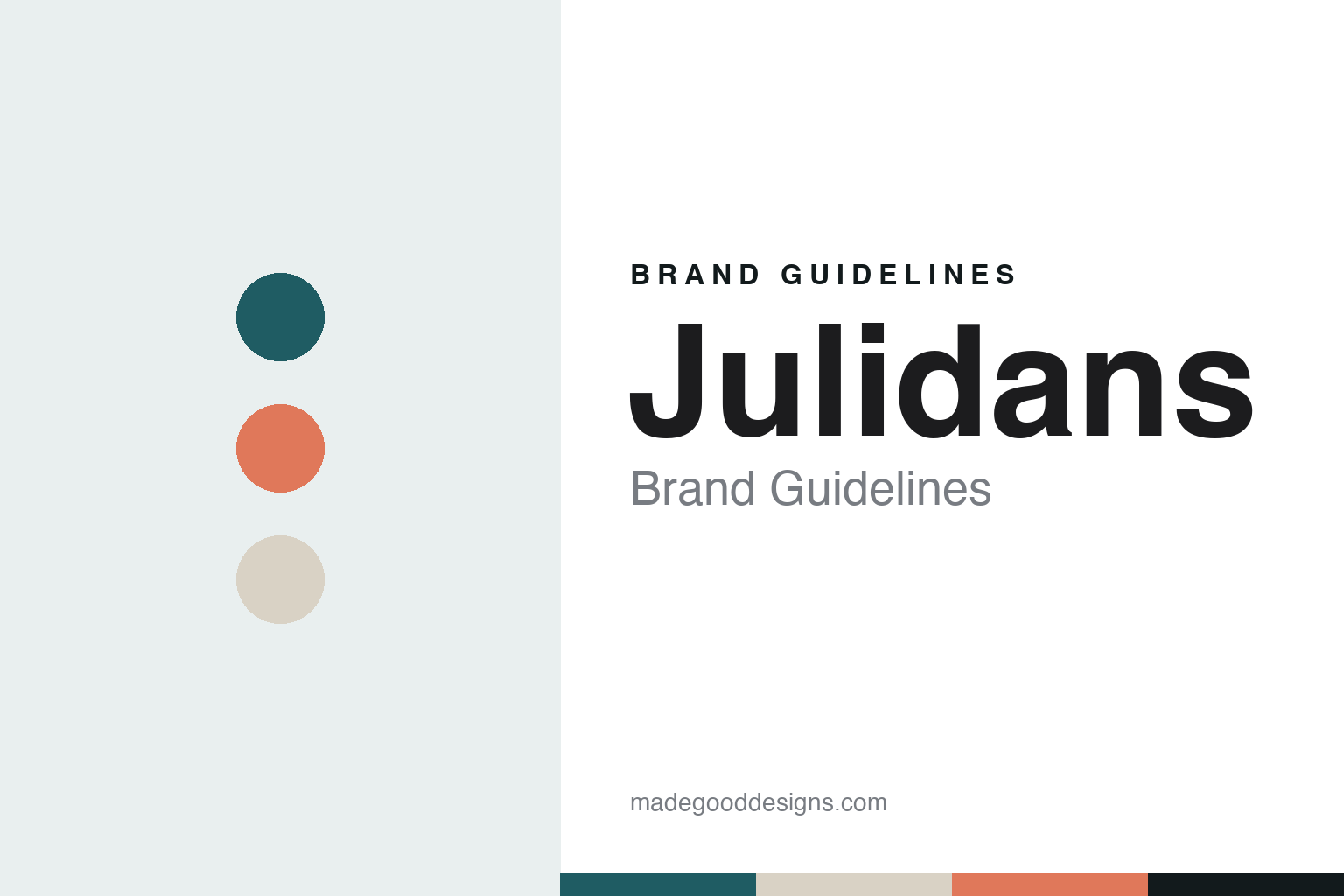
Julidans Brand Guidelines
Amsterdam’s July dance festival, centred on the Leidseplein since 1991.
Aa
Two constants: a teal, coral and stone palette and a summer serif register. Abstract homage — not a Julidans poster or mark; no logo or campaign image is reproduced.
A summer programme on the Leidseplein
Dance without words for the empty months.
Julidans — the name joins the Dutch words for July and dance — is an international festival of contemporary dance held each year in early July in Amsterdam, according to Dutch Wikipedia. The Dutch theatre database TheaterEncyclopedie dates it to 1991 and says it grew from the idea of programming performances that did not depend on language during the otherwise empty summer months at the Stadsschouwburg Amsterdam, the city theatre on the Leidseplein.
That building has remained the festival’s centre. Dutch Wikipedia says the present Stadsschouwburg dates from 1894 and has been a national monument since 1982; an extension completed in 2009 added the Rabozaal, a flexible black-box hall beside the historic auditorium. On 1 January 2018 the Stadsschouwburg and the theatre company Toneelgroep Amsterdam merged, and from the 2018–19 season the combined organisation has been called Internationaal Theater Amsterdam, or ITA. The building itself was also known as ITA from 2018 until September 2026, when it took back its original name, Dutch Wikipedia says. The same article says that every July Julidans takes place in the schouwburg and in other theatres around the Leidseplein.
The festival counts its editions. Dutch Wikipedia and the arts foundation Ammodo, a partner of the festival, both describe the 2025 festival, held from 2 to 13 July, as the 35th edition. The Dutch performing-arts fund Fonds Podiumkunsten described the festival of 2 to 14 July 2026 as the 36th.
TheaterEncyclopedie also records productions premiered under the Julidans name, alone or with co-producers, from 2003 onwards, among them premieres made with the production house of the Amsterdam music venues Paradiso and Melkweg in 2008.
Colour
From the Leidseplein to parks, clubs and museums.
From the Leidseplein the festival spreads across the city. Dutch Wikipedia names the Stadsschouwburg and Theater Bellevue as the homes of the main programme, with further performances at venues including the open-air theatre in the Vondelpark and in the Erasmuspark. Reviewing the 2011 festival for Cultureel Persbureau on 19 July 2011, its critic wrote that alongside the usual large dance-theatre productions, smaller work played at venues as varied as Bellevue, the Melkweg, Paradiso, the Vondelpark, Podium Mozaïek and the Bijlmer Parktheater. The same review said the festival had for years reached a mixed audience of local residents and passers-by as well as specialists and dance lovers, and noted an unusual amount of conceptual work that year.
That 2011 review singled out two pieces that combined text and movement: Eszter Salamon’s Dance for Nothing, a solo in which she speaks another artist’s lecture while dancing, and Daniel Linehan’s Zombie Aporia, shown at the Melkweg, which the critic described as a series of scenes asking what dance actually does.
Fifteen years later the map is wider. In June 2026 Fonds Podiumkunsten reported that the 36th edition used ITA as its festival hub and extended to the Bijlmer Parktheater, the Meervaart, Frascati, the Stedelijk Museum and the Vondelpark Open Air Theatre, with De Brakke Grond added that year. The fund described a visitors’ programme for international programmers and artistic directors, with performance packages that combine Dutch and international work, two networking sessions with presentations and pitches of new projects, and one-to-one meetings between Dutch makers and programmers. A strand called Julidans NL presents work by makers who live and work in the Netherlands, the fund said, from established names to a new generation.
The American culture magazine Air Mail wrote in its 2025 listing that, for the first half of July, Julidans “spreads like an oil slick through Amsterdam,” in the organisers’ own words, and that the festival favours choreographers in mid-career rather than beginners or long-established names. Its 2025 programme included the Greek choreographer Christos Papadopoulos’s My Fierce Ignorant Step, the magazine said.
Typography
How dance festivals present themselves.
Dance festivals usually name themselves in one of a few plain ways. Some join a place to the word for dance, as Montpellier Danse and Tanz im August do; some add the word “festival,” as the American Dance Festival and the Holland Dance Festival do; and some use a coined or borrowed name, such as ImPulsTanz, Julidans or Jacob’s Pillow, which takes its name from a rock on a Massachusetts farm.
Their calendars are just as recognisable. Many run for a few weeks in summer, as Jacob’s Pillow does in the Berkshire hills and the American Dance Festival does in Durham, North Carolina; others fill the autumn, and a biennale, as its name says, comes round every second year. Festivals are run by their own organisations rather than by the companies that perform in them: Jacob’s Pillow has its own board, and it was the American Dance Festival’s board that accepted the bid to move the festival to Duke University in 1978.
Their programmes tend to mix invited companies with teaching. The American Dance Festival runs its summer school alongside its performances, as it has done in some form since its Bennington summers of the 1930s, and Jacob’s Pillow keeps a school, an archive and residencies on the same hilltop as its stages. Performances move between theatres, studios, outdoor stages and city sites, from a free outdoor stage facing the hills to a site-specific work staged in a downtown office tower.
Visually, a festival often renews itself each edition, with a new poster, campaign image or photograph of movement, while the name and the place stay fixed. This guide sets out what can be documented about each festival — when it began, who runs it, where it happens and how it describes its programme — and treats the colours and type shown here as an unofficial interpretation, not the festival’s own identity.
Aa
A lively, high-contrast serif for a summer festival. (Specimen set in Fraunces, a serif STAND-IN; NOT the Julidans logo.)
Julidans
A month, a square and a city theatre.
The festival’s name does much of the work. It is a single Dutch word made of the month and the art form, and it fixes the calendar: early July, after the regular theatre season, in the summer months that TheaterEncyclopedie says the festival was set up to fill. The second constant is the place. Dutch Wikipedia ties Julidans to the Stadsschouwburg and the theatres around the Leidseplein, and the 2026 programme, as Fonds Podiumkunsten described it, still had the Leidseplein building as its hub, with performances as far afield as the Bijlmer Parktheater and the Meervaart.
The name of the building changed twice in that time. Under the 2018 merger the theatre on the Leidseplein was known as ITA, and from September 2026 it carries the name Stadsschouwburg again, Dutch Wikipedia says; the organisation behind it keeps the name Internationaal Theater Amsterdam. Julidans itself kept its name through both changes, and its 35th and 36th editions, in 2025 and 2026, both opened on 2 July.
The programme mixes scales. The 2011 review described large dance-theatre productions in the main house beside smaller pieces in clubs such as the Melkweg and Paradiso, and in 2026 the fund listed a museum and an open-air theatre among the venues. Alongside the public programme, the festival also works as a meeting place for programmers, with pitches and one-to-one meetings for makers based in the Netherlands.
For a design guide, Julidans shows how a festival can take its identity from a month, a square and a nineteenth-century theatre while its programme moves out to parks, clubs and museums. Compare Holland Dance Festival, the dance festival in The Hague, and Dutch National Opera, another Amsterdam stage. For this guide we use a canal teal, a summer coral and a warm stone with a serif, an unofficial interpretation; no product or logo is reproduced.
Explore & save
Keep Julidans’s identity on hand — save it to a board in the Made Good inspiration library.
Julidans identity set
Pin the Julidans teal, coral and stone palette and the summer serif register to your own board.
Source & notes
Frequently Asked Questions
What font can I use to match the Julidans look?
This guide describes Julidans’ type as “A lively, high-contrast serif for a summer festival”. Its type specimen is set in Fraunces from Google Fonts as a stand-in; Fraunces is not Julidans’ own lettering.
What colours are in the Julidans palette?
This guide’s Julidans palette is Canal teal #1F5C63, Night water #121A1C, Summer coral #E0785A, Leidseplein stone #D9D2C5 and Programme paper #F7F5F0. The tones are the guide’s own unofficial interpretation, not official Julidans hex codes.
When was Julidans founded?
Julidans was founded in 1991, in Amsterdam, Netherlands.