Première Vision Paris Brand Guidelines
The fabrics fair begun by Lyon silk makers in 1973.
Aa
Two constants: a plum, ink and raw-silk palette and a couture serif register. Abstract homage — not a Première Vision mark; no logo, key visual or fabric is reproduced.
Fifteen silk makers
A gathering of Lyon weavers that grew into a fashion-materials fair.
Première Vision Paris traces its start to 1973, when about fifteen silk makers from Lyon decided to present their new fabrics together. FashionUnited France, in a December 2019 article marking the fair’s forty-fifth year, writes that the Lyon weavers wanted more selectivity and a better-suited calendar than the one large fabric fair of the time offered: Interstoff, held twice a year in Frankfurt, in April and November. Their joint presentation was first called Première Vision Tissus de Lyon and then Première Vision Tissus Créations. The company’s own history page gives the same year and describes its founders as “some fifteen silk industry professionals from Lyons.”
The same FashionUnited article sets out three traits of the early event: it was reserved for top-end fabric houses, it was open to the world, and it ran a trend observatory. The French name translates as “first vision.”
The fair widened step by step. Silk was joined by cotton from the Vosges, then by wool from the Lille area and the south-west of France, FashionUnited wrote. In the early 1980s it took in its first weavers from elsewhere in Europe and then British wool makers, and over the years it bought fairs for yarns, textile designs, leather and contract manufacturing. Committees decide on each exhibitor, and several hundred applications are turned down every year, the article added.
The legal structure also changed. The Association Première Vision, parent of the organising company, sold 49 per cent of the capital to two trade-fair firms, GL events and Eurovet, in 2007, and Première Vision SA became a company with a management board and a supervisory board, FashionUnited reported in 2019. Première Vision says that in 2023, fifty years after its creation, it became 100 per cent owned by GL events, and that in 2025 it joined GL events’ fashion division, which groups 18 events.
Colour
Six shows under one name.
For years the Paris event was a cluster of separate shows. Apparel Resources, in a July 2015 report drawing on the organiser’s announcement, wrote that in February 2015 “Première Vision Pluriel” became Première Vision Paris, with one organiser and a brand policy built on the Première Vision name. The six shows took new names: Première Vision Yarns (formerly Expofil), Première Vision Fabrics (formerly Première Vision), Première Vision Leather (formerly Cuir à Paris), Première Vision Designs (formerly Indigo), Première Vision Accessories (formerly Modamont) and Première Vision Manufacturing (formerly Zoom). The September 2015 edition ran from 15 to 17 September at the Parc des Expositions Paris Nord Villepinte, north of the city.
The format has stayed close to that plan. The company describes Première Vision Paris as an event held twice a year, in February and September, that brings together raw materials and services for making apparel, bags, shoes and fashion jewellery: yarns, fabrics, leathers and furs, textile designs, accessories and components, and manufacturing firms that offer a sourcing service. FashionUnited counted nine sectors in May 2026, from Yarns and Fabrics to Bag & Shoe and Leatherwear, spread across three halls.
The September 2026 edition, for autumn/winter 2027/2028 collections, was dated 1 to 3 September 2026 at Paris Nord Villepinte, earlier than the usual mid-September slot; FashionUnited wrote in May 2026 that the change came from GL events, which it named as the owner. A few days before the opening, FashionUnited France reported that more than 900 exhibitors had been announced, along with three Talks & Pitches areas, 36 talks and 28 pitches. The Smart Creation area for technology and new materials had 42 exhibitors, 21 of them new. The same edition added a Cosmetic Village, developed with the French perfume and cosmetics cluster Cosmetic Valley: a 150-square-metre space in Hall 1 with around ten French cosmetics brands.
Paris is the main event in a wider family. The company lists Denim Première Vision, held twice a year in different European capitals; Blossom Première Vision in Paris, for pre-collections; Première Vision New York; and Première Vision Montréal, which it says was launched in 2025 with mode, a Quebec non-profit organisation for the fashion trade.
Typography
The category.
Jewellery, watch, beauty and textile trade fairs usually take their names from one of three places: the trade itself, the city that hosts them, or a coined word. Some names spell out the goods on show, some lead with a city such as Basel, Geneva, Munich, Vicenza, Bologna, Frankfurt or Paris, and some combine the two, so that the name tells a visitor both what is shown and where.
Most of these fairs are built first for the trade. Their halls are planned for retailers, buyers, designers, manufacturers and the press, who come to see new collections, materials and ingredients and to place orders. Some fairs set aside trade days and then open their doors to the public for a day or more, and some add a programme of talks, tours and events in the host city around the halls.
Behind each fair sits an organiser: a foundation set up by the exhibitors, a trade association, or an exhibition company that runs many shows in its own halls and abroad. The organiser often shapes the layout, grouping exhibitors by product, from brand booths and private appointment rooms to shared areas for suppliers, trend presentations and materials forums, and some run sister editions in other cities under a related name.
Visually, these fairs tend to keep a name and a wordmark from one edition to the next while the key visual, season theme or hall design changes each year. This guide describes those identities plainly, as dated sources describe them; the colours and type shown here are our own interpretation, and no logo, key visual or stand is reproduced.
Aa
A high-contrast couture serif for an event built around fabric. (Specimen set in Cormorant Garamond, a serif STAND-IN; NOT the Première Vision logo.)
Première Vision Paris
A name built on an early look at materials.
Première Vision’s identity rests on its name and on its trend work more than on any single symbol. The company says the fair introduced coordinated seasonal colour and fabric trends at its creation, and FashionUnited noted in May 2026 that the trend colours of the February 2026 edition had served as a common code across sectors. The 2015 renaming made the Première Vision name the umbrella for every show, so that Yarns, Fabrics, Leather, Designs, Accessories and Manufacturing became sections of one brand rather than separate fairs with their own names.
The company has also told its story in print. FashionUnited France reported in December 2019 on the book Mode Matières et Révolutions par Première Vision, published by La Martinière, whose ten chapters trace links between textile innovation and changes in fashion, from knitwear in collections to Lurex, polyamide and high-tech materials. The article quotes from its preface a line that sums up the fair’s outlook: shapes may grow tiresome, but a fabric never does.
The 2026 programme kept that focus on materials while widening the circle. The Prospective Space was set up as a forum for material innovations, and a web tool built with the association Paris Good Fashion, presented on 1 September 2026, was designed to help buyers compare materials by quality, availability and technical maturity, FashionUnited reported. The Cosmetic Village marked the arrival of beauty as a new sector at the Paris fair, FashionUnited wrote.
For a design guide, Première Vision Paris shows how a fair can turn one founding name into a family of sections, each read at a glance as part of the same event. Compare Viparis, whose Paris venues include Paris Nord Villepinte, and GL events, the group that owns the fair. For this guide we use an ink, a plum, raw silk and a gilt tone with a serif, an unofficial interpretation; no product or logo is reproduced.
Explore & save
Keep Première Vision Paris’s identity on hand — save it to a board in the Made Good inspiration library.
Première Vision Paris identity set
Pin the plum, ink and raw-silk palette and the couture serif register to your own board.
Source & notes
Frequently Asked Questions
What font can I use to match the Première Vision Paris look?
This guide describes Première Vision Paris’ type as “A high-contrast couture serif for an event built around fabric”. Its type specimen is set in Cormorant Garamond from Google Fonts as a stand-in; Cormorant Garamond is not Première Vision Paris’ own lettering.
What colours are in the Première Vision Paris palette?
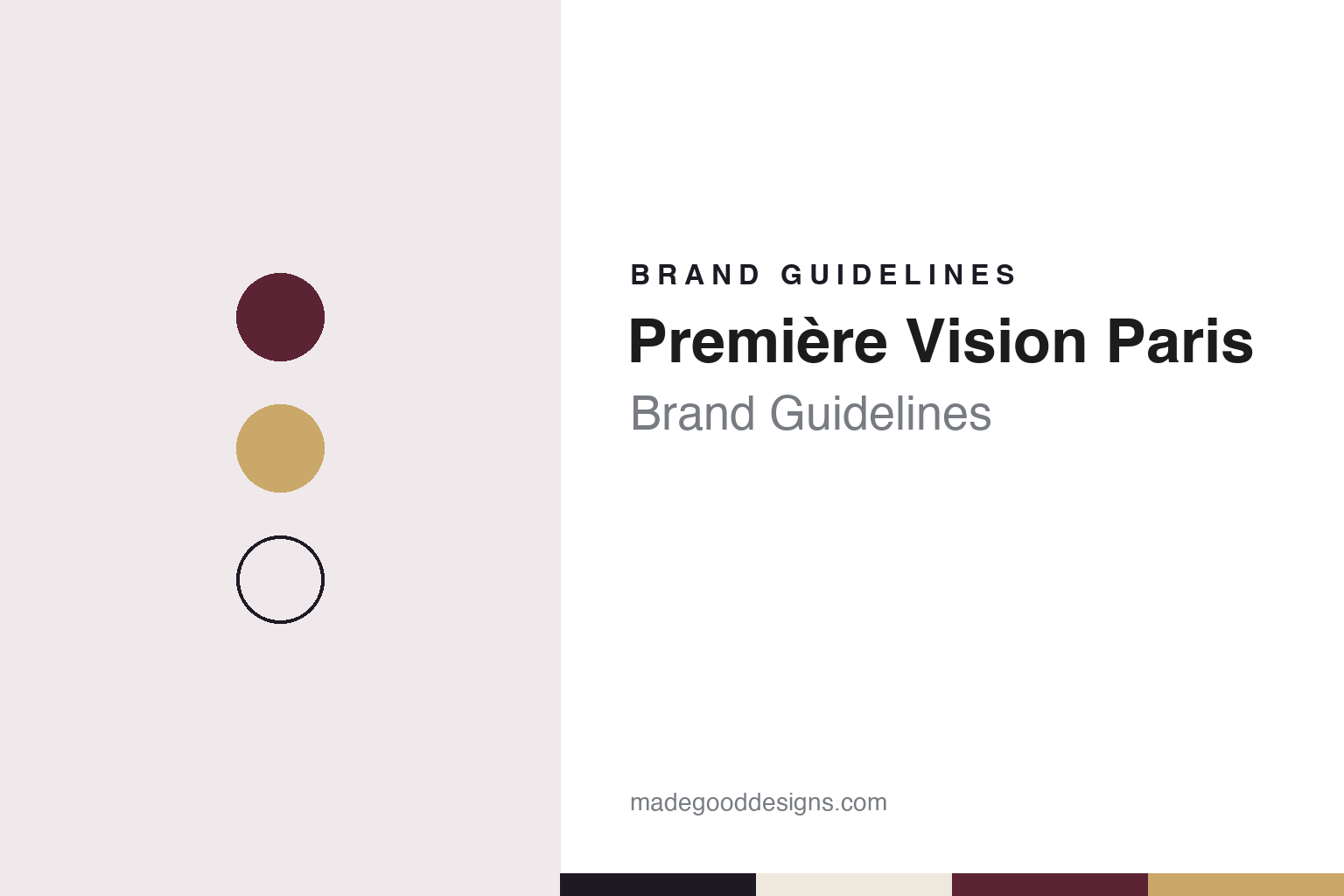
This guide’s Première Vision Paris palette is Lyon silk ink #1E1A24, Madder plum #5B2333, Raw silk #EFE8DC, Gilt thread #C9A86A and Linen paper #F7F4EE. The tones are the guide’s own unofficial interpretation, not official Première Vision Paris hex codes.
When was Première Vision Paris founded?
Première Vision Paris was founded in 1973, by Lyon silk makers.
Who founded Première Vision Paris?
Première Vision Paris was founded by Lyon silk makers in 1973.
Who owns Première Vision Paris?
Première Vision Paris is owned by GL events (wholly owned since 2023).