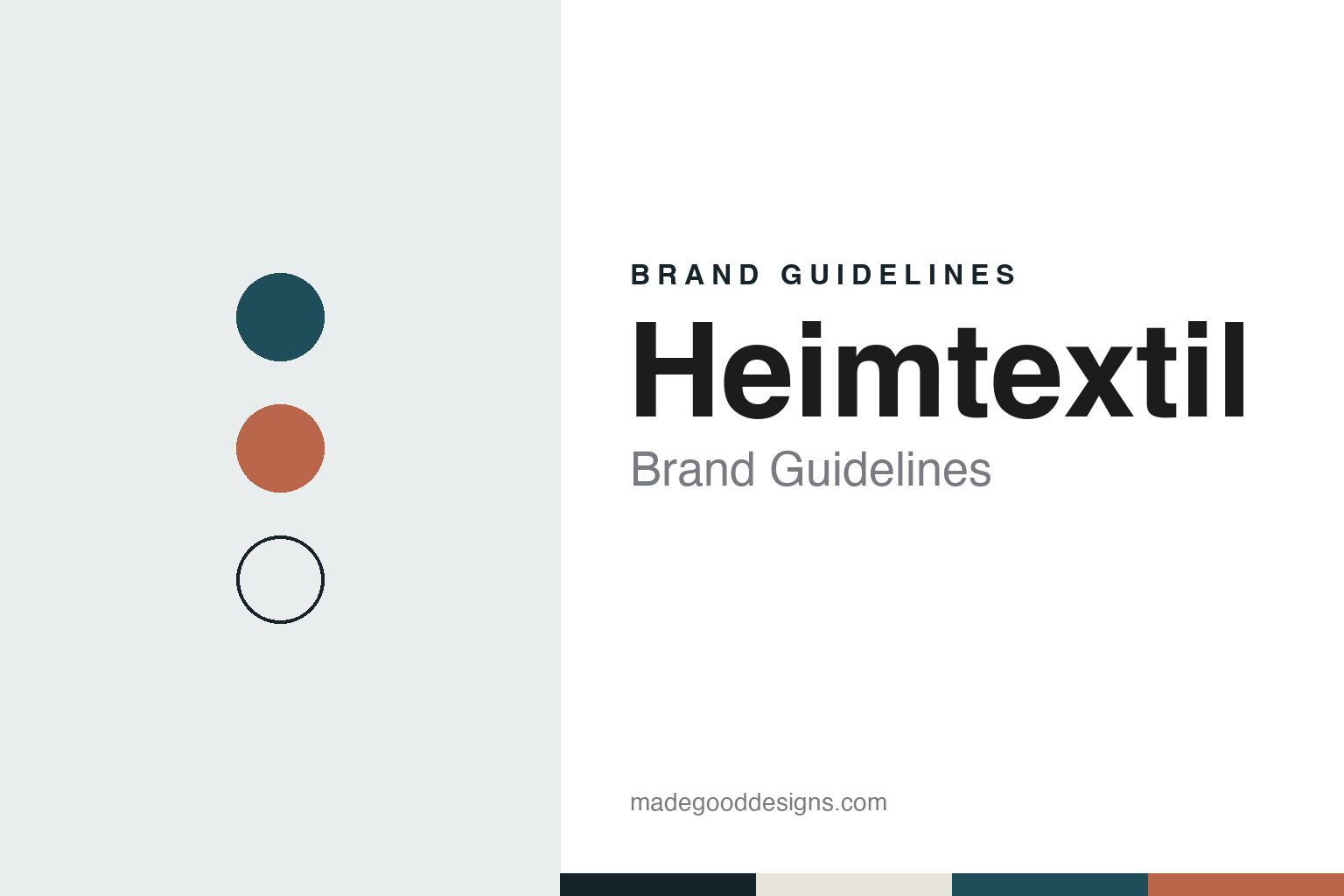
Heimtextil Brand Guidelines
Frankfurt’s January home textiles fair since 1971.
Aa
Two constants: a teal, linen and terracotta palette and a grotesque sans register. Abstract homage — not a Heimtextil mark; no logo, key visual or textile is reproduced.
A fair of its own
Home textiles leave a general fair in 1971.
Heimtextil — German for “home textiles” — was first held in January 1971 in Frankfurt am Main. Its organiser, the exhibition company Messe Frankfurt, describes the fair as part of a move towards specialised trade fairs in the city: a trend it says began in 1959 with Interstoff, a fair for apparel fabrics, and continued in 1960 with ISH for sanitation and heating, before, in 1971, “home and household textiles were allocated their own trade fair, Heimtextil.”
The first edition was already large. The trade magazine textile-network, writing in November 2019 ahead of the anniversary, reported that the 1971 fair recorded 679 exhibitors, 394 of them from Germany. It is held every January.
The edition of 7 to 10 January 2020 was the 50th, textile-network reported. Around 30 of that year’s exhibitors had also been at the first fair and were honoured at the opening press conference. A special exhibition, “Celebrating 50 Years of Interior Design,” in Hall 9.0, traced five decades of interiors through fabrics and images, with archive support from the German Design Council, and the anniversary party in Hall 11.1 took gold as its theme. The same edition grouped trends, textile design and textile technology together in Hall 3.0, and gave the international éditeurs — the high-end fabric publishers — their own area in Hall 8.0, fitted with black carpet and its own signage.
The calendar was interrupted once. On 3 December 2021 Messe Frankfurt announced that the edition planned for 11 to 14 January 2022 would not take place, Business of Home reported the same day. In January 2022 the organiser announced a one-time Summer Special for 21 to 24 June 2022, run in parallel with Techtextil and Texprocess, its fairs for technical textiles and textile processing. The fair then returned to January: the 2026 edition ran from 13 to 16 January.
Colour
Halls arranged by product group.
Heimtextil is organised by product group, and its own site sets these out as a map of the halls. Bed, Bath & Living covers bed linen, bath textiles, cushions, bedspreads, table and kitchen linen and home accessories. Carpets & Rugs runs from machine-woven, hand-woven and hand-tufted carpets to hides, doormats and entrance matting, along with fibres, yarns and machinery for carpet making. Two Global Home segments — Bed, Bath & Kitchen, and Windows, Fabrics & Decor — bring together volume manufacturers and country pavilions, and Excellence areas show manufacturers selected by an independent jury against set quality criteria, the organiser says. Design studios and textile designers sit near the trend area.
The 2026 edition, held under the motto “Lead the Change,” used a new hall plan across 17 hall levels, according to Messe Frankfurt’s opening announcement. Halls 3.0, 3.1 and 4.1 formed a hub for textile and non-textile interior design; Bed, Bath & Living filled Halls 5.0, 5.1, 6.0 and 6.1, next to the Smart Bedding segment in Hall 4.0, whose Sleep & Meet area served as a meeting point for the mattress and sleep trade. The product range ran from decorative and upholstery fabrics, bed linen and terry towelling to wallpaper and carpets.
On numbers, the organiser counted 3,000 exhibitors from 66 countries at the opening and, in its closing report of 16 January 2026, 148 participating nations and about 47,000 buyers, with 96 per cent of exhibitors coming from outside Germany. DIY International, the home-improvement trade magazine, reported on 19 January 2026 that the fair had ended with 3,000 exhibitors and more than 48,000 buyers, and noted that the organisers had counted 50,000 visitors the year before.
The programme around the stands has grown too. Messe Frankfurt ran an Interior.Architecture.Hospitality programme in 2026 for hotel, office and contract projects, and a Texpertise Stage in Hall 6.0 for talks. Heimtextil belongs to the organiser’s Texpertise Network of textile fairs.
Typography
The category.
Jewellery, watch, beauty and textile trade fairs usually take their names from one of three places: the trade itself, the city that hosts them, or a coined word. Some names spell out the goods on show, some lead with a city such as Basel, Geneva, Munich, Vicenza, Bologna, Frankfurt or Paris, and some combine the two, so that the name tells a visitor both what is shown and where.
Most of these fairs are built first for the trade. Their halls are planned for retailers, buyers, designers, manufacturers and the press, who come to see new collections, materials and ingredients and to place orders. Some fairs set aside trade days and then open their doors to the public for a day or more, and some add a programme of talks, tours and events in the host city around the halls.
Behind each fair sits an organiser: a foundation set up by the exhibitors, a trade association, or an exhibition company that runs many shows in its own halls and abroad. The organiser often shapes the layout, grouping exhibitors by product, from brand booths and private appointment rooms to shared areas for suppliers, trend presentations and materials forums, and some run sister editions in other cities under a related name.
Visually, these fairs tend to keep a name and a wordmark from one edition to the next while the key visual, season theme or hall design changes each year. This guide describes those identities plainly, as dated sources describe them; the colours and type shown here are our own interpretation, and no logo, key visual or stand is reproduced.
Aa
A clean grotesque sans for a fair laid out by halls and segments. (Specimen set in Work Sans, a sans STAND-IN; NOT the Heimtextil logo.)
Heimtextil
A trend space at the centre of the halls.
Heimtextil presents its trend programme as the core of the fair. The organiser calls the Heimtextil Trends area “a popular visitor attraction and centre piece of the trade fair,” and Business of Home illustrated its December 2021 report with a photograph of the Trend Space at the 2020 edition. Each year the trends carry a theme and a colour palette; for the 2026 edition, the Heimtextil Trends 26/27 appeared under the title “Craft is a verb,” which the organiser says linked AI tools with traditional craft.
The fair also invites designers to stage installations. At the 2026 opening press conference, the architect and designer Patricia Urquiola presented “among-all,” her second installation for Heimtextil, in conversation with the global design director of Wallpaper magazine, according to Messe Frankfurt’s announcement. The organiser described hybrid sculptures, inflated figures and hanging grid structures, with visitors’ movements fed into the staging through AI. Urquiola said the exhibition took the form of “a temporary ecosystem” of installations made from regenerated nylon, textile waste and bio-based materials.
In the halls, the identity is carried by the segment names — Bed, Bath & Living, Carpets & Rugs, Global Home, Smart Bedding — which also serve as signposts. The 2020 anniversary showed the same approach in its details: a gold theme for the party, a black-carpeted éditeurs area with its own signage, and a scarf first worn by the fair’s hostesses that the organiser offered for sale in 2020 after visitors asked for it, textile-network reported.
For a design guide, Heimtextil shows how a trade fair can build its identity from a trend space, a yearly theme and plainly named halls rather than from one fixed image. Compare Messe Frankfurt, the exhibition company that organises it, and Maison&Objet, the Paris design fair that Business of Home covered alongside Heimtextil in December 2021. For this guide we use a deep teal, an undyed linen and a terracotta with a sans, an unofficial interpretation; no product or logo is reproduced.
Explore & save
Keep Heimtextil’s identity on hand — save it to a board in the Made Good inspiration library.
Heimtextil identity set
Pin the teal, linen and terracotta palette and the grotesque sans register to your own board.
Source & notes
Frequently Asked Questions
What font can I use to match the Heimtextil look?
This guide describes Heimtextil’s type as “A clean grotesque sans for a fair laid out by halls and segments”. Its type specimen is set in Work Sans from Google Fonts as a stand-in; Work Sans is not Heimtextil’s own lettering.
What colours are in the Heimtextil palette?
This guide’s Heimtextil palette is Deep teal #1F4E5A, Night wool #16232A, Undyed linen #E9E4DA, Terracotta weft #B9664A and Paper #F6F4EF. The tones are the guide’s own unofficial interpretation, not official Heimtextil hex codes.