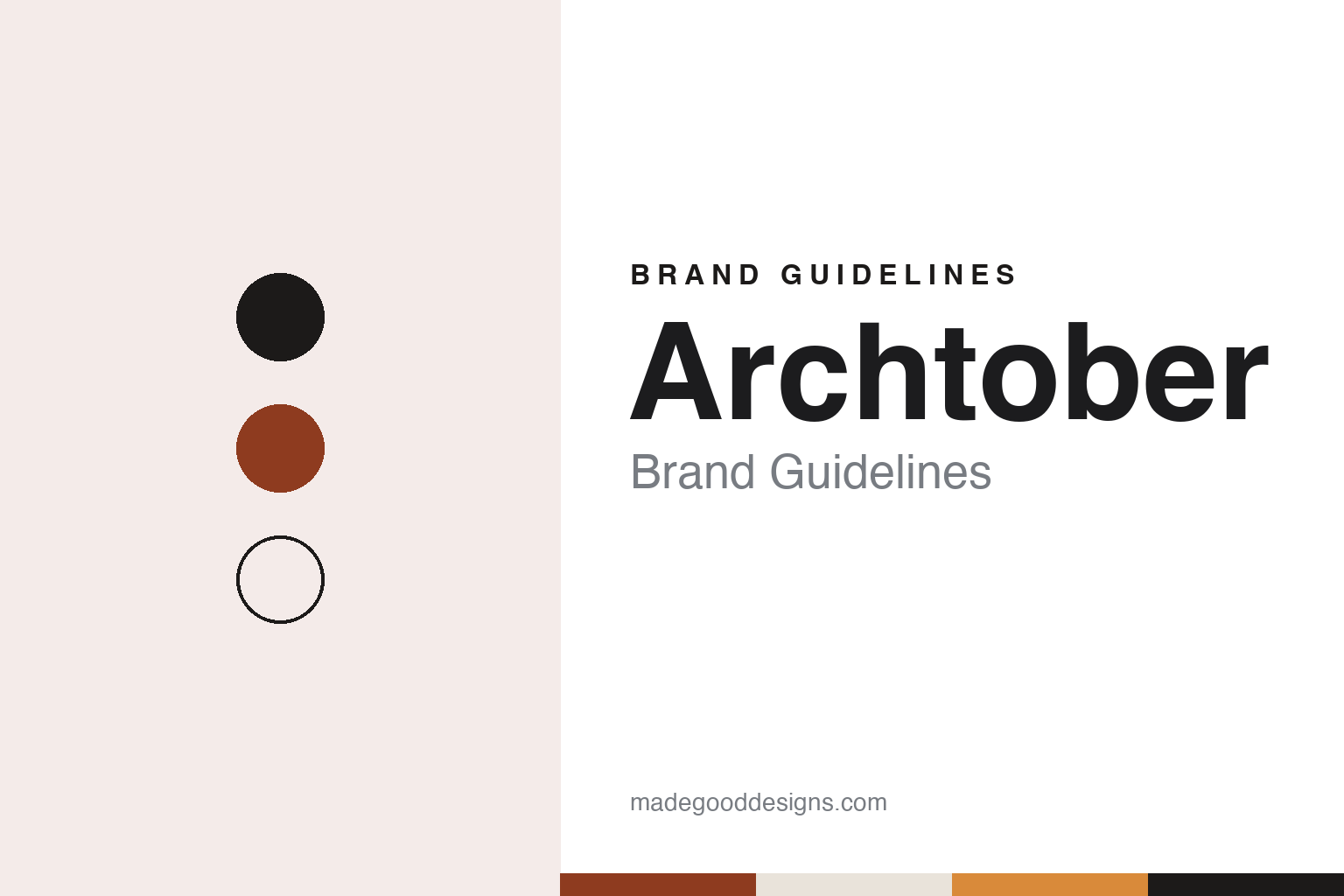
Archtober Brand Guidelines
New York City’s month of architecture, every October since 2011.
Aa
Two constants: a rust, amber and limestone palette and a grotesque sans register. Abstract homage — not an Archtober logo or key visual; no mark or festival graphic is reproduced.
From a week to a month
Architecture Week grows into October.
Archtober is the name New York gives to October. The organiser describes it as New York City’s Architecture and Design Month: an annual festival of architecture activities, programmes and exhibitions held across the whole of October, and, in its own words, a New York-based platform that promotes the discovery of architecture and design through experiences and content. The name is a blend of “architecture” and “October,” and the festival’s website prints a pronunciation guide beside it.
The festival’s own history page traces its roots to 2003. That year the American Institute of Architects New York (AIANY) opened the Center for Architecture, and Open House New York was founded. For the next seven years AIANY ran an Architecture Week in the second week of October, which ended with the OHNY Weekend, when buildings across the city open their doors. In 2010 the Architecture & Design Film Festival held its first New York event straight after that weekend, so October was already filling with architecture events.
In 2011 Architecture Week grew into a month-long celebration and took the name Archtober, bringing together a collective of local and national architecture and design organisations. The organiser gives 2011 as its founding year, and Architectural Record reported in August 2025 that the festival, which it described as organised by the AIA New York Center for Architecture, was returning for its 15th edition that October. The Center for Architecture’s announcement for that year gave the dates as 1 to 31 October 2025 and said the festival worked with nearly 100 partners and sponsors across the five boroughs.
Since 2023 each festival has opened with an annual theme, the organiser says. The 2025 theme was “Shared Spaces,” which the Center for Architecture described as an invitation to rethink how people move, connect and live together in New York City; Metropolis covered that edition in October 2025 under the same banner. For 2026 the festival’s website announced the theme “In Our Hands.” The Center for Architecture’s 2025 announcement named Katie Mullen as Director of Archtober, a role she combined with directing exhibitions and programmes at the Center.
Colour
Tours, partners and a guide in your pocket.
Archtober is less a single show than a calendar. The festival gathers events staged by its partners and adds a core programme of its own. Architectural Record listed the 2025 mix as daily architect-led building tours, open studios, talks, exhibition launches and parties, with events across all five boroughs, some free and some paid. Among the programming partners it named were Open House New York, the Van Alen Institute, the Architecture & Design Film Festival, Pratt Institute and the New York Public Library. The organiser’s own description adds museums, cultural organisations, consulates, advocacy groups and parks to the range of partners.
The longest-running strand is Building of the Day. The organiser says that since 2011 the Center for Architecture has hosted Building of the Day tours of notable contemporary and historic buildings, led by architects. Untapped New York, a media sponsor of the festival, described the format in September 2025: each day in October a different building in the city opens for an architect-led tour, giving the public a way into new and recent spaces. In 2025 the list included the Terminal Warehouse, a project by the practice COOKFOX that Metropolis named as one of the new projects open to the public that October.
The festival also lives on screens. Architectural Record reported in 2025 that the Bloomberg Connects app was partnering with the festival for a fourth year, hosting the Archtober Guide, and Metropolis noted that the free app lets people tour buildings across the five boroughs with images, interviews and stories outside the October dates. The festival website now lists events and exhibitions year-round, with partner talks, special events and exhibitions running into December, so the name now covers a year-round calendar that peaks every October.
Exhibitions sit alongside the tours. The Center for Architecture uses the festival to open its autumn exhibition, and partner museums such as the South Street Seaport Museum and the Museum of the City of New York appear in the festival’s exhibition listings. The organiser also runs an online shop of festival shirts, caps and bags under the Archtober name.
Typography
How the category presents itself.
Architecture biennials, triennials, festivals and open-house events usually take their names from the city that holds them. Most combine the place with words such as architecture, urbanism, biennale, triennial, festival or open house, and many are shortened to an acronym or a few initials, so that the name works as a date in the calendar as much as a title.
The bodies behind them vary. Some are hosted by city governments or public agencies acting in an institutional role; others are run by architecture centres, professional institutes, foundations, non-profit organisations or media and events companies. Several share an organiser with a permanent architecture centre or exhibition hall in the same city, and some work in partnership with a neighbouring city or a network of sister events abroad.
What they share is a programme spread across a city rather than gathered in one hall. Exhibition halls, reused industrial buildings, stations, plazas and parks hold curated exhibitions and installations, while talks, tours, workshops and, in open-house events, buildings opened to the public for a weekend or a week, often with volunteer guides, carry the programme into the streets. Biennials and triennials tend to work with a director or curatorial team and a yearly theme; festivals and open-house events often depend on many independent hosts.
Visual identity follows the same pattern. A steady name or wordmark carries from edition to edition, while each director or curator brings a new title, key visual and set of venues. This guide describes each event from its own first edition, using dated sources for organisers, venues, dates and themes, and sets an unofficial palette and type stand-in beside it; no logo or key visual is reproduced.
Aa
A heavy grotesque — echoing a wordmark that changes its clothes each year. (Specimen set in Archivo, a sans STAND-IN; NOT the Archtober logo.)
Archtober
One logo, a new identity every year.
Archtober’s visual identity is unusually well documented, because the organiser publishes it. Its website says that since 2011 the Center for Architecture has worked with New York graphic design firms to craft an identity for each year’s festival, starting from Pentagram’s original design for the Archtober logo. The festival’s archive credits Pentagram with every identity from 2011 to 2016, the studio With Projects with 2017, MTWTF with 2018 and Small Stuff with 2019, and the studio Greater, Inc. with each edition from 2020 to 2026. The steady logo carries the name, while the yearly theme, colours and graphics change around it.
Archtober makes that split between a fixed wordmark and a changing yearly look explicit by listing each year’s designer in public. The word itself does much of the work: a single coined name, short enough for a tote bag, a cap or a calendar listing, that tells a New Yorker both the subject and the month.
The festival’s tone is civic and practical. Its listings lead with what to do and where, its themes since 2023 have been phrased as short public invitations rather than technical titles, and its tours are framed around buildings people can walk into with an architect as a guide. The organiser’s self-description stresses access for all and partnership with hundreds of organisations, and its website groups everything under plain headings: things to do, events, exhibitions, stories.
For a design guide, Archtober shows how a coined word and a fixed logo can hold together a month of events run by many partners, while each year’s identity is handed to a different studio or refreshed by the same one. Compare Open House New York, the city’s weekend of open buildings that grew up alongside it, and the Chicago Architecture Biennial, another American city-wide architecture programme. For this guide we use a rust, an amber and a limestone with a sans, an unofficial interpretation; no product or logo is reproduced.
Explore & save
Keep Archtober’s identity on hand — save it to a board in the Made Good inspiration library.
Archtober identity set
Pin the Archtober rust, amber and limestone palette and the grotesque sans register to your own board.
Source & notes
Frequently Asked Questions
What font can I use to match the Archtober look?
This guide describes Archtober’s type as “A heavy grotesque — echoing a wordmark that changes its clothes each year”. Its type specimen is set in Archivo from Google Fonts as a stand-in; Archivo is not Archtober’s own lettering.
What colours are in the Archtober palette?
This guide’s Archtober palette is Brownstone rust #8E3B1F, Night ink #1C1A19, Limestone #E9E3DA, Autumn amber #D98A3A and Paper #F7F4EF. The tones are the guide’s own unofficial interpretation, not official Archtober hex codes.
When was Archtober founded?
Archtober was founded in 2011, in New York City, USA.