World Architecture Festival Brand Guidelines
Live crits from Barcelona to Fort Lauderdale.
Aa
Two constants: a teal, slate and brass palette and an editorial serif register. Abstract homage — not a World Architecture Festival logo or graphic; no mark is reproduced.
Barcelona, 2008
A festival built around live presentations.
The World Architecture Festival, usually shortened to WAF, is a yearly gathering of architects built around live presentations of their projects. Its own history page says the festival was held for the first time on 22–24 October 2008 in Barcelona, and that the city hosted it again in November 2009 and November 2010 before what the organiser calls the final Barcelona instalment in November 2011.
The festival then moved to Asia. From 2012 it was held at Marina Bay Sands in Singapore, in October 2012, October 2013 and October 2014, with what the organiser calls the final Singapore event in November 2015. In November 2016 WAF moved to Berlin, and the second and last Berlin edition followed in November 2017. The organiser describes the November 2018 festival in Amsterdam as its 11th edition, and it lists a further edition in December 2019.
The 2020 and 2021 festivals were combined into a single virtual WAF held in December 2021, the organiser says. The festival met in person again in Lisbon from 29 November to 1 December 2022, and returned to Marina Bay Sands in Singapore for 29 November to 1 December 2023 and for 6 to 8 November 2024.
In 2025 the festival crossed to the United States. ArchDaily reported on 14 November 2025 that the closing gala of WAF, which it called the eighteenth edition of the festival, took place at the Miami Beach Convention Center in Florida. In 2026 the festival moved up the coast to Fort Lauderdale: Planning, Building & Construction Today reported in July 2026 that it would take place there from 18 to 20 November, and ArchDaily named the venue as the Broward County Convention Center. The festival’s own website confirmed after the event that WAF 2026 had closed after three days in Fort Lauderdale.
Colour
A media brand with a festival attached.
WAF has always belonged to an architecture publisher rather than to a city or a professional body. When the business-media group Ascential, formerly Emap, sold its remaining UK heritage brands in June 2017, Press Gazette reported that the buyer was the Croydon-based publisher Metropolis, and the trade body FIPP listed the brands sold as including the Architects’ Journal, The Architectural Review “and its associated World Architecture Festival.” The festival’s website today carries the copyright of EMAP Publishing Limited. The organiser names Paul Finch as the festival’s Programme Director, and his monthly blog appears on its site.
The festival’s format is what sets the tone. Shortlisted teams present their projects in person to judging panels, with an audience of peers able to watch. Planning, Building & Construction Today described the 2026 process in July 2026: during the first two days, shortlisted teams presented live to international judging panels, and category winners went forward to a Super Jury; it put the jury at 164 architects, designers, academics and industry professionals from 37 countries. Awards are part of the festival, decided through this live-judged programme.
Around the presentations sits a conference and a trade hall. The organiser’s 2026 programme listed talks across two stages on the conference theme “Water,” chosen for Fort Lauderdale’s waterways, presentations in 16 crit rooms, a Festival Hall of exhibitors, building tours, partner fringe events and a closing gala dinner. It also ran a 40 Under 40 programme, partnered in 2026 with Architecture Hunter and focused on South America. A parallel interiors strand, INSIDE World Festival of Interiors, runs alongside the main festival, the organiser says, with its own interiors categories.
Entries are kept in the World Buildings Directory, which the organiser describes as an online record of projects entered into past and present editions. The festival also publishes a monthly newsletter, WAFN, with building visits, commentary and book reviews, and an archive of films with keynote speakers.
Typography
How the category presents itself.
Architecture biennials, triennials, festivals and open-house events usually take their names from the city that holds them. Most combine the place with words such as architecture, urbanism, biennale, triennial, festival or open house, and many are shortened to an acronym or a few initials, so that the name works as a date in the calendar as much as a title.
The bodies behind them vary. Some are hosted by city governments or public agencies acting in an institutional role; others are run by architecture centres, professional institutes, foundations, non-profit organisations or media and events companies. Several share an organiser with a permanent architecture centre or exhibition hall in the same city, and some work in partnership with a neighbouring city or a network of sister events abroad.
What they share is a programme spread across a city rather than gathered in one hall. Exhibition halls, reused industrial buildings, stations, plazas and parks hold curated exhibitions and installations, while talks, tours, workshops and, in open-house events, buildings opened to the public for a weekend or a week, often with volunteer guides, carry the programme into the streets. Biennials and triennials tend to work with a director or curatorial team and a yearly theme; festivals and open-house events often depend on many independent hosts.
Visual identity follows the same pattern. A steady name or wordmark carries from edition to edition, while each director or curator brings a new title, key visual and set of venues. This guide describes each event from its own first edition, using dated sources for organisers, venues, dates and themes, and sets an unofficial palette and type stand-in beside it; no logo or key visual is reproduced.
Aa
An editorial serif — the voice of a festival run by architecture magazines. (Specimen set in Fraunces, a serif STAND-IN; NOT the World Architecture Festival logo.)
World Architecture Festival
Three letters that travel.
WAF’s identity rests on its initials. The three letters appear in the festival’s web addresses, in the name of its WAFN newsletter, and in the edition names used by the organiser and the press, from “WAF 2025” to “WAF 2026.” Each edition then adds a host city and, in recent years, a conference theme, so the same short name can carry a Singapore marina one year and a Florida convention centre the next.
The festival’s place inside a publishing house shapes how it looks and sounds. Its site leads with shortlists, speakers, programme and entries, in the manner of a magazine’s events arm, and the organiser’s language is the language of entries, categories, crits and juries. Its archive is organised by year and host city, which makes the list of venues part of the brand story.
The live crit is the visual signature. The organiser’s 2026 material describes rooms where finalists present to judges in front of an audience, and the press coverage of the 2025 and 2026 editions repeated that framing. The gala that closes each edition, and the shortlist wall where delegates have their photographs taken, are recurring images in its own publicity.
For a design guide, the World Architecture Festival shows how a short set of initials can hold steady while the host city, venue and theme change around it. Compare the Lisbon Architecture Triennale, based in the city that hosted WAF in 2022, and the London Festival of Architecture, another festival name built from the word architecture. For this guide we use a teal, a slate and a brass with a serif, an unofficial interpretation; no product or logo is reproduced.
Explore & save
Keep World Architecture Festival’s identity on hand — save it to a board in the Made Good inspiration library.
World Architecture Festival identity set
Pin the World Architecture Festival teal, slate and brass palette and the editorial serif register to your own board.
Source & notes
Frequently Asked Questions
What font can I use to match the World Architecture Festival look?
This guide describes World Architecture Festival’s type as “An editorial serif — the voice of a festival run by architecture magazines”. Its type specimen is set in Fraunces from Google Fonts as a stand-in; Fraunces is not World Architecture Festival’s own lettering.
What colours are in the World Architecture Festival palette?
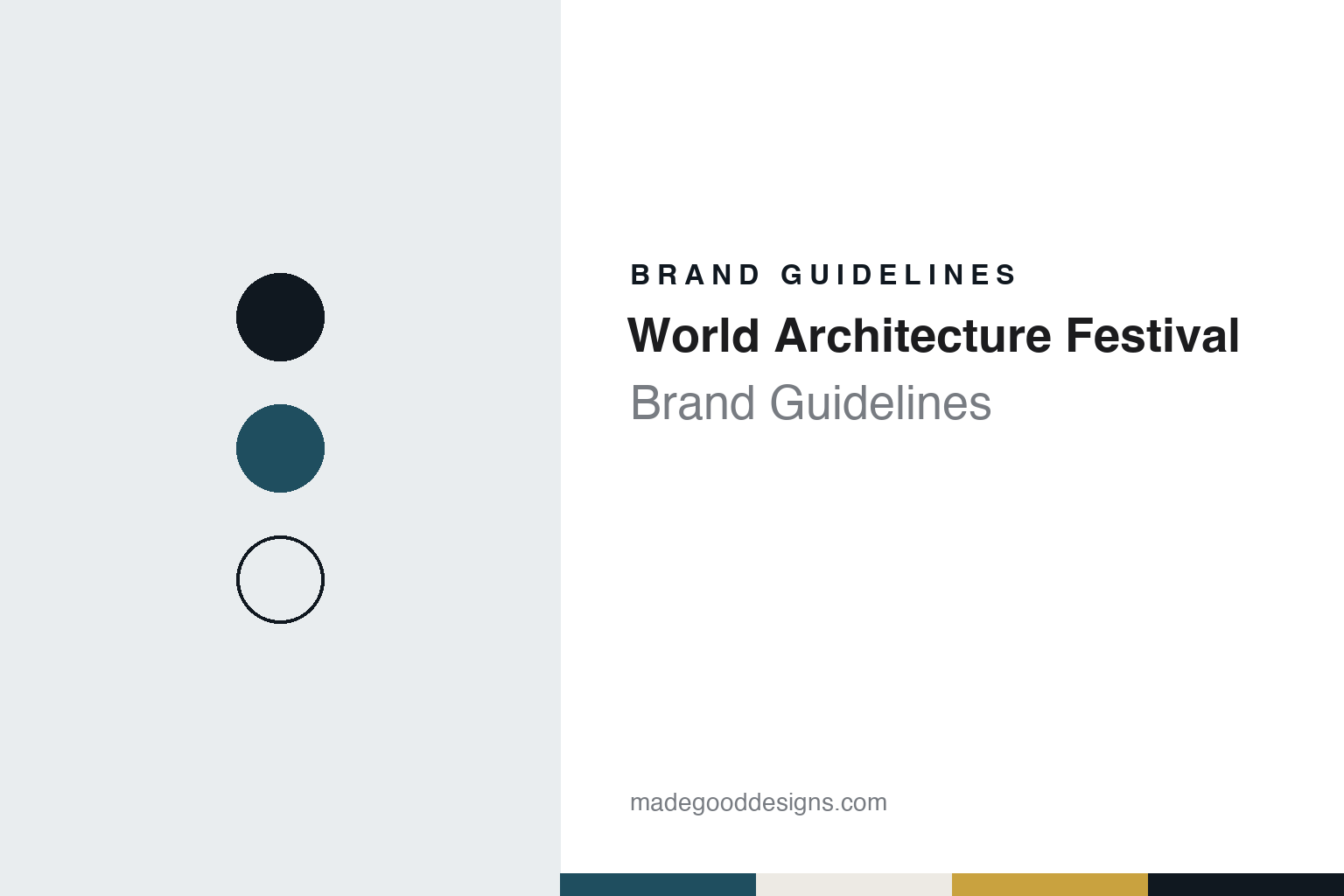
This guide’s World Architecture Festival palette is Harbour teal #1F4E5F, Deep slate #101820, Plaster #EDEAE4, Brass #C9A23F and Paper #F8F6F2. The tones are the guide’s own unofficial interpretation, not official World Architecture Festival hex codes.