London Festival of Architecture Brand Guidelines
A June-long citywide festival of architecture, since 2004.
Aa
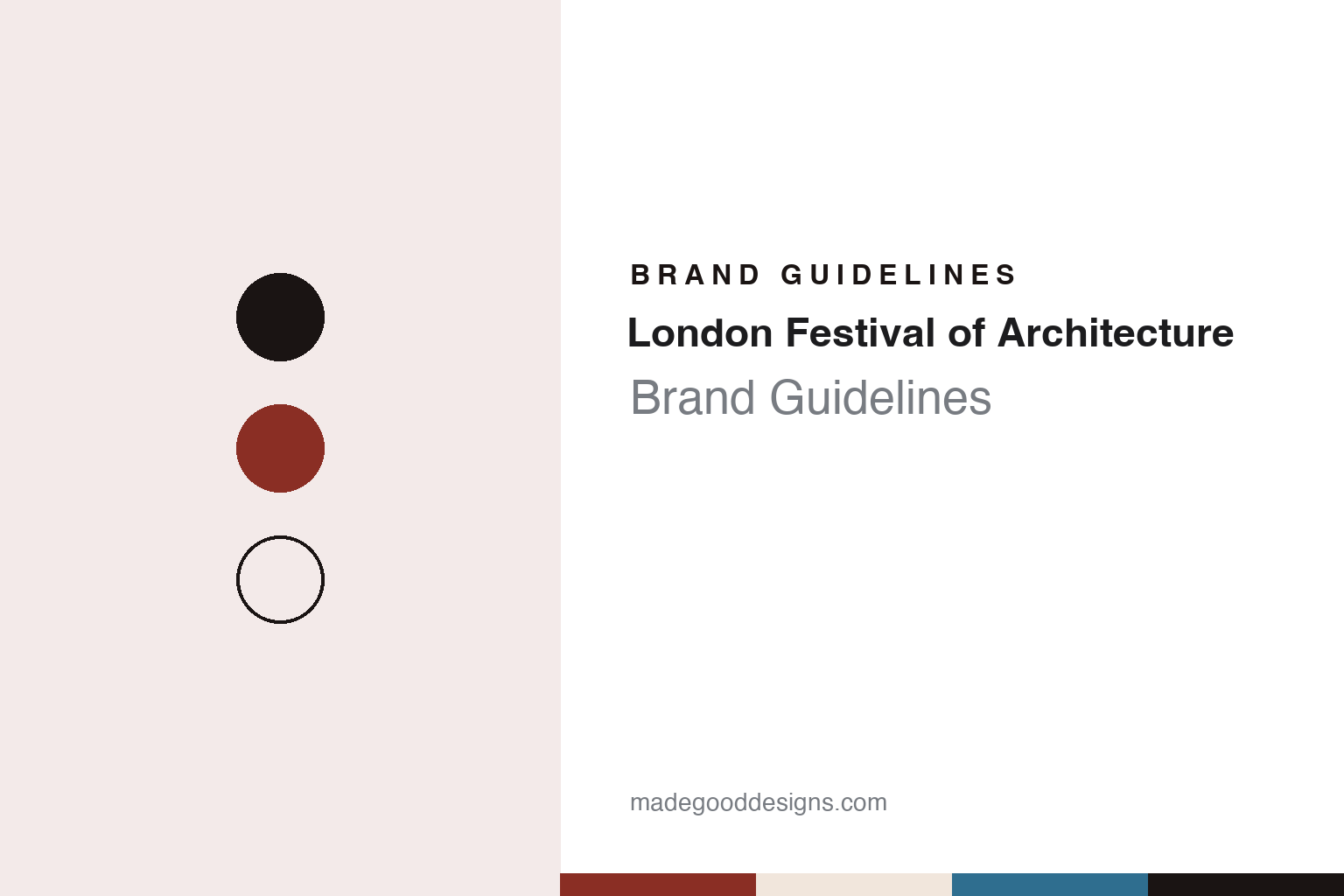
Two constants: a London brick, stone and Thames blue palette and a Bold civic sans register. Abstract homage — not an LFA mark; no logo, poster or key visual is reproduced.
From biennale to festival
A week in 2004, a month every June now.
The London Festival of Architecture, shortened to LFA, began in 2004 under another name: the London Architecture Biennale. English Wikipedia names Peter Murray as its founder and former director, and says the event was held every two years until 2006 and has taken place every year since 2008, usually through the month of June.
The festival’s own history page describes the start as “a week-long biennial event,” opened by a sheep drive along St John Street in Clerkenwell, which was closed to traffic for the occasion. That opening week grew into the annual festival, which the organiser now calls a month-long celebration of architecture and city-making taking place every June across London. Its website gives the dates simply as 1–30 June.
Today the festival’s website states that LFA is run by NLA, which it describes as London’s built environment community, a cross-sector membership organisation; the festival’s pages and its news items use the line “powered by NLA.” NLA’s own news pages announce the festival programme, as in its notice of 7 May 2025 for that June’s edition.
The festival is led by a small team. Its director, according to the festival’s website and to Wallpaper* in May 2025, is Rosa Rogina; English Wikipedia, citing Dezeen, dates her appointment to September 2021. The website lists further staff for programme, built installations, marketing and partnerships, and a curation panel of practitioners, writers and organisations that selects and shapes each year’s programme.
The organiser counts its editions in its own way: it calls the 2025 festival its 18th edition and the 2026 festival its 19th, and it marked 20 years of the festival in 2024.
Colour
A theme for every June.
Each year’s festival is built around a single word or short phrase. English Wikipedia and the organiser’s history page together give the run: Community (2016), Memory (2017), Identity (2018), Boundaries (2019), Power (2020), Care (2021), Act (2022), In Common (2023), Reimagine (2024), Voices (2025) and Belonging (2026). The theme sets the frame within which independent organisers — practices, schools, community groups and cultural venues — propose events.
The format changed with circumstances. The organiser says the 2020 festival was its digital-only edition and that 2021 used a hybrid model, mixing physical and online events and unveiling installations from competitions launched earlier that year. By its account, the 2022 programme, under the theme Act, included a temporary pedestrianisation and activities on a stretch of road in Somers Town and a trial of pop-up bike parking outside Victoria Station.
The 2025 edition shows the current scale and structure. Wallpaper*, in a guide published on 19 May 2025, described a programme of more than 450 events under the theme Voices, including 55 exhibitions, more than 80 workshops and 20 installations. It said the programme was organised around four Destinations — Barnet, Brentford Golden Mile, the City of London and Fitzrovia — and a group of Neighbourhoods, including Clapham Junction, the Fleet Street Quarter and Wood Green and Alexandra Palace. Event types ran from workshops, tours and talks to exhibitions, performances, studio lates, film and installations, all curated by a panel of architects, consultants, journalists and planners, the magazine said. After the festival, the organiser’s report counted 470 events across 24 London boroughs.
Built work is a steady part of the programme. The organiser runs LFA competitions and a strand of built projects, temporary installations and pavilions placed in streets and public spaces during June; some, it says, have led to permanent changes. Its news pages for 2026 list a wayfinding scheme in Fitzrovia, a pavilion opened at the Barbican and a micro-market square in Morden, alongside a design competition with a Fitzrovia business partnership.
Typography
Design and documentation.
Architecture biennials, triennials, festivals and open-house events usually take their names from the city that holds them. Most combine the place with words such as architecture, urbanism, biennale, triennial, festival or open house, and many are shortened to an acronym or a few initials, so that the name works as a date in the calendar as much as a title.
The bodies behind them vary. Some are hosted by city governments or public agencies acting in an institutional role; others are run by architecture centres, professional institutes, foundations, non-profit organisations or media and events companies. Several share an organiser with a permanent architecture centre or exhibition hall in the same city, and some work in partnership with a neighbouring city or a network of sister events abroad.
What they share is a programme spread across a city rather than gathered in one hall. Exhibition halls, reused industrial buildings, stations, plazas and parks hold curated exhibitions and installations, while talks, tours, workshops and, in open-house events, buildings opened to the public for a weekend or a week, often with volunteer guides, carry the programme into the streets. Biennials and triennials tend to work with a director or curatorial team and a yearly theme; festivals and open-house events often depend on many independent hosts.
Visual identity follows the same pattern. A steady name or wordmark carries from edition to edition, while each director or curator brings a new title, key visual and set of venues. This guide describes each event from its own first edition, using dated sources for organisers, venues, dates and themes, and sets an unofficial palette and type stand-in beside it; no logo or key visual is reproduced.
Aa
A bold civic sans — LFA and a hashtag. (Specimen set in Archivo, a sans STAND-IN; NOT the London Festival of Architecture logo.)
LFA
Three letters, a year and a theme.
The festival’s naming system is compact. The full name, London Festival of Architecture, sits beside the three-letter short form LFA, and each edition is labelled with a tag that adds the year, such as LFA2025, which appears across its website and in NLA’s announcements. The yearly theme then gives each June its own word: the 2026 pages, for instance, carried “Belonging” as the edition’s headline.
The identity also travels through the city rather than sitting in one building. The festival has no single main venue; the Wallpaper* guide of May 2025 and the organiser’s own report describe events spread across many boroughs, grouped by Destinations and Neighbourhoods. Each Destination or Neighbourhood can carry its own local programme, and partners such as business improvement districts commission installations or signage for the festival, as the Fitzrovia wayfinding scheme of June 2026 shows in the organiser’s news.
Because the festival is open, its look is shared. Hundreds of organisers produce their own events, and the festival’s role, as its website describes it, is to set the theme, select and curate the programme, run competitions and publish the calendar. Its website is rebuilt for each year, with earlier editions kept at year-specific addresses, so the visual treatment can change while the LFA name and the June dates stay constant. The organiser also runs a podcast, Building Sounds, and publishes a report on each edition after it closes.
For a design guide, the London Festival of Architecture shows how a short form, a year and a single theme word can hold together a programme made by hundreds of different hands. Compare London Design Festival, another citywide London festival, and Open House London, which opens the city’s buildings to the public. For this guide we use a London brick, a stone and a Thames blue with a sans, an unofficial interpretation; no product or logo is reproduced.
Explore & save
Keep London Festival of Architecture’s identity on hand — save it to a board in the Made Good inspiration library.
London Festival of Architecture identity set
Pin the London Festival of Architecture brick, stone and Thames blue palette and the Bold civic sans register to your own board.
Source & notes
Frequently Asked Questions
What font can I use to match the London Festival of Architecture look?
This guide describes London Festival of Architecture’s type as “A bold civic sans — LFA and a hashtag”. Its type specimen is set in Archivo from Google Fonts as a stand-in; Archivo is not London Festival of Architecture’s own lettering.
What colours are in the London Festival of Architecture palette?
This guide’s London Festival of Architecture palette is London brick #8A2E24, Ink #1A1413, Portland stone #F1E6DC, Thames blue #2F6E8F and Paper #FAF6F2. The tones are the guide’s own unofficial interpretation, not official London Festival of Architecture hex codes.
When was London Festival of Architecture founded?
London Festival of Architecture was founded in 2004 (as the London Architecture Biennale), in London, UK.
Who founded London Festival of Architecture?
London Festival of Architecture was founded by Peter Murray in 2004 (as the London Architecture Biennale).