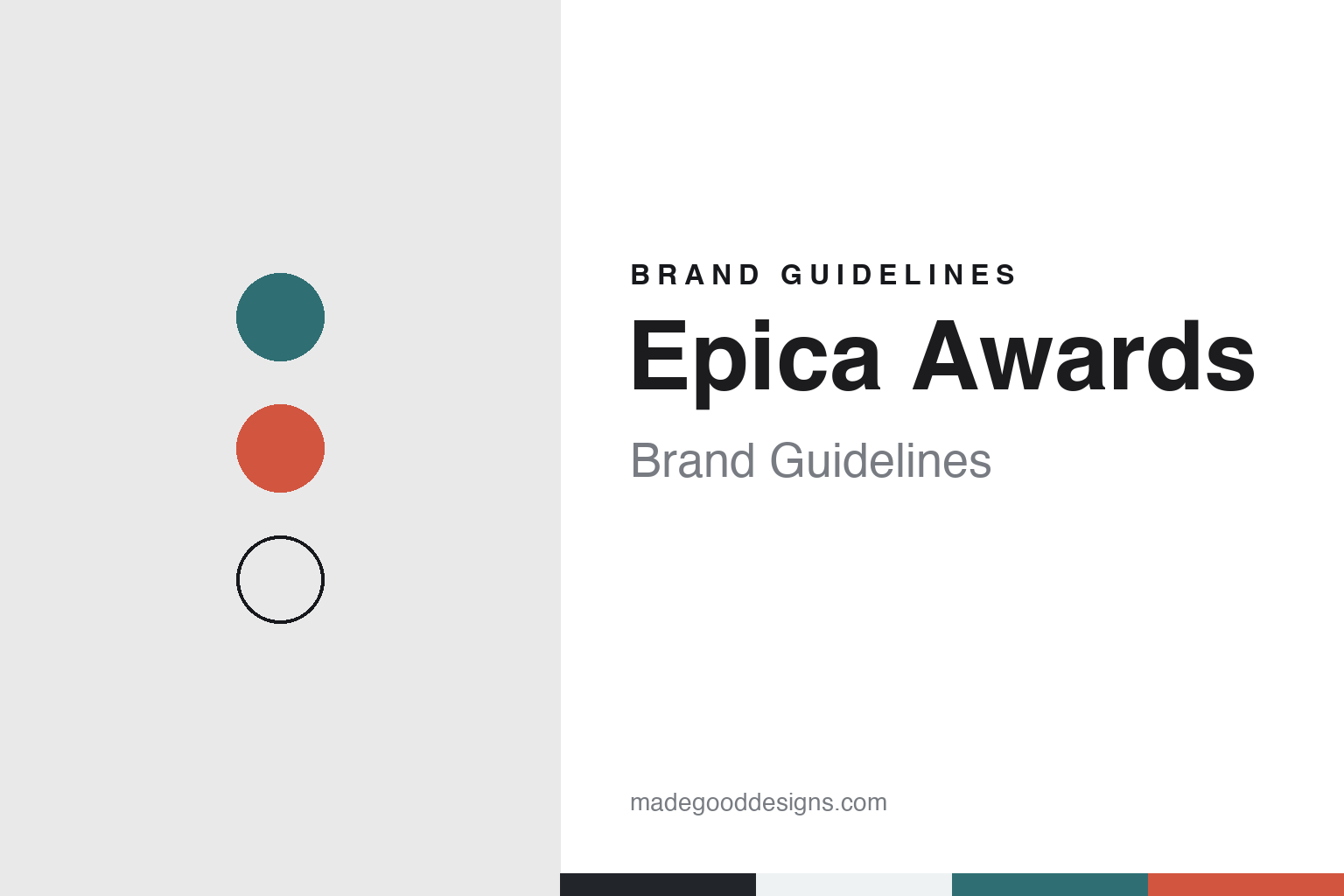
Epica Awards Brand Guidelines
The creative prize that hands the vote to the press.
Aa
Two constants: a graphite, frost, teal and coral palette and an angled grotesque register. Abstract homage — not an Epica trophy, logo or mark; nothing of the programme’s identity is reproduced.
A jury of journalists
Set up in 1987, based in Paris.
The Epica Awards were created in 1987 and are based in Paris, according to English Wikipedia, and the organiser’s own site and footer date the competition from the same year. The idea behind the prize sits in its jury: instead of agency creatives, the votes come from journalists. The organiser describes a jury of more than 200 editors and senior reporters in over 60 countries, drawn from marketing and communications trade titles and, over the years, from specialist titles that vote on the categories of their own industries, as well as online publications.
The competition began with a narrower reach. English Wikipedia says it first covered Europe, the Middle East and Africa only, and became global in 2012. The Philippine trade magazine adobo reported in June 2014 that the French company Maydream, owner of the AdForum archive of advertising, had acquired Epica two years earlier. A December 2018 article on the Epica site described Maydream as the competition’s French parent company and named Philippe Paget as its chief executive, with Maydream also owning AdForum.
The jury list on the organiser’s site names each title with its country, and includes national marketing weeklies, design and photography magazines, business titles and specialist sector publications, with countries listed alongside each one. The design press is part of it; the list includes Creative Review in the United Kingdom and Communication Arts in the United States. In 2014, adobo reported, more than 40 magazines and websites sat on the jury, with members added that year from Argentina, Japan, Malaysia and Spain.
The organiser says jurors have the right to write about the work they see, and that winners gain interviews, articles and exhibitions. Entry is open to agencies, design studios, production companies, advertisers and other parts of the communications business.
Colour
Categories, scores and the pyramid.
The rules set out two criteria. Entries are judged on the originality of the creative idea and the quality of its execution, with a pre-selection jury and a final jury made up of journalists and senior editors from the marketing-communications trade press; some votes can come from journalists who specialise in the sector a category covers. English Wikipedia adds that in the craft and imagery categories only execution is judged.
The 2026 categories are grouped under six headings: Industry Specific, Technique, Craft & Imagery, Design, Digital and Special. The industry list alone runs to more than 30 categories, from food and drinks to retail, financial services and corporate image, while the technique list covers areas such as radio and audio, media innovation, branded content and public relations. Entries are also sorted by media type, which decides which Grand Prix they can compete for.
Results are decided category by category. Gold, silver and bronze go to work that passes a qualifying score, and the jury can withhold awards when no entry in a category reaches it, the rules say. Under the 2026 rules, seven Grand Prix are chosen from the highest-scoring film, print, innovation, digital, PR, media and design entries. All Grand Prix and category winners receive a crystal pyramid trophy and a certificate, and the organiser calls the pyramid itself the mark of an Epica award.
English Wikipedia says the winners and a selection of other high-scoring entries are printed each year in the Epica Book, and that film winners have toured as Epica on Tour; it lists 2016 stops including Sydney, London, Paris, Stockholm, Milan and New York.
The cycle runs through the second half of the year. For 2026 the organiser listed an early-bird entry period from 1 April to 1 September, a normal period to 4 October and a late period from 19 to 31 October, with the shortlist in late November and the ceremony in December.
Typography
Awards and their marks.
Advertising and creative awards tend to present themselves through very few elements. The name is usually short: a set of initials, a club’s name, or the city where the festival takes place. Next to it sits a trophy with a name and a shape of its own, such as a lion, a pencil, a statuette, a cube or an eye, and that object often does the work of a logo, lending its name to the levels of award and to the everyday talk around them.
The organisations behind these programmes vary. Some are associations or clubs formed by working designers, art directors and copywriters; some are registered charities or non-profits; others are run by publishers or events companies, and a few have changed owners as those companies were bought and sold. Where a programme has a parent company, the festival name usually stays in front and the owner appears in the small print.
Most follow a yearly cycle. Entries open months ahead, juries of practitioners meet in rounds, a shortlist is published, and the awards are given at a ceremony or during a festival week, often with talks, workshops and student competitions alongside. Award levels are typically graded, from a shortlist through bronze, silver and gold or their equivalents, with a top prize that juries may decide not to give.
The visual identity has two speeds. A steady wordmark and trophy carry over from year to year, while a key visual is refreshed for each edition, and the selected work is kept in an annual book or an online archive. This guide describes those elements as the organisers and dated sources set them out, and the colours and type shown here are an unofficial interpretation.
Aa
An angled grotesque for a press-judged prize. (Specimen set in Archivo, a sans STAND-IN; NOT the Epica Awards logo.)
Epica
A different angle, a 2014 rebrand.
The current look took shape in 2014. adobo reported on 24 June 2014 that Epica had rebranded, with a new logo, website and advertising campaign all designed by the Barcelona agency Vasava. The logo, the magazine said, was built around the positioning line “A different angle on creativity.” The same year five new categories were introduced, among them copywriting and storytelling and title and credit sequences, and a one-off World Cup category was added.
The 2014 changes also moved the event. adobo reported that the jury meeting would switch from Paris to Amsterdam on 17–20 November 2014 and be combined with an awards ceremony hosted by the Dutch magazine Marketing Tribune, with a conference for journalists beforehand. English Wikipedia says the ceremony has been held in a different city in most years, naming hosts such as Berlin, Brussels, London, Zurich, Lisbon, Prague, Milan and Dublin, and that it has been paired with a conference called Creative Circle.
Amsterdam returned. In December 2018 the Epica site reported that Maydream had decided to keep the Epica Awards and the Creative Circle conference in Amsterdam for 2019, after a 2018 edition whose evening presentation took place at the Royal Tropical Institute; the Dutch title Adformatie was named as journalistic partner and the agency Ad Business as local organiser.
For a design guide, Epica Awards shows how a prize can build its identity around who does the judging, with a geometric trophy and a positioning line about seeing work from another angle. Compare Creative Review, one of the titles on its jury, and the New York-born Effie Awards. For this guide we use graphite, frost, a prism teal and a coral with a sans, an unofficial interpretation; no product or logo is reproduced.
Explore & save
Keep Epica Awards’s identity on hand — save it to a board in the Made Good inspiration library.
Epica Awards identity set
Pin the Epica Awards graphite, frost, teal and coral palette and the angled grotesque register to your own board.
Source & notes
Frequently Asked Questions
What font can I use to match the Epica Awards look?
This guide describes Epica Awards’ type as “An angled grotesque for a press-judged prize”. Its type specimen is set in Archivo from Google Fonts as a stand-in; Archivo is not Epica Awards’ own lettering.
What colours are in the Epica Awards palette?
This guide’s Epica Awards palette is Prism teal #2F6F73, Graphite #22252A, Frost #EEF2F2, Press coral #D2553F and Newsprint #F8F8F6. The tones are the guide’s own unofficial interpretation, not official Epica Awards hex codes.
When was Epica Awards founded?
Epica Awards was founded in 1987, in Paris, France. This guide lists Maydream (French company) (from about 2012) as its owner.
Who owns Epica Awards?
Epica Awards is owned by Maydream (French company) (from about 2012).