Effie Awards Brand Guidelines
New York’s awards for marketing that can show its results.
Aa
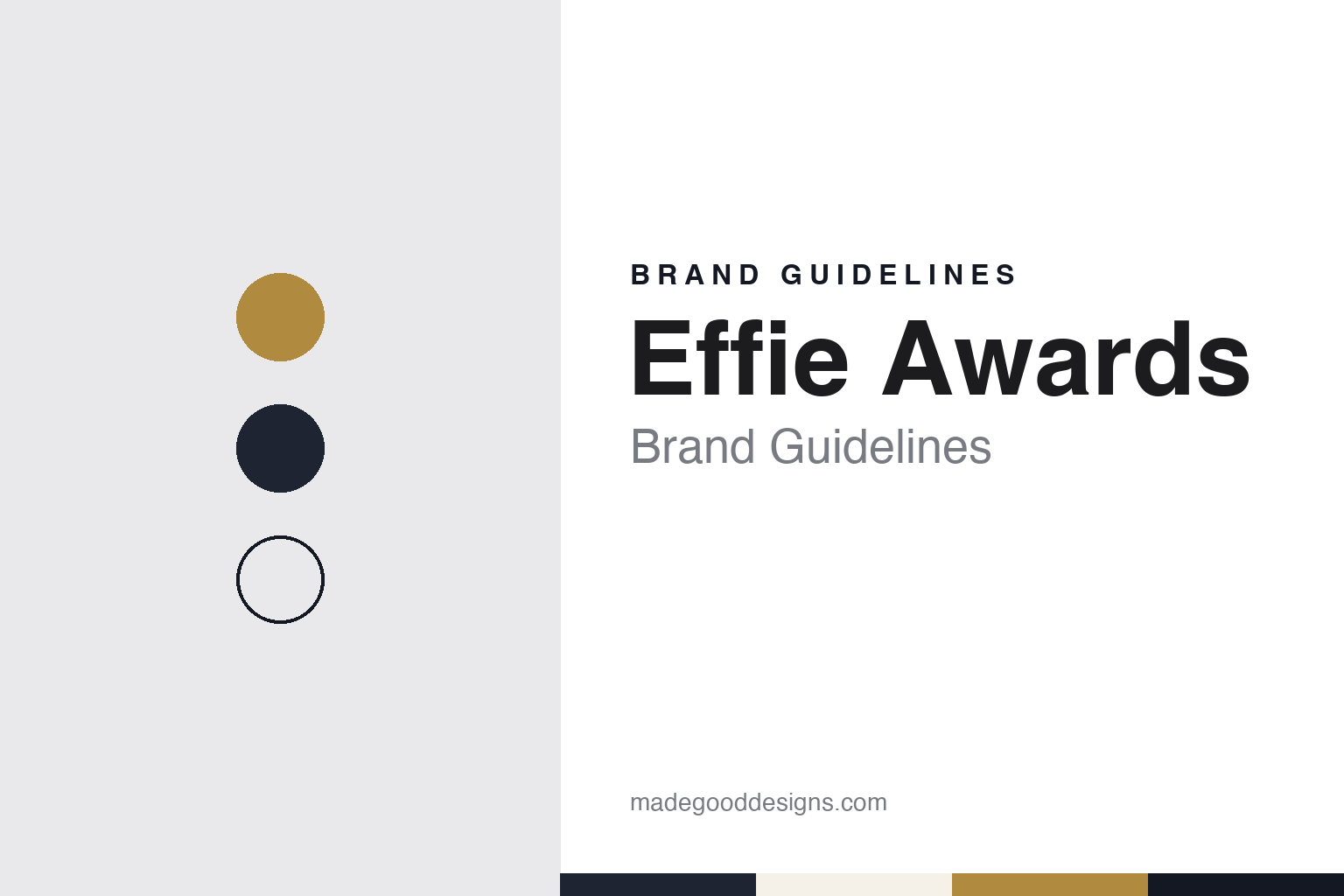
Two constants: an ink navy, ivory and burnished gold palette and a firm grotesque sans register. Abstract homage — not an Effie trophy, logo or mark; nothing of the programme’s identity is reproduced.
An award for results
Begun in New York in 1968.
The Effie Awards began in New York in 1968. German Wikipedia says the prize was founded that year by the New York American Marketing Association, the New York chapter of the marketers’ association, and the organiser’s own history says it started in New York City “as an award to honor the most effective advertising.” The United States competition still uses the line “since 1968” on its page.
The programme is built around results. Entrants submit a written case alongside the creative work, and the organiser describes marketing as “creativity with an objective”: growing a business, selling a product or changing how a brand is seen. It describes its awards as celebrating “work that works.” The name Effie is used for the prize, the programme and the organisation alike.
The awards later passed to a separate body, Effie Worldwide. In a December 2018 announcement marking its fiftieth year, Effie Worldwide described itself as a 501(c)(3) non-profit based in New York, running more than 50 award programmes around the world, and named Traci Alford, who joined in 2017, as its president and chief executive. The same announcement said the fiftieth-anniversary celebrations would close with a summit and the Effie Gala in New York on 30 May 2019.
Today the organiser describes its work under four headings: the awards; Effie Academy, a set of training programmes; Effie Insights, built around a case library that it says holds more than 10,000 effectiveness cases; and the Effie Index, a yearly ranking of companies drawn from award results. Its about page counts about 60 international programmes covering more than 125 markets, and a community of some 25,000 judges.
Colour
Three rounds, four pillars, many countries.
The organiser sets out the judging in plain terms. Every Effie programme, it says, uses three rounds. In the First round, a mix of virtual and in-person sessions picks the finalists. In the Final round, in-person juries decide the Bronze, Silver and Gold awards. A last Grand session then selects a single case as the year’s Grand winner, known as the Grand Effie.
Judges are drawn from across the industry and matched with entries to avoid conflicts of interest, the organiser says; each juror scores in confidence, and each case is read by several jurors. Cases are scored against what the organiser calls the Effie Framework, four pillars of marketing effectiveness, with the scores weighted towards results. Jurors read a written case and look at the creative work, give four scores and add written feedback. A category can have several winners or none at all, as the organiser puts it, because only work that meets its benchmarks is awarded.
The awards run at several levels: global, regional and local, in the organiser’s words. National programmes are run with local partners, and many have long histories of their own. German Wikipedia says the GWA Effie has been presented in Germany every year since 1981 by the agency association GWA; in 2025 it had 22 categories, split between goal categories and discipline categories, and its gala is held each November after a congress. The same article says the Swiss award is presented by the agency association Leading Swiss Agencies, and the Austrian one by the Austrian chapter of the International Advertising Association. In Germany the GWA also publishes a yearly Effie book with the Campus Verlag publishing house.
The calendar is spread across the year because each country keeps its own dates. In late November 2026 the organiser’s calendar listed entry deadlines for the Israeli and Slovak programmes. The United States competition, the original programme, held its 2026 gala in New York in late May, according to the organiser’s news pages.
Typography
Awards and their marks.
Advertising and creative awards tend to present themselves through very few elements. The name is usually short: a set of initials, a club’s name, or the city where the festival takes place. Next to it sits a trophy with a name and a shape of its own, such as a lion, a pencil, a statuette, a cube or an eye, and that object often does the work of a logo, lending its name to the levels of award and to the everyday talk around them.
The organisations behind these programmes vary. Some are associations or clubs formed by working designers, art directors and copywriters; some are registered charities or non-profits; others are run by publishers or events companies, and a few have changed owners as those companies were bought and sold. Where a programme has a parent company, the festival name usually stays in front and the owner appears in the small print.
Most follow a yearly cycle. Entries open months ahead, juries of practitioners meet in rounds, a shortlist is published, and the awards are given at a ceremony or during a festival week, often with talks, workshops and student competitions alongside. Award levels are typically graded, from a shortlist through bronze, silver and gold or their equivalents, with a top prize that juries may decide not to give.
The visual identity has two speeds. A steady wordmark and trophy carry over from year to year, while a key visual is refreshed for each edition, and the selected work is kept in an annual book or an online archive. This guide describes those elements as the organisers and dated sources set them out, and the colours and type shown here are an unofficial interpretation.
Aa
A firm grotesque sans for a results-first programme. (Specimen set in Libre Franklin, a sans STAND-IN; NOT the Effie logo.)
Effie
A name and an icon, redrawn in 2018.
The identity rests on the short name. In its December 2018 announcement, Effie Worldwide said it had unveiled a new logo that “focuses on” the Effie name and its icon, simplifying the symbol it uses for the award; the organiser credited the redesign to the studio Blackletter. The same release tied the new logo to a wider rebranding, as the organisation moved further into training and published research alongside the awards. Gold, silver and bronze appear as award levels, and the organiser presents its winners by level, category, programme and year in its case library.
A change of ownership was agreed in 2024. On 8 August 2024 the Australian trade title B&T reported that Ascential, the owner of Cannes Lions and WARC, had agreed to acquire the commercial assets of Effie, which would join Ascential’s LIONS division subject to regulatory approval. Under the agreement, B&T reported, the not-for-profit Effie Worldwide, Inc. was to be kept and turned into a new foundation, The Effie LIONS Foundation, Inc., focused on education. The report quoted Philip Thomas, Ascential’s chief executive, and said Effie had its headquarters in New York, offices in Beijing and the UK, and a network of 59 partners covering more than 125 markets, with Traci Alford continuing to lead it. By 2026 the Effie website stated that “Effie is brought to you by WARC LLC and its affiliated entities,” with WARC LLC based in New York.
On the organiser’s pages the programmes appear under the Effie name with the country or region attached, such as Effie United States, Effie Israel or Effie Slovakia, each with its own entry deadlines, judging dates and gala. The 2018 announcement also introduced a one-off “5 for 50” award for the anniversary, open to brands that had won Effies in more than one year.
For a design guide, Effie Awards shows how a short coined name and a single icon can hold together dozens of national programmes, each with its own dates, juries and galas. Compare Cannes Lions and the journalist-judged Epica Awards. For this guide we use ink navy, ivory and a burnished gold with a sans, an unofficial interpretation; no product or logo is reproduced.
Explore & save
Keep Effie Awards’s identity on hand — save it to a board in the Made Good inspiration library.
Effie Awards identity set
Pin the Effie Awards ink navy, ivory and burnished gold palette and the results sans register to your own board.
Source & notes
Frequently Asked Questions
What font can I use to match the Effie Awards look?
This guide describes Effie Awards’ type as “A firm grotesque sans for a results-first programme”. Its type specimen is set in Libre Franklin from Google Fonts as a stand-in; Libre Franklin is not Effie Awards’ own lettering.
What colours are in the Effie Awards palette?
This guide’s Effie Awards palette is Burnished gold #B08A3E, Ink navy #1F2433, Night #141823, Ivory #F5F1E8 and Slate #5A5F6B. The tones are the guide’s own unofficial interpretation, not official Effie Awards hex codes.
When was Effie Awards founded?
Effie Awards was founded in 1968, in New York, USA.