Booker Prize Brand Guidelines
A London fiction prize, from 1969 to a revived gold trophy.
Aa
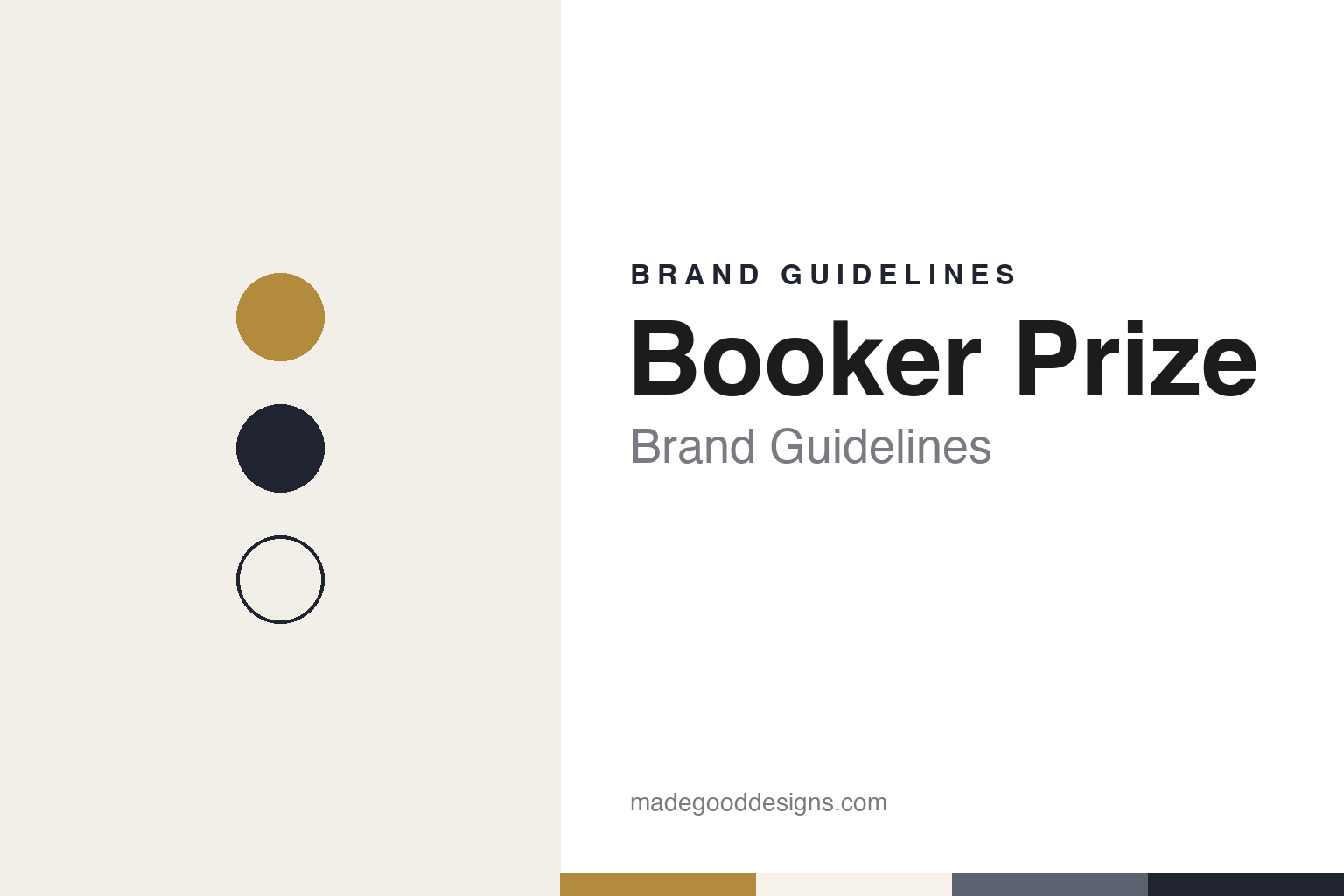
Two constants: an ink, gold and warm paper palette and a bookish serif register. Abstract homage — not a Booker Prize trophy, logo or mark; nothing of the prize’s own identity is reproduced.
Booker Prize for Fiction
A sponsored prize that became a foundation.
The Booker Prize is an annual award for a single novel written in English and published in the United Kingdom or Ireland. It began in 1969 as the Booker Prize for Fiction, after the company Booker, McConnell Ltd agreed to sponsor a new award; English Wikipedia names the publisher Tom Maschler among those who set it up, and the Factum Foundation, in its account of the trophy, calls him the prize’s founder. English Wikipedia dates the first award ceremony to 22 April 1969, in the City of London.
In its early years the prize was open only to authors from the Commonwealth and the Republic of Ireland, Oxford Brookes University’s special collections page says; NPR, reporting in July 2015, adds Zimbabwe to that list. The timing changed in 1971: the award had been given for books published in the previous year, and from then on the publication year and the award year were the same, with the award made in November, according to English Wikipedia. Longlists were not made public at first; English Wikipedia says they have been published since 2001, and capped at 12 or 13 titles since 2007.
In 2002 administration passed to the Booker Prize Foundation, which English Wikipedia describes as an independent registered charity, and the investment company Man Group became title sponsor. The award was called the Man Booker Prize from 2002 to 2019; Oxford Brookes University counts eighteen years of Man Group sponsorship. In March 2019 Books+Publishing reported that the charitable foundation Crankstart would be the new sponsor, on a five-year term beginning on 1 June 2019. Crankstart did not add its name: from June 2019 the award went back to being called The Booker Prize, Oxford Brookes University records.
The other large change concerned eligibility. On 18 September 2013 the organisers announced that, from the 2014 prize, any novel written in English and published in the UK would be considered, whatever the author’s nationality; The Christian Science Monitor reported the decision the next day. NPR described the same rule in 2015 as an expansion to writers across the English-speaking world, with publication in the UK or Ireland as the condition, as English Wikipedia also puts it.
Colour
Five judges, a Booker Dozen and six.
The selection runs on a yearly cycle. A panel of five judges is appointed each year and changes every year; English Wikipedia says the chief executive of the Booker Prize Foundation, Gaby Wood, in post since 2015, chooses them in consultation with an advisory committee drawn from the UK publishing industry. Publishers submit eligible novels, and each judge is expected to read every book submitted; English Wikipedia says the 2023 judges read 163 books over seven months.
The judges then name a longlist of 12 or 13 titles, sometimes called the “Booker Dozen,” a phrase NPR also used in 2015; they reread those books and choose a shortlist of six, then read the six a third time before naming a single winner. NPR’s 2015 report gave a September date for the shortlist and an October date for the winner’s announcement in London.
The ceremony has moved around London. For many years the winner was announced at a formal dinner at Guildhall, English Wikipedia says. In 2020 the ceremony was broadcast from the Roundhouse in London in partnership with the BBC; the Roundhouse was the venue again on 17 October 2022, the Factum Foundation records, and English Wikipedia places the 2023 and 2024 ceremonies at Old Billingsgate.
The object at the centre of the evening has its own history. The original trophy was commissioned by Tom Maschler from the illustrator Jan Pieńkowski, who based it on an art deco lamp found in a junk shop in Portobello Market, according to the Factum Foundation; the first one stood about 60 centimetres tall. For the 2022 prize the Booker Prize Foundation worked with the Factum Foundation to bring the design back for the first time in decades: the original was scanned by photogrammetry at ARCHiOx in Oxford’s Bodleian Library in September 2022, and the new trophy is a 38-centimetre, 3D-printed statue painted gold. English Wikipedia gives 2023 as the year of the revival; the Factum Foundation’s project record gives 2022. In January 2023, The Bookseller reported, the foundation launched a public competition to give the golden statuette a name.
The prize also keeps its paper trail. Oxford Brookes University Library became the permanent home of the Booker Prize Archive in 2003; its catalogue covers material from 1968 onwards, including correspondence, publicity, longlists and shortlists, minutes, photographs and papers from the awards dinner, with embargoes of ten or twenty years on judging material.
Typography
How book prizes present themselves.
Literary and book prizes present themselves through a small set of recurring elements. The first is the name. Some carry a namesake, a writer, illustrator or benefactor whose name stands in the title; some carry the name of a foundation, a society, a library association or a university that runs them; and some carry a sponsor’s name, which can change with the sponsorship while the rest of the title stays the same.
The second is an object. Many prizes give a medal, a statuette or a trophy, and some give that piece a name of its own, presented again each year.
The third is the calendar. Most prizes follow a yearly cycle: a call for submissions or an eligibility period, a longlist, a shortlist and an announcement, often at a ceremony or dinner in a fixed month and city. Judges, juries, panels or members’ votes decide each stage, as each organiser describes it, and the names of the levels — longlist, shortlist, honour, winner — become part of how the prize is presented.
Finally, prizes are carried by the places around them. Ceremonies, broadcasts, festivals, bookshop displays and library lists repeat the name and its colours through the year. This guide looks at how each prize sets out those elements: its founders and organiser, its names over time, its cycle and levels, and the object it hands over.
Aa
A bookish serif for a prize built around novels. (Specimen set in Cormorant Garamond, a serif STAND-IN; NOT the Booker Prize logo or its typeface.)
The Booker Prizes
A family of prizes around one name.
The Booker name now covers more than one award. The International Booker Prize began as the Man Booker International Prize, given every two years for an author’s body of work. In July 2015 Publishers Weekly reported that from 2016 it would merge with the Independent Foreign Fiction Prize and become an annual award for a single work of fiction translated into English, open to novels and short story collections, with the award shared equally between author and translator. The new cycle followed the main prize’s pattern on a spring timetable: a longlist of 12 or 13 books in March, a shortlist of six in April and a winner in May.
Oxford Brookes University lists other programmes in the archive it holds, including a Booker Russian Novel prize and one-off awards such as the Golden Man Booker, given in 2018 to mark fifty years of the main prize. English Wikipedia adds a third current award, the Children’s Booker Prize, launched in 2025.
Through these changes the prize has kept a recognisable shape: a single novel, five judges who change each year, a longlist, a shortlist of six and an announcement in London. The sponsor names in the title have changed with the dates — Booker Prize for Fiction from 1969, Man Booker Prize from 2002, The Booker Prize again from 2019 — while the word Booker has stayed at the front throughout.
For a design guide, the Booker Prize shows how a prize can keep one short name through several sponsors and give a returning trophy a central place in its identity. Compare the Women’s Prize for Fiction, another London fiction prize with a statuette and a yearly longlist, and the Giller Prize. For this guide we use ink, gold and warm paper with a serif, an unofficial interpretation; no product or logo is reproduced.
Explore & save
Keep Booker Prize’s identity on hand — save it to a board in the Made Good inspiration library.
Booker Prize identity set
Pin the Booker Prize ink, gold and warm paper palette and the bookish serif register to your own board.
Source & notes
Frequently Asked Questions
What font can I use to match the Booker Prize look?
This guide describes Booker Prize’s type as “A bookish serif for a prize built around novels”. Its type specimen is set in Cormorant Garamond from Google Fonts as a stand-in; Cormorant Garamond is not Booker Prize’s own lettering.
What colours are in the Booker Prize palette?
This guide’s Booker Prize palette is Ink #1F2430, Trophy gold #B38B3C, Warm paper #F6F2EA, Slate #5B6270 and Linen #FBF9F4. The tones are the guide’s own unofficial interpretation, not official Booker Prize hex codes.