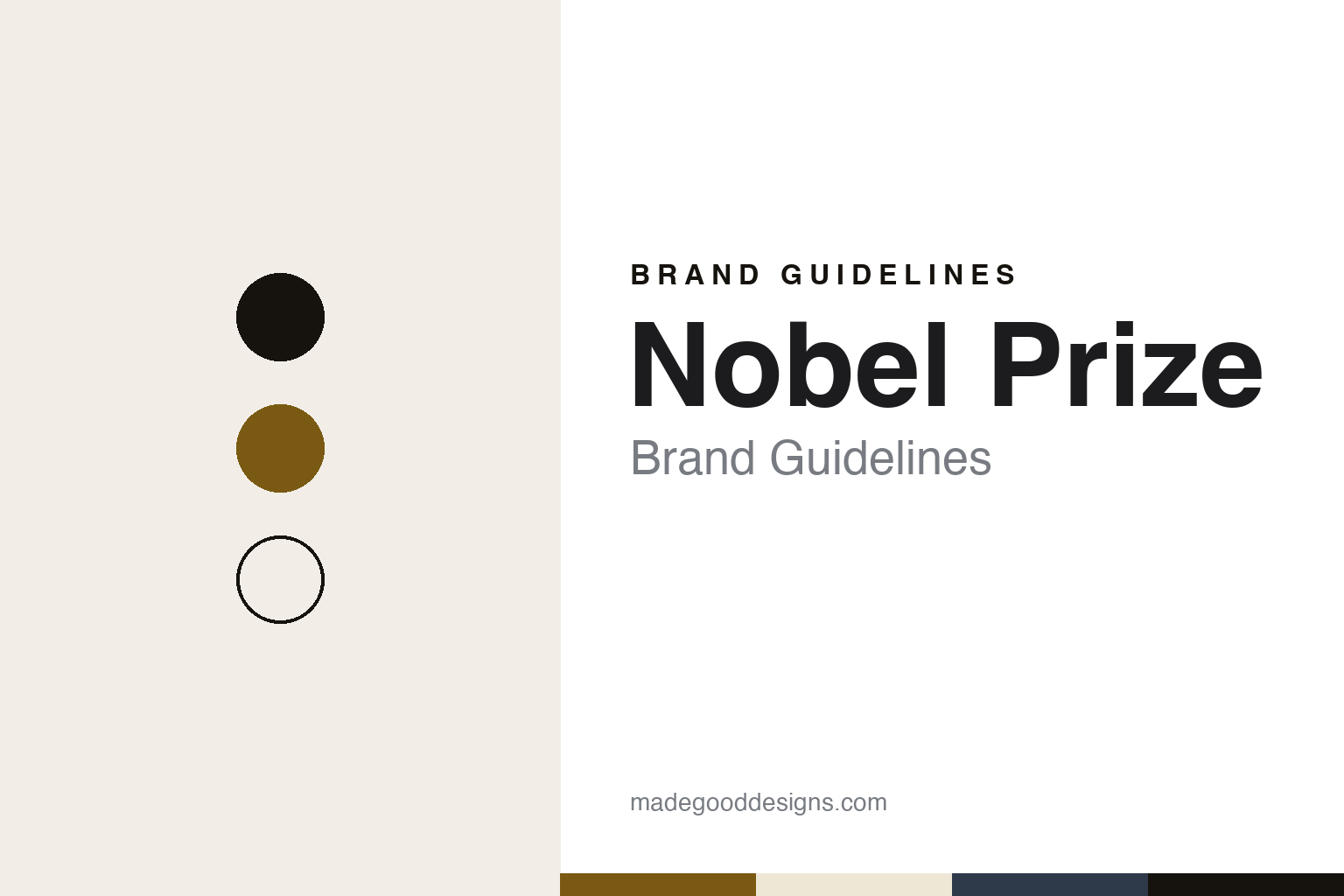
Nobel Prize Brand Guidelines
Six prizes, two cities and a gold medal since 1901.
Aa
Two constants: a gold, ink and cream palette and a classical serif register. Abstract homage — not a Nobel Prize medal, diploma or mark; no medal, portrait or logo is reproduced.
The will of 1895
A testament, a foundation and five prizes.
The Nobel Prize rests on a single document. On 27 November 1895 Alfred Nobel signed the will that the Nobel Foundation publishes in full: after private bequests, his remaining assets were to form a fund whose interest would be paid each year as prizes to those who, during the preceding year, had “conferred the greatest benefit to humankind.” The will divided that interest into five equal parts: physics, chemistry, physiology or medicine, literature, and work for fellowship among nations and peace congresses.
The same text named who would choose the laureates. According to the foundation, the will assigned physics and chemistry to the Royal Swedish Academy of Sciences, physiology or medicine to Karolinska Institutet in Stockholm, literature to the Swedish Academy, and the peace prize to a committee of five people elected by the Norwegian parliament, the Storting, today the Norwegian Nobel Committee.
To carry the will out, the Nobel Foundation was established as a private organisation on 29 June 1900, the foundation and English Wikipedia say; its statutes were promulgated by King Oscar II the same year. English Wikipedia describes a board of five Swedish or Norwegian citizens with its seat in Stockholm. The foundation manages the fund and, in its own words, has “ultimate responsibility” for fulfilling the will, while the prize-awarding institutions make the selections independently.
The first prizes were presented on 10 December 1901, in Stockholm and in Christiania, now Oslo, the foundation says. In some years prizes were not awarded: the foundation’s published facts list several such years in each category, including 1940 to 1942 for all five original prizes.
Colour
Institutions, October and 10 December.
Today there are six prize categories. Five are those of the will. The sixth was added in 1968, when the Swedish central bank, Sveriges Riksbank, established the Sveriges Riksbank Prize in Economic Sciences in Memory of Alfred Nobel on its 300th anniversary; the Royal Swedish Academy of Sciences has selected its laureates since 1969, and the foundation’s own pages call it a memorial prize. By November 2026 the foundation’s facts page counted 1,036 laureates.
Selection follows a long annual cycle. English Wikipedia describes nomination forms sent by the Nobel committees to about 3,000 people, usually in September of the year before the award, with a deadline of 31 January; the committees then narrow the field and the institutions vote, and nomination records stay sealed for 50 years. The laureates are announced by the awarding institutions in early October, as the Swiss news agency Keystone-SDA noted in its report of 10 December 2025.
The prizes are presented on 10 December each year in two cities. In Stockholm the ceremony has taken place, almost without exception, at Konserthuset Stockholm, the Stockholm Concert Hall, since 1926, the foundation says. Speeches present each laureate’s work, and the King of Sweden hands each laureate a diploma and a medal; Keystone-SDA described King Carl XVI Gustaf doing so at the Concert Hall on 10 December 2025. A banquet for about 1,300 guests, including 250 students, follows at Stockholm City Hall, where it has been held, with a few exceptions, since 1930. The foundation arranges the Stockholm festivities.
The Nobel Peace Prize is presented the same day in Oslo by the chair of the Norwegian Nobel Committee. The foundation says the ceremony was held for many years at the Nobel Institute, from 1947 in the auditorium of the University of Oslo, and since 1990 at Oslo City Hall; the committee hosts its own banquet later that day.
Typography
How prizes present themselves.
Literary and book prizes present themselves through a small set of recurring elements. The first is the name. Some carry a namesake, a writer, illustrator or benefactor whose name stands in the title; some carry the name of a foundation, a society, a library association or a university that runs them; and some carry a sponsor’s name, which can change with the sponsorship while the rest of the title stays the same.
The second is an object. Many prizes give a medal, a statuette or a trophy, and some give that piece a name of its own, presented again each year.
The third is the calendar. Most prizes follow a yearly cycle: a call for submissions or an eligibility period, a longlist, a shortlist and an announcement, often at a ceremony or dinner in a fixed month and city. Judges, juries, panels or members’ votes decide each stage, as each organiser describes it, and the names of the levels — longlist, shortlist, honour, winner — become part of how the prize is presented.
Finally, prizes are carried by the places around them. Ceremonies, broadcasts, festivals, bookshop displays and library lists repeat the name and its colours through the year. This guide looks at how each prize sets out those elements: its founders and organiser, its names over time, its cycle and levels, and the object it hands over.
Aa
A classical serif for a medal-and-diploma programme. (Specimen set in Cormorant Garamond, a serif STAND-IN; NOT the Nobel Prize logo or any official typeface.)
Nobel Prize
A gold medal with a portrait and a Latin line.
The programme’s physical objects are its medal and diploma. At the ceremonies laureates receive three things, the foundation says: a diploma, a medal and a document confirming the prize. Each diploma is a unique work by Swedish and Norwegian artists and calligraphers; Swedish Wikipedia adds that the diploma carries a picture, the laureate’s name and usually a citation, and that the peace diplomas carry no citation.
The medals have their own history. The 1901 laureates received temporary medals, the foundation says, because the reverse designs had not yet been approved by each institution; the first finished medals for physics, chemistry, physiology or medicine and literature, designed by the Swedish sculptor and engraver Erik Lindberg, were struck in 1902. The Norwegian sculptor Gustav Vigeland designed the peace medal, with Lindberg cutting the dies, and those designs remain in use. The medal for economic sciences was designed separately after 1968.
Every medal shows a portrait of Alfred Nobel on the front, in different versions. The three Swedish medals share the reverse inscription “Inventas vitam iuvat excoluisse per artes,” with images that change according to each institution’s symbols; physics and chemistry look the same. The peace medal reads “Pro pace et fraternitate gentium,” and the economic sciences medal has no quotation. On the Swedish medals the laureate’s name is engraved on a plate on the reverse; on the peace and economics medals it is on the edge. Until 1980 the Swedish medals were struck in 23-carat gold; since then they have been made of 18-carat recycled gold, weighing 175 grams, or 185 grams for economic sciences, the foundation says.
Swedish Wikipedia records that the medals are registered trademarks of the Nobel Foundation, that the state mint in Eskilstuna struck them from 1902 until 2010, that Norway’s mint at Kongsberg made all the medals in 2011, and that the contract passed to Svenska Medalj AB of Eskilstuna in an announcement of 30 May 2012, which English Wikipedia also dates.
For a design guide, the Nobel Prize shows how a programme can carry its identity through objects and ritual rather than a logo: a medal, a diploma, two halls and one date. Compare two other prize programmes in this series, the Pulitzer Prize and the Booker Prize. For this guide we use a medal gold, ink and a diploma cream with a serif, an unofficial interpretation; no product or logo is reproduced.
Explore & save
Keep Nobel Prize’s identity on hand — save it to a board in the Made Good inspiration library.
Nobel Prize identity set
Pin the Nobel Prize gold, ink and cream palette and the classical serif register to your own board.
Source & notes
Frequently Asked Questions
What font can I use to match the Nobel Prize look?
This guide describes Nobel Prize’s type as “A classical serif for a medal-and-diploma programme”. Its type specimen is set in Cormorant Garamond from Google Fonts as a stand-in; Cormorant Garamond is not Nobel Prize’s own lettering.
What colours are in the Nobel Prize palette?
This guide’s Nobel Prize palette is Medal gold #7A5A12, Ink #16130E, Diploma cream #EFE7D6, Hall blue #2E3A4A and Paper #FAF7F1. The tones are the guide’s own unofficial interpretation, not official Nobel Prize hex codes.