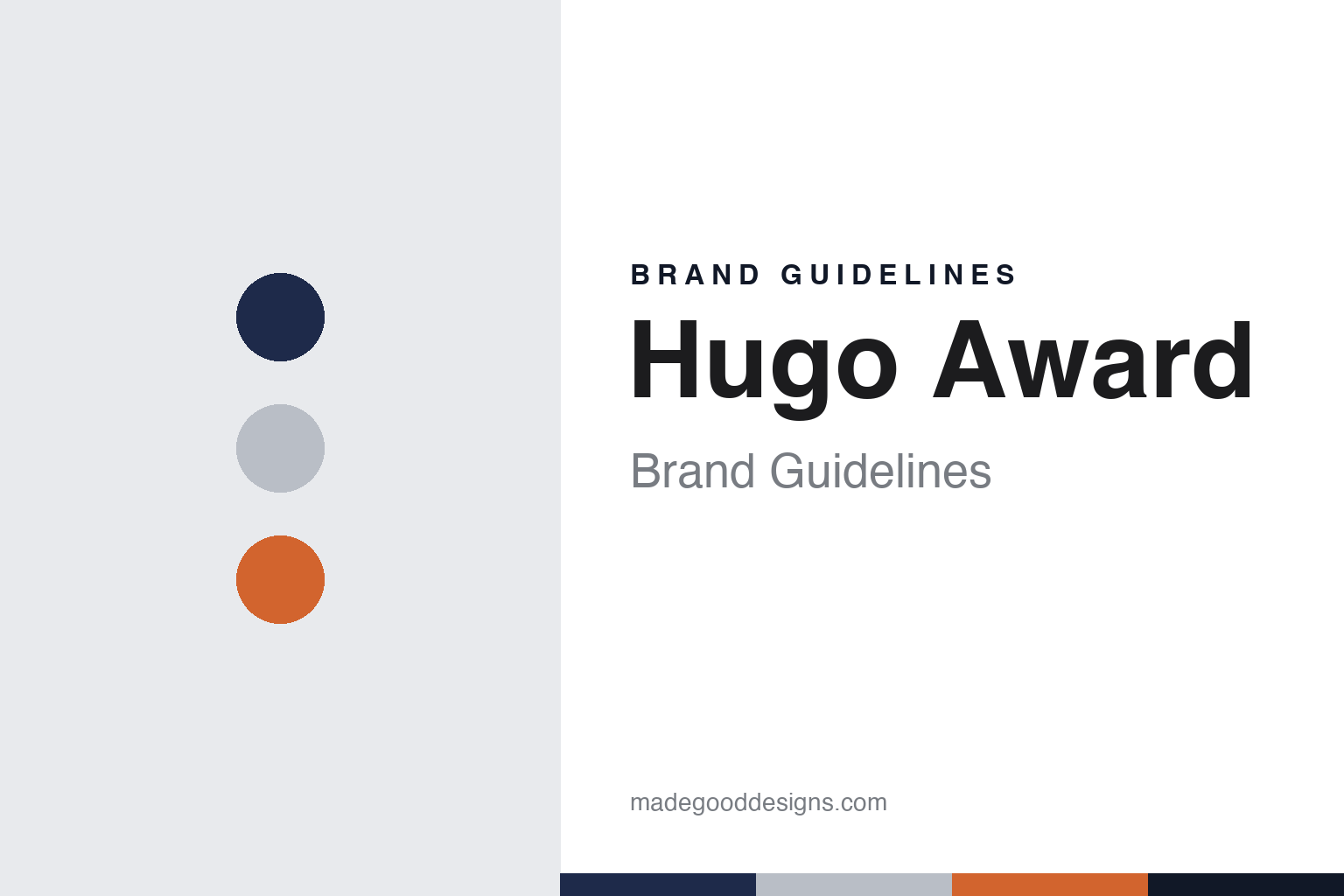
Hugo Award Brand Guidelines
The fan-voted science fiction award with a rocket cast from one mould.
Aa
Two constants: a night-sky navy, chrome and orange palette and a geometric sans register. Abstract homage — not a Hugo Award trophy, logo or mark; nothing is reproduced.
Worldcon, 1953
An award run by a convention’s own members.
The Hugo Award is presented each year at the World Science Fiction Convention, known as Worldcon, and is chosen by that convention’s members. English Wikipedia records that the first Hugos were handed out in 1953 at the 11th Worldcon in Philadelphia, in seven categories. The 1954 convention did not repeat them, but the awards returned in 1955 and have been presented every year since, a run the official Hugo site also gives. The Encyclopedia of Science Fiction, in an entry updated in August 2026, says the original idea came from a fan and was modelled on the film academy’s Oscars.
The award is named after Hugo Gernsback, the magazine editor who founded Amazing Stories in 1926, according to the official site. For decades the formal title was the Science Fiction Achievement Award, with “Hugo” as a nickname. The Hugo site says “Hugo Award” became the official name with the 1993 awards, because the longer, descriptive title could not be registered as a service mark; English Wikipedia dates the change to the 1992 awards, so the two sources differ by a year.
The Hugos have no permanent head office. They belong to the World Science Fiction Society (WSFS), which the official site describes as an unincorporated literary society with no officers of its own: it is a framework for the individual Worldcons, each run by an independent committee in a different city. The Hugo names, the logo and the distinctive shape of the rocket are service marks held by Worldcon Intellectual Property, a California non-profit corporation managed by the society’s Mark Protection Committee, whose marketing subcommittee runs the official website. Each year’s Worldcon appoints Hugo administrators who run and count the ballot.
Colour
Nominate, shortlist, rank.
The cycle follows the convention calendar. According to the official site, members nominate from January to March, naming up to five works or people from the previous calendar year in each category; finalists are announced in spring and a final ballot runs until about July, depending on when Worldcon is held. The awards are then presented at a formal evening ceremony, usually on the third or fourth night of the convention. The 2026 Hugos were presented on 30 August 2026 at LAcon V, the 84th Worldcon, in Anaheim, California, according to English Wikipedia and the Hugo site. For that year the Hugo site reported 23,543 nominations for 4,299 works and individuals across 21 categories.
The method has been refined several times, the official site’s short history says. The early awards were a single vote; a separate nominating ballot arrived in 1959, voting on the final ballot was limited to current Worldcon members from 1961, and the society adopted a written constitution in 1963, which has defined the categories since the 1964 convention. Instant-runoff counting of the final ballot began in 1968. In 2017 nominations started to be counted with a system called E Pluribus Hugo, and the number of finalists in each category went from five to six. Voters rank the finalists and may also choose “No Award.” Anyone may be nominated; only members vote, and a supporting membership allows voting without attending.
Categories are set by the WSFS constitution and change by amendment at the annual business meeting. The official site groups them into three kinds: individual works, such as a novel or a film; people, such as a professional artist, judged on their work in the year; and serial publications, such as a fanzine, judged on a year’s run. Current fiction categories run from the novel through the novella and novelette to the short story, alongside a series category, graphic stories or comics, related works and long- and short-form dramatic presentations; there are also categories for editors, professional and fan artists, semiprozines, fanzines, fancasts and fan writers. A poem category was presented in 2025 and 2026. Works may come from any country and any language, and work first published in another language is eligible in its first year in English translation. Two further awards, for new writers and for young-adult books, are voted and presented alongside the Hugos but are not Hugos themselves, the site notes. Retrospective “Retro-Hugos” for earlier years were added in 1996 and removed from the constitution in 2025, English Wikipedia records.
Typography
How literary prizes present themselves.
Literary and book prizes present themselves through a small set of recurring elements. The first is the name. Some carry a namesake, a writer, illustrator or benefactor whose name stands in the title; some carry the name of a foundation, a society, a library association or a university that runs them; and some carry a sponsor’s name, which can change with the sponsorship while the rest of the title stays the same.
The second is an object. Many prizes give a medal, a statuette or a trophy, and some give that piece a name of its own, presented again each year.
The third is the calendar. Most prizes follow a yearly cycle: a call for submissions or an eligibility period, a longlist, a shortlist and an announcement, often at a ceremony or dinner in a fixed month and city. Judges, juries, panels or members’ votes decide each stage, as each organiser describes it, and the names of the levels — longlist, shortlist, honour, winner — become part of how the prize is presented.
Finally, prizes are carried by the places around them. Ceremonies, broadcasts, festivals, bookshop displays and library lists repeat the name and its colours through the year. This guide looks at how each prize sets out those elements: its founders and organiser, its names over time, its cycle and levels, and the object it hands over.
Aa
A geometric sans for a programme run by its members. (Specimen set in Space Grotesk, a sans STAND-IN; NOT the Hugo Award logo.)
The rocket
One mould, a new base every year.
The trophy’s rocket has kept one shape for four decades. The official site says the first trophy rocket was designed by Jack McKnight and Ben Jason in 1953, based on the hood ornament of a 1950s American car; English Wikipedia adds that it stood on a wooden base. The Encyclopedia of Science Fiction credits McKnight with the first model and says a similar design by Jason has normally been used since 1955. Every trophy except 1958’s, which English Wikipedia describes as a plaque, has carried a finned rocket on top.
The rocket’s outline drifted as committees reinterpreted it until a refinement introduced in 1984, which the site calls definitive. Since then every rocket except 1991’s has been cast from the same mould at the Ashwater Foundry in England; The Encyclopedia of Science Fiction places the foundry in Birmingham and notes that the rockets were gold-plated in 1992 for the 50th Worldcon and in 2003 for the 50th anniversary of the first awards. The site’s specification sheet sets the rocket at 13 inches tall and two inches across from fin tip to fin tip, with a solid finish and nothing engraved or printed on it.
The base is where each year differs. Each Worldcon committee designs its own, often through an open competition, the site says. Bases must stand on a flat surface, use a stable material such as wood or metal, make the rocket an integral part of the design and leave room for plaques naming the convention, the recipient and the category. Some have been plain and others fanciful: the official site records that the 1992 base included pieces of a gantry from NASA’s Kennedy Space Center, and that the 1994 base held metal from Canadian sounding rockets that had been in space. The Hugo logo, which the site offers for download in black and white, must keep its service-mark symbol and may not be distorted, according to the site’s usage guide.
For a design guide, the Hugo Award shows how a single fixed object, repeated for decades, can carry a programme whose organisers change every year. Compare the Nebula Awards, voted by professional writers, and the National Book Award. For this guide we use night-sky navy, rocket chrome and a launch orange with a geometric sans, an unofficial interpretation; no product or logo is reproduced.
Explore & save
Keep Hugo Award’s identity on hand — save it to a board in the Made Good inspiration library.
Hugo Award identity set
Pin the Hugo Award night-sky navy, chrome and orange palette and the geometric sans register to your own board.
Source & notes
Frequently Asked Questions
What font can I use to match the Hugo Award look?
This guide describes Hugo Award’s type as “A geometric sans for a programme run by its members”. Its type specimen is set in Space Grotesk from Google Fonts as a stand-in; Space Grotesk is not Hugo Award’s own lettering.
What colours are in the Hugo Award palette?
This guide’s Hugo Award palette is Night-sky navy #1E2A4A, Deep space #111827, Rocket chrome #B9BEC6, Launch orange #D2642E and Paper #F6F5F2. The tones are the guide’s own unofficial interpretation, not official Hugo Award hex codes.
When was Hugo Award founded?
Hugo Award was founded in 1953 (11th Worldcon), in Philadelphia, USA.