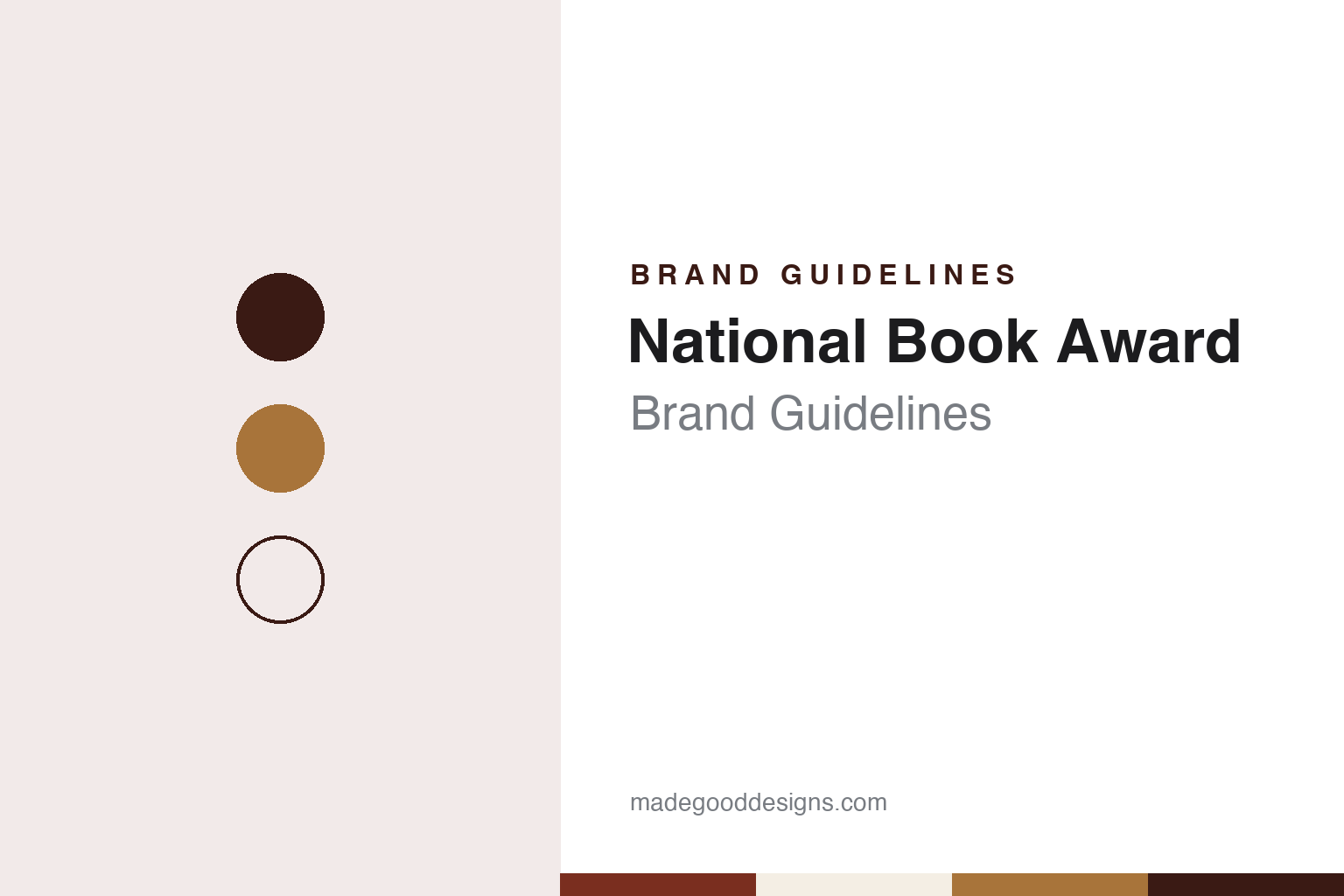
National Book Award Brand Guidelines
Longlist, finalists and a bronze sculpture, every November in New York.
Aa
Two constants: a binding red, endpaper and bronze palette and a display serif register. Abstract homage — not a National Book Foundation asset; no medal, sculpture, medallion or logo is reproduced.
Booksellers, then the book trade
A booksellers’ vote, then a relaunch in 1950.
The National Book Awards have two beginnings. English Wikipedia says the first awards were set up by the American Booksellers Association and presented in May 1936 at its annual convention, with the books chosen by a vote of its members; from 1937 to 1942 they were announced each February or March, and the series then lapsed until three book-trade organisations re-established it in 1950.
The series the organiser counts today began in 1950. The National Book Foundation says that on 16 March 1950 publishers, editors, writers and critics gathered at the Waldorf-Astoria hotel in New York City for the first annual National Book Awards, jointly sponsored by the American Book Publishers Council, the Book Manufacturers’ Institute and the American Booksellers Association, with prizes for fiction, nonfiction and poetry. English Wikipedia adds that the National Book Committee administered the awards from 1950 to 1974.
The categories then grew. The foundation says that from the mid-1960s through the 1970s new awards were added for science, philosophy and religion, history and biography, arts and letters, translation, autobiography, first novels, original paperbacks and children’s books. By 1980, it says, 28 prizes in 16 categories were given each year under a new name, the American Book Awards. English Wikipedia says that format ran from 1980 to 1983, that the 1984 programme was cut to three categories and moved from spring to late autumn, and that the “National” name returned in 1987.
Colour
A foundation, five panels and one evening.
The organiser today is the National Book Foundation, a nonprofit organisation that, by its own account, has overseen the awards since 1989; English Wikipedia dates the foundation’s establishment to 1988. The foundation lists its executive directors on its website, with Ruth Dickey in the role since 2021. Poetry returned as a category in 1991, Young People’s Literature was added in 1996 and Translated Literature in 2018, the foundation says, giving the five current categories: Fiction, Nonfiction, Poetry, Translated Literature and Young People’s Literature. English Wikipedia notes that an earlier translation award ran from 1967 to 1983, and that in 2024 the foundation dropped the requirement of United States citizenship.
The foundation describes a fixed yearly cycle. Submissions open in March and close in May, and only publishers may submit: authors cannot enter their own books, and self-published books qualify only if the publisher also publishes other authors. Books must have been published in the United States between 1 December of the previous year and 30 November of the current year. Twenty-five judges, writers, translators, critics, librarians and booksellers, sit on five panels of five, each with a Panel Chair, who may ask for books that were not submitted. For Translated Literature there is no citizenship or residency requirement for author or translator. Judges are nominated by past winners, finalists and judges and recruited by the executive director, and the panels deliberate independently of the foundation’s board and staff. Submissions typically range from about 150 titles in Translated Literature to more than 600 in Nonfiction, the foundation says; English Wikipedia gives 1,637 books entered across the five categories in 2018.
The levels are named plainly. Since 2013 each panel has chosen a Longlist of ten titles, announced in mid-September, then five Finalists in early October, the foundation says; each panel picks its Winner on the day of the ceremony. The night before, finalists receive a medal and a citation from their panel at a private Medal Ceremony, followed by a public Finalist Reading. Winners receive a bronze sculpture at the National Book Awards Ceremony and Benefit Dinner. Literary Hub reported in October 2026 that the finalists’ medal is bronze.
Typography
How literary and book prizes present themselves.
Literary and book prizes present themselves through a small set of recurring elements. The first is the name. Some carry a namesake, a writer, illustrator or benefactor whose name stands in the title; some carry the name of a foundation, a society, a library association or a university that runs them; and some carry a sponsor’s name, which can change with the sponsorship while the rest of the title stays the same.
The second is an object. Many prizes give a medal, a statuette or a trophy, and some give that piece a name of its own, presented again each year.
The third is the calendar. Most prizes follow a yearly cycle: a call for submissions or an eligibility period, a longlist, a shortlist and an announcement, often at a ceremony or dinner in a fixed month and city. Judges, juries, panels or members’ votes decide each stage, as each organiser describes it, and the names of the levels — longlist, shortlist, honour, winner — become part of how the prize is presented.
Finally, prizes are carried by the places around them. Ceremonies, broadcasts, festivals, bookshop displays and library lists repeat the name and its colours through the year. This guide looks at how each prize sets out those elements: its founders and organiser, its names over time, its cycle and levels, and the object it hands over.
Aa
A display serif for a programme built around book covers. (Specimen set in DM Serif Display, a serif STAND-IN; NOT the National Book Foundation logo.)
National Book Award
A medallion on the cover.
The award reaches readers through the book itself. The foundation sells medallion stickers and licenses digital medallion images for Longlist, Finalist and Winner titles, and for its 5 Under 35 honourees; publishers do not have to use them, but they need a licence from the foundation before using the medallion in marketing or on a jacket, a paperback cover, an ebook or an audiobook. It says medallions are available for more than 2,000 backlist titles.
The ceremony also carries two lifetime honours. English Wikipedia says the foundation presents the Medal for Distinguished Contribution to American Letters and, since 2005, the Literarian Award for Outstanding Service to the American Literary Community at the same event. The foundation’s other programmes include 5 Under 35, which it lists among its prizes and honours.
The 2026 cycle followed the published calendar. NPR reported that the 2026 finalists were announced on the morning of Tuesday, 6 October 2026, and that the winners would be named on 18 November 2026. The foundation billed the evening as the 77th National Book Awards, held on Wednesday, 18 November 2026, and streamed on its website and on YouTube; Literary Hub placed the Ceremony & Benefit Dinner in New York City.
For a design guide, the National Book Award shows how a prize can be carried by a few clear words and a mark on the cover: longlist, finalist, winner, a medal and a sculpture, with five category names in place since 2018. Compare the Pulitzer Prize, another New York programme with books categories, and the Newbery Medal, an American prize for children’s books. Since 1984 the awards have been presented in the autumn, usually in November, English Wikipedia says, which ties the identity to a single evening at the end of the publishing year. For this guide we use binding red, endpaper and bronze with a serif, an unofficial interpretation; no product or logo is reproduced.
Explore & save
Keep National Book Award’s identity on hand — save it to a board in the Made Good inspiration library.
National Book Award identity set
Pin the National Book Award binding red, endpaper and bronze palette and the display serif register to your own board.
Source & notes
Frequently Asked Questions
What font can I use to match the National Book Award look?
This guide describes National Book Award’s type as “A display serif for a programme built around book covers”. Its type specimen is set in DM Serif Display from Google Fonts as a stand-in; DM Serif Display is not National Book Award’s own lettering.
What colours are in the National Book Award palette?
This guide’s National Book Award palette is Binding red #7A2E1F, Dark cloth #3A1A14, Bronze #A8743A, Endpaper #F4EEE4 and Page white #FBF8F2. The tones are the guide’s own unofficial interpretation, not official National Book Award hex codes.
When was National Book Award founded?
National Book Award was founded in 1950 (earlier series 1936–1942), in New York, USA.