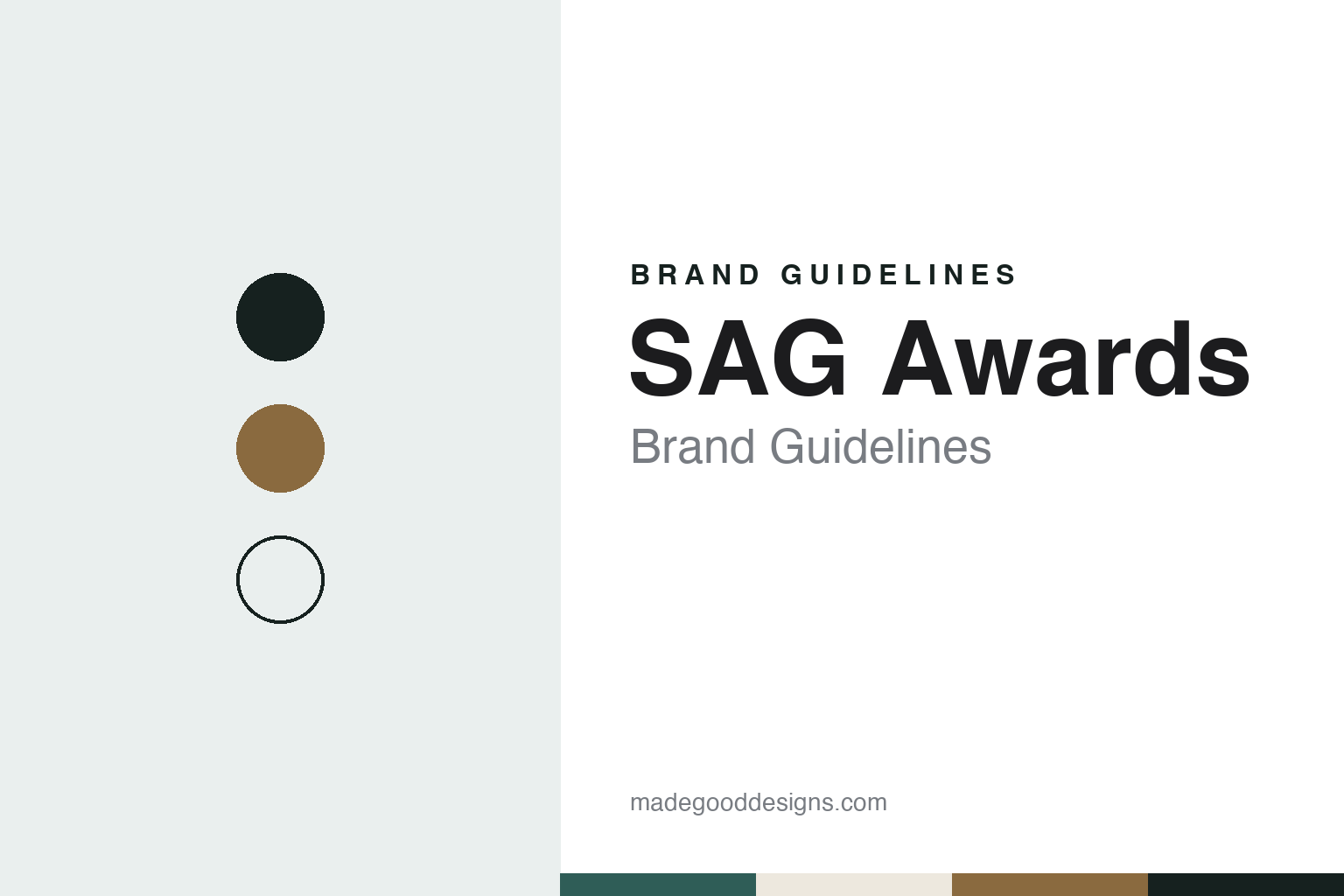
SAG Awards Brand Guidelines
The actors’ awards, now named for their bronze statuette.
Aa
Two constants: a patina green, bronze and ivory palette and a theatrical serif register. Abstract homage — not a SAG Awards or Actor Awards asset; no statuette, logo or mark is reproduced.
Screen Actors Guild Awards
An awards show voted on by performers.
The Screen Actors Guild Awards began in 1995 to recognise performances in films and primetime television each year, the Associated Press reported in November 2025 in a story carried by NBC News. The first ceremony was broadcast live from Stage 12 at Universal Studios, English Wikipedia says, giving the date as February 25, 1995; the organiser’s own history page dates the first presentation to March 8, 1995. The second ceremony moved to the Santa Monica Civic Auditorium, and later ceremonies have been held at the Shrine Auditorium in Los Angeles, according to English Wikipedia.
The awards are presented by SAG-AFTRA, which the Associated Press describes as the union that presents the awards and represents film and television actors in the United States, among other performers. The organiser describes the idea behind the show simply: an awards ceremony “by actors, for actors.” It says the programme now presents 15 awards across film and television, and that the vote is open to a membership of more than 160,000 performers.
From the start the show opened in a set way. The organiser says the first ceremony began with an actor telling the audience a short story about their own career, and that this opening became a tradition: for the first eight years one actor gave it each year, and from the ninth edition several actors told shorter stories, each closing with the line “I am an actor.” The organiser says more than 120 actors have taken part since the first ceremony.
On television, the awards went out on NBC from 1995 to 1997 and on TNT from 1998 to 2022, with a simulcast on TBS from 2007, English Wikipedia says. In 2023 Netflix streamed the ceremony on its YouTube channel, and from 2024 it has carried the show live.
Colour
Ensembles, leading roles and stunt work.
The categories are built around performance rather than productions. English Wikipedia lists six film awards: Outstanding Performance by a Cast in a Motion Picture, four awards for male and female actors in leading and supporting roles, and an award for a stunt ensemble in a motion picture. Television has nine: ensemble awards for a drama series and a comedy series, awards for male and female actors in a drama series, a comedy series and a television movie or limited series, and a stunt ensemble award for a television series. The ensemble awards, which honour a whole cast at once, are the feature English Wikipedia singles out.
Selection runs in two stages, as the organiser describes it. Nominations are chosen by two committees, one for motion pictures and one for television, each made up of 2,500 randomly selected members; the committees are drawn afresh every year from paid-up, active members who have not served in the previous eight years. Once nominations are announced, final voting is open to all paid-up, active members. Performances can be submitted by producers, studios, networks, agents, managers or publicists with the actor’s permission, or by actors themselves, and the organiser says titles need not be in English.
The calendar is published a year ahead.
Alongside the competitive awards sits the non-competitive SAG-AFTRA Life Achievement Award. Its recipient is chosen by the union’s National Honors and Tributes Committee, and the choice must be approved by SAG-AFTRA’s president and national executive director, the organiser says.
Typography
How screen and music awards present themselves.
Music, screen and media awards usually carry the name of the body behind them. Some are run by a television network, which both organises the night and broadcasts it; others by a trade association, an academy, a guild of performers, a critics’ association or a university. That organiser sets the rules, the eligibility period and the voting method, and its name or initials often become the programme’s nickname — CMAs, VMAs, AMAs — long before anyone reads the full title.
Most programmes follow a yearly cycle. Work released within a fixed window, sometimes twelve months that do not match the calendar year, becomes eligible; a first ballot or submission round produces nominees; and a later vote or jury decision picks the winners in each category. Depending on the programme, the voters may be the organiser’s professional members in several rounds, a voting academy of industry and media figures, a panel or jury, or the public through fan votes.
The ceremony itself is usually built for television or streaming. Many awards keep a regular month and a regular venue for years at a time, and some of the categories are presented on air while others are handed out separately or announced in advance. Special honours, such as lifetime achievement awards, sit alongside the competitive categories.
The most constant visual element is often the object handed to winners. A named statuette, a sculpted star or a crystal trophy can outlast every change of logo, host city or broadcaster, and organisers often tell the story of its shape, material and maker. The guides in this group describe those programmes plainly: who runs them, how their categories and voting work, and how their trophies and names present them, without listing winners.
Aa
A theatrical serif for a show named after its statuette. (Specimen set in Cormorant Garamond, a serif STAND-IN; NOT the SAG Awards or Actor Awards logo.)
The Actor
A bronze figure holding two masks.
The trophy came first in the naming. The statuette, called The Actor, is a nude male figure holding the masks of comedy and tragedy, cast in solid bronze, English Wikipedia says. The organiser gives its height as 16 inches and its weight as 12 pounds, on a base four inches across, and credits the sculpture to Edward Saenz and the design to Jim Heimann and Jim Barnett. It is made at the American Fine Arts Foundry in Burbank, California, where, the organiser says, a team of about ten craftspeople spends three to four months each year on the statuettes, with more than 1,000 produced since 1995. The first cast is displayed at SAG-AFTRA’s headquarters in Los Angeles.
The organiser describes the method as lost-wax casting: a silicone mould makes a wax figure, the arms are cast separately because of the pose and attached by hand, and the wax is encased in ceramic to make the mould for molten bronze. After the shell is broken away, the bronze is sandblasted, ground, polished and chased, and its blue-green finish comes from chemical oxidation, with heat speeding the natural patina. Each statuette is stamped with its own serial number.
In November 2025 the programme took the statuette’s name. The Associated Press reported on November 15, 2025, in a story carried by NBC News, that the show commonly known as the SAG Awards would officially become the Actor Awards presented by SAG-AFTRA at its next ceremony on March 1, 2026; the change was announced to the SAG-AFTRA board the day before. The organiser’s website now carries the new name, and its archive keeps the earlier editions under their original titles, from the inaugural Screen Actors Guild Awards to the 31st.
For a design guide, the SAG Awards show how a programme can rename itself after its trophy while keeping the same voters and the same cycle. Compare Netflix, which has carried the ceremony live since 2024, and NBC, its first broadcaster from 1995 to 1997. For this guide we use a patina green, a cast bronze and an ivory with a serif, an unofficial interpretation; no product or logo is reproduced.
Explore & save
Keep SAG Awards’s identity on hand — save it to a board in the Made Good inspiration library.
SAG Awards identity set
Pin the SAG Awards patina green, bronze and ivory palette and the theatrical serif register to your own board.
Source & notes
Frequently Asked Questions
What font can I use to match the SAG Awards look?
This guide describes SAG Awards’ type as “A theatrical serif for a show named after its statuette”. Its type specimen is set in Cormorant Garamond from Google Fonts as a stand-in; Cormorant Garamond is not SAG Awards’ own lettering.
What colours are in the SAG Awards palette?
This guide’s SAG Awards palette is Patina green #2F5D57, Night stage #16211F, Cast bronze #8A6A3F, Programme ivory #EDE8DE and Paper #F7F5F0. The tones are the guide’s own unofficial interpretation, not official SAG Awards hex codes.
When was SAG Awards founded?
SAG Awards was founded in 1995, in Los Angeles, USA.