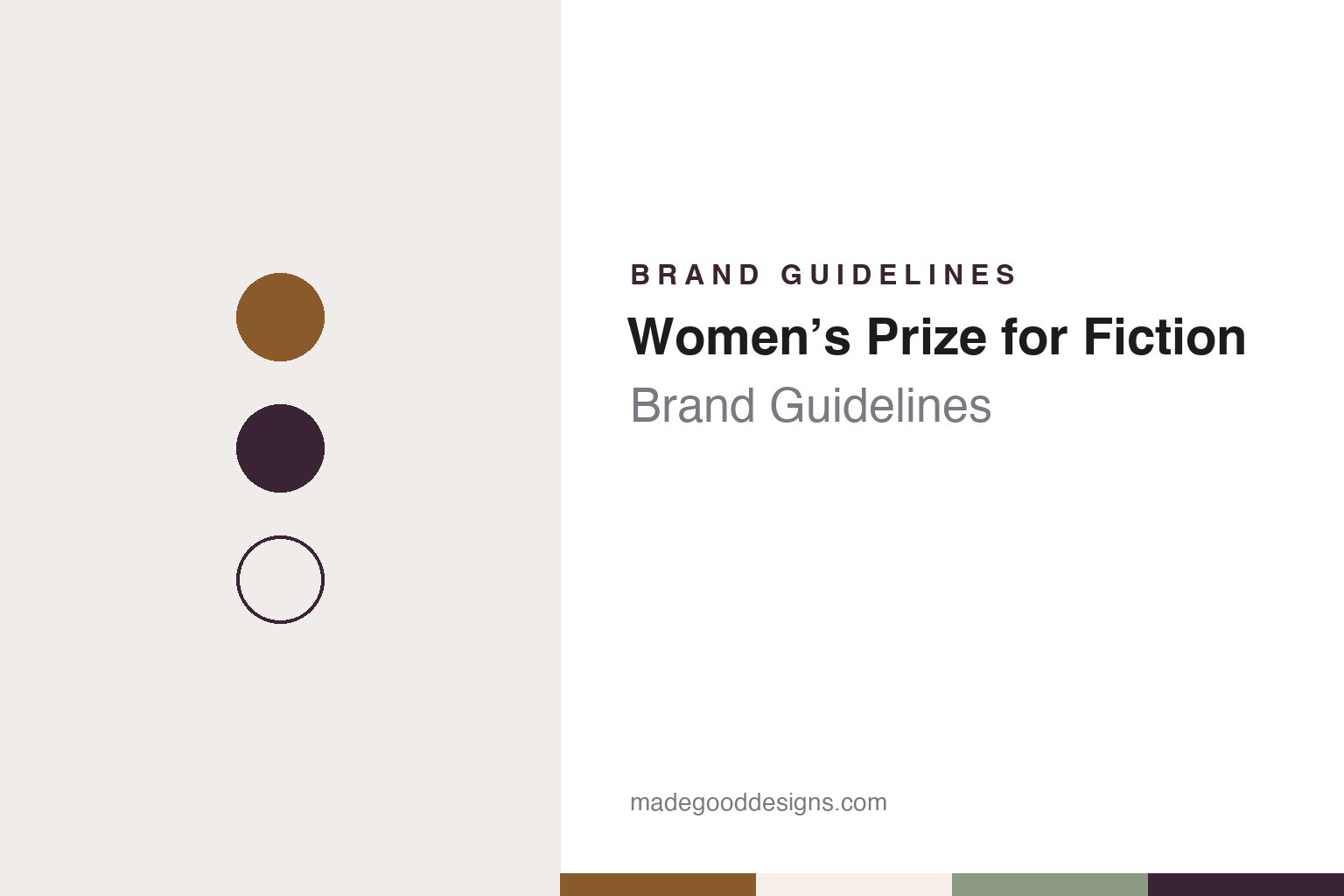
Women’s Prize for Fiction Brand Guidelines
From the Orange Prize to the bronze Bessie.
Aa
Two constants: a bronze, aubergine and blush palette and a display serif register. Abstract homage — not the Bessie statuette or any Women’s Prize logo or mark; nothing of the prize’s own identity is reproduced.
The Orange Prize
A prize set up by people in the book trade.
The Women’s Prize for Fiction is an annual award for a full-length novel written in English by a woman of any nationality and published in the United Kingdom. It was established in 1996. English Wikipedia says it grew out of meetings of people working in the book industry — authors, publishers, agents, booksellers, librarians and journalists — and the prize itself names the novelist Kate Mosse as its co-founder; she is now Founder Director of the Women’s Prize Trust, the charity that runs it, the trust’s website says.
For most of its history the prize carried a sponsor’s name. Its first sponsor was the telecommunications company Orange, and it was called the Orange Prize for Fiction from 1996 to 2006 and again from 2009 to 2012, with the name Orange Broadband Prize for Fiction in 2007 and 2008, English Wikipedia records. Orange ended its sponsorship in May 2012, HuffPost UK reported, and the 2013 prize was run without a title sponsor under the plain name Women’s Prize for Fiction.
On 3 June 2013 HuffPost UK reported a new three-year partnership with the cream liqueur brand Baileys, under which the competition would be known from 2014 as the Baileys Women’s Prize for Fiction. The Wheeler Centre in Melbourne, writing the next day, said more than twenty sponsors had competed for the role and that Baileys had signed for an initial three years. English Wikipedia dates the Baileys name to 2014–2017.
In 2017 the prize changed its model. Its own announcement that year said that from 2018 it would be supported by a “family of sponsors,” a group of businesses from different sectors, rather than by a single title sponsor, and that Baileys would be part of that family. English Wikipedia says the name was simplified to Women’s Prize for Fiction from 2018, and lists Baileys and Audible among the sponsors as of 2023.
Colour
Five women, sixteen books, six, one.
The prize describes its cycle in some detail. The process begins in the summer of the year before the award, when UK publishers are invited to submit eligible books. A panel of five women, appointed each year, reads them and chooses a longlist of sixteen, a shortlist of six and one winner. The prize says the judges work to three tenets that have stayed the same since it was founded: excellence, originality and accessibility.
English Wikipedia describes the usual timetable as a longlist around March and a shortlist later in spring, with the winner announced in June. The ceremony has been held in London. In June 2013 HuffPost UK reported that the announcement would be streamed live from the Clore Ballroom at the Royal Festival Hall on the South Bank, and the prize’s 2017 announcement placed that year’s ceremony at the Royal Festival Hall on 7 June 2017. More recently the prize says its winners for fiction and non-fiction are revealed together at the Women’s Prize Trust’s annual summer party in Bedford Square Gardens in London.
The prize’s object is a statuette rather than a medal. The winner receives the Bessie, a bronze statuette created and donated by the artist Grizel Niven, according to the prize; English Wikipedia also describes it as a bronze sculpture by Niven, and HuffPost UK referred to it in 2013 simply as “the Bessie” award.
Around the main prize the organisers have run other programmes. English Wikipedia lists several that grew out of it in the Orange years, including the Orange Award for New Writers and a readers’ group prize, and notes a list of fifty contemporary “essential reads” chosen in 2004 by a sample of people attending the Hay Festival. The trust’s website today also describes development work for writers, including Discoveries, a programme for unpublished writers.
Typography
How book prizes present themselves.
Literary and book prizes present themselves through a small set of recurring elements. The first is the name. Some carry a namesake, a writer, illustrator or benefactor whose name stands in the title; some carry the name of a foundation, a society, a library association or a university that runs them; and some carry a sponsor’s name, which can change with the sponsorship while the rest of the title stays the same.
The second is an object. Many prizes give a medal, a statuette or a trophy, and some give that piece a name of its own, presented again each year.
The third is the calendar. Most prizes follow a yearly cycle: a call for submissions or an eligibility period, a longlist, a shortlist and an announcement, often at a ceremony or dinner in a fixed month and city. Judges, juries, panels or members’ votes decide each stage, as each organiser describes it, and the names of the levels — longlist, shortlist, honour, winner — become part of how the prize is presented.
Finally, prizes are carried by the places around them. Ceremonies, broadcasts, festivals, bookshop displays and library lists repeat the name and its colours through the year. This guide looks at how each prize sets out those elements: its founders and organiser, its names over time, its cycle and levels, and the object it hands over.
Aa
A display serif with a bronze accent. (Specimen set in DM Serif Display, a serif STAND-IN; NOT the Women’s Prize logo or its typeface.)
The Women’s Prizes
A non-fiction sister prize from 2024.
The trust now runs two annual prizes under the same name. On 9 February 2023 the University of Glasgow reported that the Women’s Prize Trust, the UK charity behind the Women’s Prize for Fiction, had announced its intention to create an annual Women’s Prize for Non-Fiction, and that research by the university’s CREATe centre on authors’ earnings had informed the decision. English Wikipedia says the non-fiction prize was first awarded in 2024, and that its winner receives a separate statuette, “The Charlotte,” supplied by the Charlotte Aitken Trust, which also funded the non-fiction award for its first three years.
The two prizes share a calendar. The prize’s own page says the winners of the Women’s Prizes for Fiction and Non-Fiction are revealed on the same evening in June, at the trust’s summer party. English Wikipedia also records a one-off Women’s Prize Outstanding Contribution Award in 2025, for a living writer’s body of work, open to authors who had been longlisted, shortlisted or had won the fiction prize over three decades and had published at least five books.
Across its names — Orange Prize for Fiction, Orange Broadband Prize for Fiction, Baileys Women’s Prize for Fiction and Women’s Prize for Fiction — the prize has kept the same core: a novel in English by a woman, published in the UK, judged by a panel of five women, with the Bessie for the winner. Since 2018 the sponsor names have sat beside the prize rather than in its title.
For a design guide, the Women’s Prize for Fiction shows how a prize can move from a sponsor’s name to a name of its own and keep a single sculpted object at the centre of its identity. Compare the Booker Prize, another London fiction prize with a longlist, a shortlist of six and a statuette, and the Hay Festival, where the 2004 reading list was chosen. For this guide we use bronze, aubergine and blush with a serif, an unofficial interpretation; no product or logo is reproduced.
Explore & save
Keep Women’s Prize for Fiction’s identity on hand — save it to a board in the Made Good inspiration library.
Women’s Prize identity set
Pin the Women’s Prize for Fiction bronze, aubergine and blush palette and the display serif register to your own board.
Source & notes
Frequently Asked Questions
What font can I use to match the Women’s Prize for Fiction look?
This guide describes Women’s Prize for Fiction’s type as “A display serif with a bronze accent”. Its type specimen is set in DM Serif Display from Google Fonts as a stand-in; DM Serif Display is not Women’s Prize for Fiction’s own lettering.
What colours are in the Women’s Prize for Fiction palette?
This guide’s Women’s Prize for Fiction palette is Bronze #8A5A2B, Aubergine #3A2433, Blush paper #F6EEE9, Sage #8C9A84 and Paper #FBF8F5. The tones are the guide’s own unofficial interpretation, not official Women’s Prize for Fiction hex codes.
When was Women’s Prize for Fiction founded?
Women’s Prize for Fiction was founded in 1996 (as the Orange Prize for Fiction), in London, UK.