American Music Awards Brand Guidelines
Dick Clark’s fan-voted awards, first held in 1974.
Aa
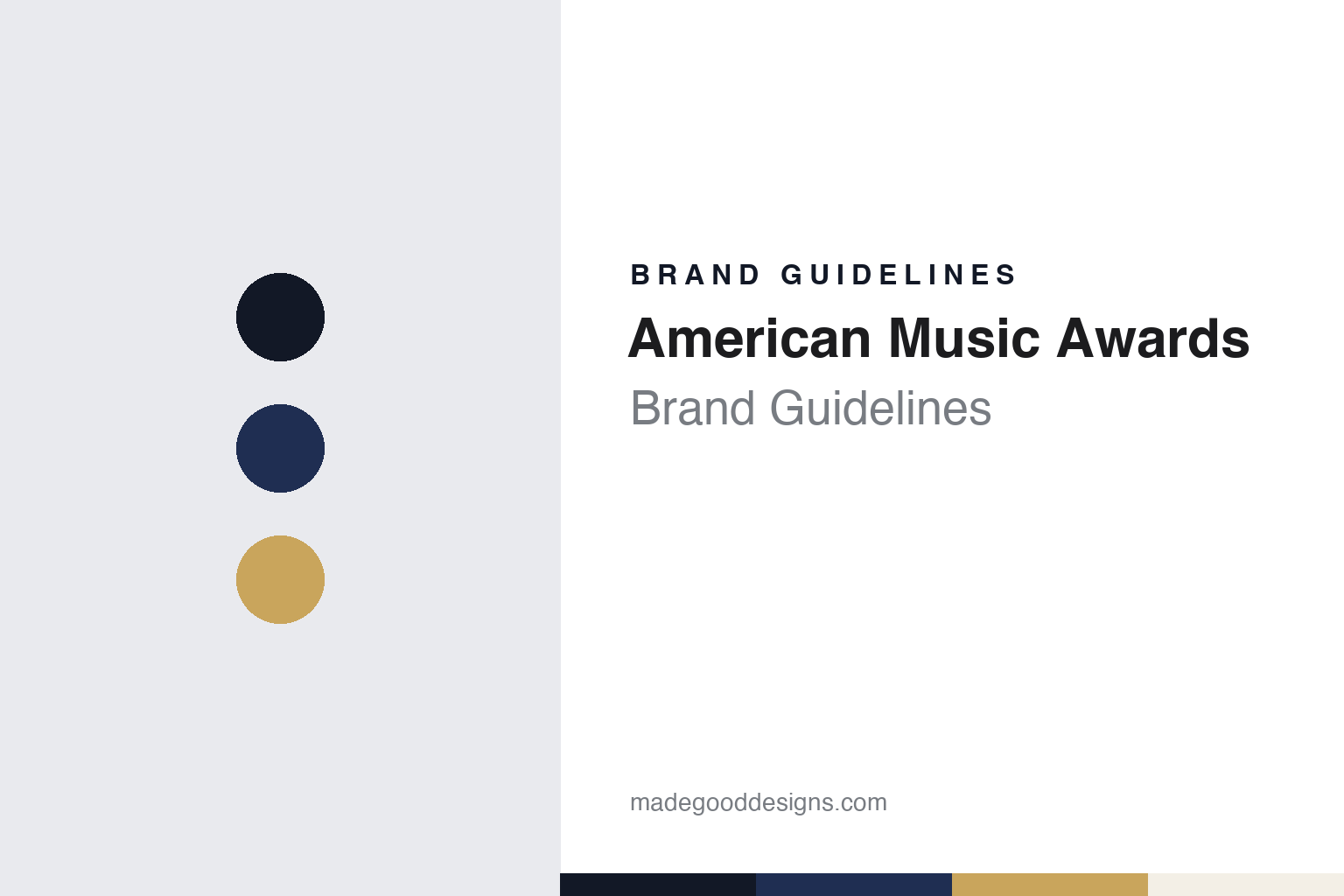
Two constants: a navy, gold and ivory palette and a high-contrast serif register. Abstract homage — not an American Music Awards asset; no statuette, logo or mark is reproduced.
A fan-driven alternative
Dick Clark, ABC and February 1974.
The American Music Awards, shortened to the AMAs, were created by the television producer Dick Clark and first presented on 19 February 1974. Billboard, looking back in October 2024, described the show as having debuted that night “as a fan-driven alternative to the Grammy Awards,” and recalled that Clark had announced it in a page-one interview in its issue of 15 December 1973, under the headline “ABC-TV Slates Favorite Acts’ Awards Feb. 19.” English Wikipedia says Clark created the show in 1973, after ABC’s contract to air the Grammy Awards ended and that ceremony moved to CBS.
The awards have always been produced by Dick Clark Productions, the company Clark founded, English Wikipedia says. The production company itself has changed hands several times: English Wikipedia records sales in 2007 and 2012, a period inside the media group MRC, during which the Dick Clark Productions name was dropped in September 2021 and then restored when that merger was unwound in August 2022, and a purchase in January 2023 by Penske Media Eldridge. Billboard reported in April 2026 that Dick Clark Productions is owned by Penske Media Eldridge, a joint venture between Eldridge Industries and Penske Media, the parent company of Billboard.
The calendar has moved over the decades. English Wikipedia says the first two ceremonies, in 1974 and 1975, were held in February; from 1976 the show was usually held in mid- to late January; and from late 2003 it moved to November, usually the Sunday before Thanksgiving. In 2014, it adds, the Spanish-language network Telemundo acquired the rights to produce a Spanish-language version, launched in 2015 as the Latin American Music Awards.
Colour
From ABC to CBS, from November to May.
ABC carried the AMAs from the first ceremony until 2022. English Wikipedia says that after the 2022 ceremony, when ABC’s broadcast rights ended, the awards went on hiatus, and that in March 2024 CBS acquired the rights as part of a package with the Golden Globe Awards, which Dick Clark Productions also produces. In place of a 2024 ceremony, CBS aired the American Music Awards 50th Anniversary Special on 6 October 2024, a two-hour retrospective that Billboard reviewed the next day. English Wikipedia says CBS renewed its rights in August 2025 under a five-year agreement.
The relaunched show moved to Memorial Day weekend in May and to Las Vegas. The Hollywood Reporter reported on 12 March 2026 that the 2025 edition had been held on Memorial Day at Fontainebleau Las Vegas, and that CBS and Dick Clark Productions had announced the 52nd American Music Awards for Memorial Day, 25 May 2026, at the MGM Grand Garden Arena, live on CBS and streaming on Paramount+.
Selection works in two stages. Nominations, Billboard reported in April 2026, are based on fan interactions, including streaming, album and song sales, radio airplay and tour grosses, tracked by Billboard and Luminate over an eligibility period that for 2026 ran from 21 March 2025 to 26 March 2026. Winners are then chosen by fan votes. For 2026, the nominees were announced on 14 April and voting ran on the VoteAMAs.com site and the AMAs Instagram profile until 8 May, with two categories, social song of the year and tour of the year, open into the first half-hour of the broadcast, Billboard reported.
The categories are arranged by genre. The Hollywood Reporter counted 50 for 2026. Billboard grouped them as genre-neutral awards such as artist, album, song and tour of the year, followed by pop, country, hip-hop, R&B, Latin and rock or alternative categories and a group for other genres, including dance and electronic, K-pop, Afrobeats and, new in 2026, Americana and folk. Over the years the show has also given honorary awards; English Wikipedia lists the Award of Merit, the International Artist Award of Excellence, the Icon Award, introduced in 2013, and the Dick Clark Award for Excellence, first given in 2014. English Wikipedia says the statuette is made by the awards maker Society Awards.
Typography
Music, screen and media awards.
Music, screen and media awards usually carry the name of the body behind them. Some are run by a television network, which both organises the night and broadcasts it; others by a trade association, an academy, a guild of performers, a critics’ association or a university. That organiser sets the rules, the eligibility period and the voting method, and its name or initials often become the programme’s nickname — CMAs, VMAs, AMAs — long before anyone reads the full title.
Most programmes follow a yearly cycle. Work released within a fixed window, sometimes twelve months that do not match the calendar year, becomes eligible; a first ballot or submission round produces nominees; and a later vote or jury decision picks the winners in each category. Depending on the programme, the voters may be the organiser’s professional members in several rounds, a voting academy of industry and media figures, a panel or jury, or the public through fan votes.
The ceremony itself is usually built for television or streaming. Many awards keep a regular month and a regular venue for years at a time, and some of the categories are presented on air while others are handed out separately or announced in advance. Special honours, such as lifetime achievement awards, sit alongside the competitive categories.
The most constant visual element is often the object handed to winners. A named statuette, a sculpted star or a crystal trophy can outlast every change of logo, host city or broadcaster, and organisers often tell the story of its shape, material and maker. The guides in this group describe those programmes plainly: who runs them, how their categories and voting work, and how their trophies and names present them, without listing winners.
Aa
A high-contrast serif for a long-running television awards show. (Specimen set in Playfair Display, a serif STAND-IN; NOT the American Music Awards logo.)
American Music Awards
A producer’s show, decided by the public.
The AMAs are a producer’s creation rather than an academy’s. They are not run by a membership body: they belong to the production company that makes the broadcast, and the people who choose the winners are members of the public voting online. That arrangement goes back to Clark’s own description of his plan in December 1973, which Billboard quoted in 2024: a show that would “finally get the general public involved in popular music awards.”
The data behind the nominations has also changed. English Wikipedia says that before 2010 nominations were based only on sales and airplay; since then they have also drawn on social-media activity and video viewing, and by 2026 Billboard listed streaming, sales, airplay and tour grosses as the measures, tracked by Billboard and Luminate. Sponsors have occasionally entered the show itself: English Wikipedia says that between 2012 and 2014, as part of a sponsorship by Samsung Electronics, winners were revealed on the lock screens of Samsung Galaxy phones instead of in envelopes.
The name has been the constant. The short form, AMAs, is used by the organiser, which runs its fan voting through the VoteAMAs.com site and an AMAs Instagram profile, and by the press, including Billboard and The Hollywood Reporter. Around that name the show has moved from ABC to CBS, from January to November and then to May, and since 2025 to Las Vegas, while keeping the same title since 1974.
For a design guide, the American Music Awards show how a television awards brand can hold one name for half a century while its network, month and city change around it. Compare Billboard, whose charts track the data behind the nominations, and CBS, the show’s broadcaster since 2024. For this guide we use navy, an old gold and ivory with a serif, an unofficial interpretation; no product or logo is reproduced.
Explore & save
Keep American Music Awards’s identity on hand — save it to a board in the Made Good inspiration library.
American Music Awards identity set
Pin the navy, gold and ivory palette and the high-contrast serif register to your own board.
Source & notes
Frequently Asked Questions
What font can I use to match the American Music Awards look?
This guide describes American Music Awards’ type as “A high-contrast serif for a long-running television awards show”. Its type specimen is set in Playfair Display from Google Fonts as a stand-in; Playfair Display is not American Music Awards’ own lettering.
What colours are in the American Music Awards palette?
This guide’s American Music Awards palette is Midnight ink #121826, Stage navy #1F2E52, Old gold #C9A55C, Ivory #F3EFE6 and Paper #FAF9F6. The tones are the guide’s own unofficial interpretation, not official American Music Awards hex codes.
Who founded American Music Awards?
American Music Awards was founded by Dick Clark.