Brit Awards Brand Guidelines
The BPI’s music awards, from Wembley in 1977 to Manchester.
Aa
Two constants: a stage black, amber and coral palette and a condensed sans register. Abstract homage — not a Brit Awards statuette or mark; no trophy, logo or figure is reproduced.
From Wembley to Manchester
A record-industry show that became the BRITs.
The Brit Awards are the annual popular-music awards of the BPI, the trade body for the UK’s recorded-music industry, as Pollstar described it in June 2025. The organiser writes the name in capitals, as “The BRIT Awards,” and shortens it to “the BRITs.” In the BPI’s announcements of 2025 and 2026 the full title carries a sponsor’s name: “The BRIT Awards with Mastercard.”
The first ceremony was held in 1977. Billboard reported in June 2025 that it took place at the Wembley Conference Centre and that the event became a yearly fixture from 1982. English Wikipedia says the 1977 awards marked the Queen’s Silver Jubilee under the title “The BRITish Record Industry BRITannia Awards” and were televised by Thames Television. The ceremonies of the 1980s ran as the BPI Awards; English Wikipedia says the name changed to the BRIT Awards in 1989, and that “BRIT” began as a short form of “British,” “Britain” or “Britannia,” the last linked to early sponsorship by the Britannia Music Club, before being treated as standing for British Record Industry Trusts Show.
For most of their history the awards stayed in London. Billboard listed the venues as the Grosvenor House Hotel from 1982 to 1987, Alexandra Palace from 1993 to 1995, Earls Court from 1996 and the O2 Arena from 2012; English Wikipedia dates the last Earls Court show to 2010 and the move to the O2 to 2011. In June 2025 the BPI announced that the ceremony would move to Co-op Live in Manchester, the first time it had been held outside the capital, as Billboard and Pollstar reported.
Colour
An academy, a committee and a new trophy each year.
The awards cover British and international music. At the 2026 ceremony the BPI listed the four main “of the Year” awards for artist, album, song and group; a Breakthrough Artist award; international awards for artist, group and song; and genre awards for pop, alternative and rock, hip hop, grime and rap, dance, and R&B acts. Some honours are announced before the show, among them Producer of the Year and the Critics’ Choice award, and others recognise careers, such as Songwriter of the Year and Outstanding Contribution to Music.
English Wikipedia, citing the BRITs’ website, says the list of eligible artists, albums and singles is compiled by the Official Charts Company and put to a voting academy of more than 1,000 members of the music industry, including the previous year’s nominees and winners; votes are cast online and scrutinised by Electoral Reform Services. Fan voting was dropped after 2019 and brought back in 2022, it adds. In March 2026 the BPI said two song awards that year were decided by fans voting through WhatsApp, as part of a partnership with Meta.
The running of the show is shared among the major record companies. Billboard reported in June 2025 that stewardship rotates between the three major labels and that 2026 opened a three-year stewardship under Sony Music UK. A BRIT Committee directs the show; its chair oversees performer bookings, hosts, show creative and categories, according to Pollstar.
The trophy is a statuette of Britannia, the female personification of Britain, English Wikipedia says. Its look changes: Dezeen reported in November 2025 that the organisers choose a different designer to create the statuette for each year’s awards, and the BPI’s list of past designers runs from artists and fashion designers to architects, among them Zaha Hadid.
For 2026 the commission went to the Manchester-born designer Matthew Williamson. The BPI and Dezeen describe a statuette cast in amber-toned resin, a reference to the worker bee of Manchester’s city emblem, standing on a globe that Williamson said represents the worldwide reach of British music.
Typography
Prizes, juries and ceremonies.
Music, screen and media awards usually carry the name of the body behind them. Some are run by a television network, which both organises the night and broadcasts it; others by a trade association, an academy, a guild of performers, a critics’ association or a university. That organiser sets the rules, the eligibility period and the voting method, and its name or initials often become the programme’s nickname — CMAs, VMAs, AMAs — long before anyone reads the full title.
Most programmes follow a yearly cycle. Work released within a fixed window, sometimes twelve months that do not match the calendar year, becomes eligible; a first ballot or submission round produces nominees; and a later vote or jury decision picks the winners in each category. Depending on the programme, the voters may be the organiser’s professional members in several rounds, a voting academy of industry and media figures, a panel or jury, or the public through fan votes.
The ceremony itself is usually built for television or streaming. Many awards keep a regular month and a regular venue for years at a time, and some of the categories are presented on air while others are handed out separately or announced in advance. Special honours, such as lifetime achievement awards, sit alongside the competitive categories.
The most constant visual element is often the object handed to winners. A named statuette, a sculpted star or a crystal trophy can outlast every change of logo, host city or broadcaster, and organisers often tell the story of its shape, material and maker. The guides in this group describe those programmes plainly: who runs them, how their categories and voting work, and how their trophies and names present them, without listing winners.
Aa
A condensed sans for a capitalised acronym. (Specimen set in Barlow Condensed, a sans STAND-IN; NOT the Brit Awards logo.)
The BRITs
Thames, the BBC and ITV.
Television has carried the awards through most of their history. English Wikipedia says the 1982 to 1984 shows were not televised, the BBC broadcast the ceremony from 1985, and the 1988 awards were the first shown live. The BBC kept the renamed show, live in 1989 and pre-recorded from 1990 to 1992. ITV has broadcast the awards since 1993, pre-recorded until 2006 and live from 2007, and BBC Radio 1 has provided backstage radio coverage since 2008, it adds.
ITV stayed with the show for the move north. Pollstar reported in June 2025 that the 2026 ceremony would be broadcast on ITV1, ITVX, STV and STV Player, and the BPI’s roundup of 1 March 2026 says UK viewers could also watch on ITV’s YouTube channel, while viewers outside the UK followed on the BRITs’ own YouTube channel for the thirteenth year. The 2026 ceremony took place on 28 February 2026 at Co-op Live, in a show of about two and a half hours with performances across five stages inside the arena, the BPI said.
The calendar around the ceremony has its own fixtures. English Wikipedia says ITV for many years aired a January launch show, The BRITs Are Coming, which revealed some of the nominees; from 2024 it was renamed Bring on The BRITs and streamed on the BRITs’ Instagram and Facebook accounts. A classical counterpart, the Classic BRIT Awards, was held annually from 2000 to 2013 and once more in 2018, English Wikipedia says.
In the BPI’s own usage the capitalised “BRIT” and the plural “BRITs” appear in event titles, launch-show names and the sponsor line, while the statuette keeps one figure, Britannia, and changes its maker from year to year.
For a design guide, the Brit Awards show a programme whose acronym, Britannia figure and changing trophy carry the identity from year to year. Compare the ITV guide, the broadcaster of the ceremony since 1993, and the Peabody Awards, whose medallion keeps a single sculpted design. For this guide we use stage black, amber and coral with a condensed sans, an unofficial interpretation; no product or logo is reproduced.
Explore & save
Keep Brit Awards’s identity on hand — save it to a board in the Made Good inspiration library.
Brit Awards identity set
Pin the stage black, amber and coral palette and the condensed sans register to your own board.
Source & notes
Frequently Asked Questions
What font can I use to match the Brit Awards look?
This guide describes Brit Awards’ type as “A condensed sans for a capitalised acronym”. Its type specimen is set in Barlow Condensed from Google Fonts as a stand-in; Barlow Condensed is not Brit Awards’ own lettering.
What colours are in the Brit Awards palette?
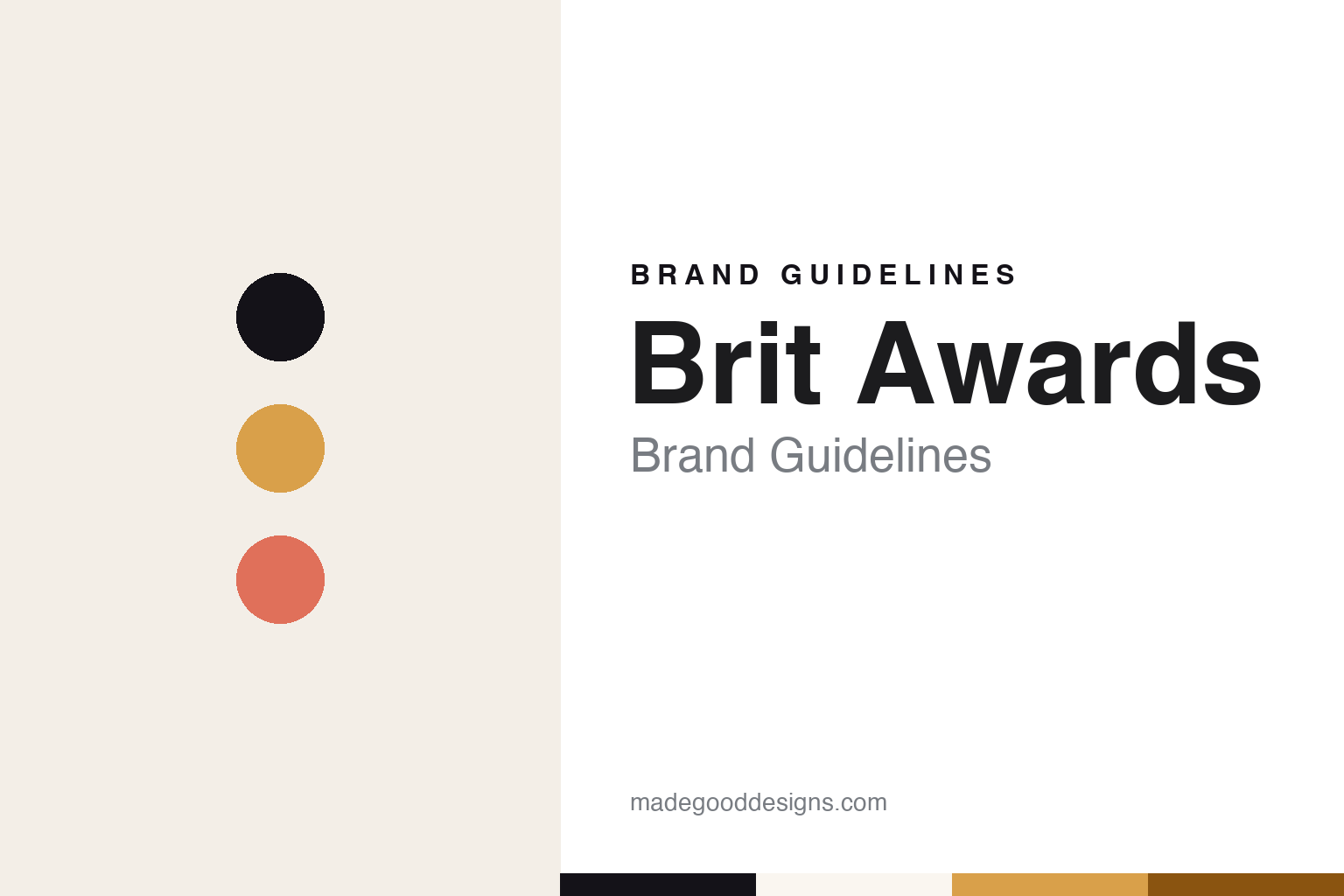
This guide’s Brit Awards palette is Stage black #141218, Dark amber #8A5410, Amber resin #D9A04A, Coral #E0705A and Paper #FAF6F0. The tones are the guide’s own unofficial interpretation, not official Brit Awards hex codes.
When was Brit Awards founded?
Brit Awards was founded in 1977 (yearly from 1982), in London, UK.