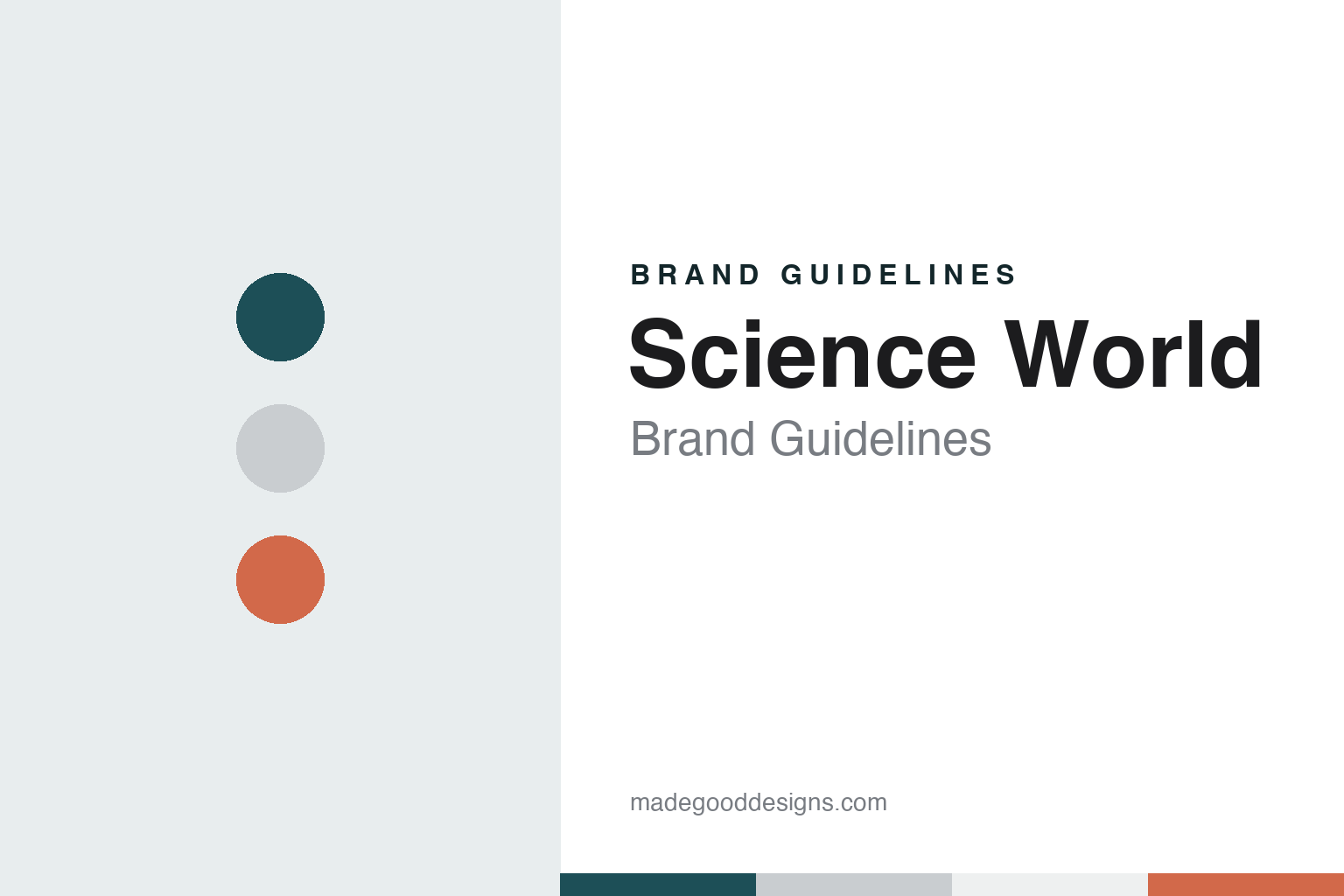
Science World Brand Guidelines
A world’s fair dome on False Creek that was built to come down and stayed.
Aa
Two constants: a creek teal, aluminium and coral palette and a geometric sans register. Abstract homage — not a Science World asset; no building image, logo or sign is reproduced.
Expo Centre
A world’s fair dome on False Creek.
Science World is a science centre at the eastern end of False Creek in Vancouver, British Columbia, run by the not-for-profit ASTC Science World Society, according to English Wikipedia; the organisation describes itself as a charitable non-profit. It opened as Science World on 6 May 1989, in a building made for a world’s fair.
Its roots are older than the building. English Wikipedia says that from 1977 a programme of mobile hands-on exhibits called the Extended I toured British Columbia’s Lower Mainland, and that a temporary Arts, Sciences & Technology Centre opened in downtown Vancouver on 15 January 1982, with outreach programmes delivered around the province.
The building was the Expo Centre of Expo 86, the transportation-themed world’s fair held on the shores of False Creek for Vancouver’s centenary. The Vancouver Heritage Foundation says it opened in 1985 as the Expo Preview Centre and became the Expo Centre when the fair opened in 1986. It was designed by the fair’s architect, Bruno Freschi, as the visual anchor at the eastern end of the creek and the marker of the fair’s main entrance, and Freschi placed it on the axis of Georgia Street as a symbolic link to the Jubilee Fountain at Lost Lagoon, the foundation’s Places That Matter page says. During the fair the dome held an Omnimax theatre, which the foundation’s plaque calls Canada’s first, while the rest of the building housed exhibits on the future of transportation and technology.
The dome was meant to be temporary. Science World’s own history, published in September 2020, says Freschi designed it as a structure to be taken down after the fair, and that community members organised as a non-profit saw it as a permanent home for a science centre; when the dome was acquired, that non-profit became A.S.T.C. Science World. The Georgia Straight made the same point in April 2026, describing the dome as originally intended to be temporary. A four-month preview of the converted building ran in 1988, English Wikipedia says, before the opening in May 1989.
Colour
Aluminium triangles and a steel frame.
The dome is a geodesic sphere, a form the Vancouver Heritage Foundation credits to the American inventor Buckminster Fuller. The foundation’s Heritage Site Finder, citing a 2018 City of Vancouver report, says it was built from 766 aluminium triangles supported by an outer frame of white steel; Science World describes it as 17 storeys tall. English Wikipedia dates construction from 1984 to early 1985. The additions that turned the Expo Centre into Science World were designed by the architect Boak Alexander, according to the Heritage Site Finder, and after the conversion an Omnimax theatre filled the upper part of the dome.
The building’s heritage status is on record. The Heritage Site Finder says Science World was added to the Vancouver Heritage Register as an A-listed building in 2019, citing its unusual architecture, its architect, its association with Expo 86 and its continued use as a science centre, and that the Vancouver Heritage Foundation marked it with a Places That Matter plaque in 2013.
Inside, Science World lists permanent galleries including Eureka!, on light, sound, fluids and machines; BodyWorks, on the human body; Search: The Sara Stern Gallery, on natural history; and Puzzles & Illusions. Its exhibition pages also name a Creative Technology gallery, the Tinkering Space for making and building, and Wonder, an early-learning gallery for children up to five. Outside, the Ken Spencer Science Park, which English Wikipedia says opened in late 2012 after a renovation that followed the 2010 Winter Olympics, deals with food, water and energy. Feature exhibitions change through the year alongside the permanent galleries.
Typography
How science centres present themselves.
Science centres and planetariums tend to present themselves through a small set of parts. Many trace their origins to a founding body: a learned society or academy, a city, a state agency or a non-profit formed to build a museum. That origin often stays in the name, in words such as “academy,” “institute” or “center,” even when the institution itself has changed a great deal since its founding.
The building often carries much of the identity. A geodesic dome, a tower, a set of arches or a planted roof can become the outline by which a centre is recognised in photographs, on signs and in its own publicity. A dome that began as a film theatre may later become a digital planetarium without any change to its shape, so the silhouette outlasts the technology inside it.
Inside, the offer is broadly similar from one centre to the next: hands-on galleries arranged by theme, a planetarium or dome theatre, and sometimes an aquarium, live animals or a living collection of plants. Around these sit programmes for schools and families, such as field trips, workshops, summer camps and training for teachers, along with evening events for adults. An institution that also does research, such as a natural history academy, adds collections and laboratories that visitors rarely see.
A name may change with a new building, a merger or a sponsor, and an older name may later return. For a designer, the useful constants are the founding story, the shape of the building and the plain description of what visitors find inside; the palettes and typefaces in these guides are our own unofficial interpretations, not the institutions’ own.
Aa
A geometric sans to echo a triangulated sphere. (Specimen set in Figtree, a sans STAND-IN; NOT the Science World logo.)
Science World
A name lent and returned.
The centre’s name has changed with a sponsor. English Wikipedia says the building was renamed “Telusphere” in January 2005 under a naming-rights agreement with the telecommunications company TELUS, and that from mid-2005 the centre was called Science World at TELUS World of Science; the TELUS World of Science brand was also used for science centres in Calgary and Edmonton. The agreement ended in 2020, when the centre dropped “TELUS World of Science” and returned to the plain name Science World, English Wikipedia says. The nearby SkyTrain station kept the name Main Street–Science World throughout.
Earlier, from 1996, the aluminium company Alcan held a title sponsorship of the Omnimax theatre, which was renamed the Alcan Omnimax Theatre before returning to its original name, English Wikipedia adds.
The dome works as a sign as well as a building. The Georgia Straight reported in April 2026 that its exterior lighting had been upgraded to 651 LED bulbs and that the dome is lit as a jack-o’-lantern at Halloween and as a soccer ball when the Vancouver Whitecaps play at home; English Wikipedia says the exterior was dressed as a soccer ball in May 2026 for the FIFA World Cup, which Vancouver co-hosted. The same Straight article described a display of Expo-era memorabilia in the atrium for the fair’s 40th anniversary. Beyond the dome, Science World runs outreach across the province, including On the Road, in which staff take workshops and science shows to schools and communities, English Wikipedia says.
For a design guide, Science World shows how a temporary world’s fair building can become a lasting emblem, and how a name can be lent to a sponsor and taken back while the silhouette stays the same. Compare Pacific Science Center in Seattle, which reused the United States Science Pavilion of the 1962 world’s fair, and NEMO Science Museum in Amsterdam, another hands-on science centre. For this guide we use a deep teal, aluminium grey and a sunset coral with a sans, an unofficial interpretation; no product or logo is reproduced.
Explore & save
Keep Science World’s identity on hand — save it to a board in the Made Good inspiration library.
Science World identity set
Pin the Science World creek teal, aluminium and coral palette and the geometric sans register to your own board.
Source & notes
Frequently Asked Questions
What font can I use to match the Science World look?
This guide describes Science World’s type as “A geometric sans to echo a triangulated sphere”. Its type specimen is set in Figtree from Google Fonts as a stand-in; Figtree is not Science World’s own lettering.
What colours are in the Science World palette?
This guide’s Science World palette is Creek teal #1D4F57, Aluminium #C9CDD0, Steel white #EEF0F0, Sunset coral #D2694A and Night ink #13262A. The tones are the guide’s own unofficial interpretation, not official Science World hex codes.
When did Science World open?
Science World opened on 6 May 1989, in False Creek, Vancouver, British Columbia.