Pacific Science Center Brand Guidelines
A world’s-fair pavilion that became a science centre the month the fair closed.
Aa
Two constants: a precast white, pool blue and night ink palette and a geometric sans register. Abstract homage — not a Pacific Science Center mark; no logo, sign or building image is reproduced.
A pavilion for Century 21
A federal science building for a world’s fair.
Pacific Science Center began as a building for a world’s fair. In 1960 the Seattle-born architect Minoru Yamasaki was selected to design the United States science exhibit for the Century 21 Exposition, the 1962 Seattle World’s Fair, the centre says. The University of Washington’s Pacific Coast Architecture Database (PCAD) records that the federal pavilion was conceived after the 1957 Sputnik launch to show the country’s commitment to science education, that it was designed with the Seattle firm Naramore, Bain, Brady and Johanson (NBBJ) and the engineers Worthington and Skilling, and that it was built between 1959 and 1962. The centre dates the groundbreaking to February 1961, marked by a radio signal sent from Washington, D.C. that bounced off the Moon and arrived in Seattle.
PCAD says Yamasaki first considered a 110-foot tower for the pavilion but dropped the idea once the Space Needle was chosen for the fairgrounds. Instead he drew on the Swedish Pavilion at the 1939 New York World’s Fair, which was organised around a small garden, and grouped the United States Science Pavilion as interconnected buildings around a courtyard with reflecting pools. English Wikipedia says the fair’s World of Science was one of five theme areas, set at the southern end of the grounds, west of the Space Needle and beside the arches.
After the fair closed in October 1962, the pavilion reopened that month as the non-profit Pacific Science Center. Some exhibits stayed on from the fair, and English Wikipedia names two that remain, the Lens and Mirror Machine and a suspended model of the Moon. The centre says the Pacific Science Center Foundation received title to the buildings and grounds from the federal government in 1974, on condition that they remain a science museum for the next 30 years.
Colour
Precast arches, pools and a courtyard.
The architecture is the centre’s most recognisable feature. PCAD describes buildings of precast concrete and a tower of five arches rising to 110 feet. The Cultural Landscape Foundation describes skeletal, cathedral-like walls that mix a Gothic aesthetic with modern simplicity, set around a courtyard of abstracted Gothic arches, fountains and concrete platforms that appear to float on reflecting pools. In 1963, the centre says, Yamasaki, with the arches and fountains, appeared on the cover of Time.
The design was recognised early and later protected. The City of Seattle designated Pacific Science Center a city landmark in 2010, after a unanimous vote of its Landmarks Preservation Board, the centre says; the Cultural Landscape Foundation reported the designation in July 2010. The centre says the original cedar-lined pools were refurbished and resealed in 2011.
Inside, the centre has grown in stages. It says the Willard Smith Planetarium opened in 1977, and today it presents live, presenter-led shows on the night sky and the solar system, including a short show for preschool children. In 1979 the Eames Theater, which English Wikipedia says was built for a multi-screen film at the fair, became an IMAX theatre, and the centre says its PACCAR IMAX Theater was first fitted with film in 1979 and converted to digital in 2011. A dome first built as the Spacerium, according to English Wikipedia, is now the Laser Dome, used for laser shows; the centre says laser equipment was first installed in 1974, alongside a renovation of Building 4, after it gained title to the site. In the 1990s, the centre says, it added the Ackerley Family Exhibit Gallery, a second IMAX theatre, the Tropical Butterfly House and the Kiewit Pavilion.
Typography
Science centres and planetariums.
Science centres and planetariums tend to present themselves through a small set of parts. Many trace their origins to a founding body: a learned society or academy, a city, a state agency or a non-profit formed to build a museum. That origin often stays in the name, in words such as “academy,” “institute” or “center,” even when the institution itself has changed a great deal since its founding.
The building often carries much of the identity. A geodesic dome, a tower, a set of arches or a planted roof can become the outline by which a centre is recognised in photographs, on signs and in its own publicity. A dome that began as a film theatre may later become a digital planetarium without any change to its shape, so the silhouette outlasts the technology inside it.
Inside, the offer is broadly similar from one centre to the next: hands-on galleries arranged by theme, a planetarium or dome theatre, and sometimes an aquarium, live animals or a living collection of plants. Around these sit programmes for schools and families, such as field trips, workshops, summer camps and training for teachers, along with evening events for adults. An institution that also does research, such as a natural history academy, adds collections and laboratories that visitors rarely see.
A name may change with a new building, a merger or a sponsor, and an older name may later return. For a designer, the useful constants are the founding story, the shape of the building and the plain description of what visitors find inside; the palettes and typefaces in these guides are our own unofficial interpretations, not the institutions’ own.
Aa
A geometric sans for white arches and long pools. (Specimen set in Jost, a sans STAND-IN; NOT the Pacific Science Center logo.)
Pacific Science Center
PacSci, under the arches.
Pacific Science Center describes itself as a non-profit science education organisation, and English Wikipedia places its museum at the southwest corner of Seattle Center, the city-owned civic campus that grew from the fairgrounds. Its galleries today include Science on a Sphere, Destination: Outer Space, Brainy Bodies, a Maker & Innovation Lab and the Tropical Butterfly House, the centre says, alongside changing exhibitions. Beyond Seattle Center it runs Science on Wheels, founded in 1974, which began with staff carrying portable exhibits to schools in their own cars and now uses a fleet of vans, and the Mercer Slough Environmental Education Center in Bellevue, opened in 1993 with the City of Bellevue on a 320-acre stretch of marsh, woods and meadow and expanded in 2008. It also lists field trips, camps, homeschool workshops and evening events for adults. In 2013, English Wikipedia says, a call for public art on solar energy led to Sonic Bloom, five flower sculptures about 10 metres tall by a Seattle artist, which carry solar panels in their flower heads and light up at night.
The centre uses the short name PacSci across its website, and its exhibits page invites visitors to explore “under the PacSci Arches.” Since 2022, the centre says, the arches have been lit on game days for the Seattle Kraken ice hockey team, in a partnership with Amazon Web Services.
For a design guide, Pacific Science Center shows how a world’s-fair building can become an institution’s identity: white precast arches, long pools and a courtyard that have framed the centre since 1962. Compare the Space Needle, which also came from the 1962 Seattle World’s Fair, and the Exploratorium, a hands-on science museum in San Francisco. For this guide we use a precast white, a pool blue and a night ink with a geometric sans, an unofficial interpretation; no product or logo is reproduced.
Explore & save
Keep Pacific Science Center’s identity on hand — save it to a board in the Made Good inspiration library.
Pacific Science Center identity set
Pin the Pacific Science Center precast white, pool blue and night ink palette and the geometric sans register to your own board.
Source & notes
Frequently Asked Questions
What font can I use to match the Pacific Science Center look?
This guide describes Pacific Science Center’s type as “A geometric sans for white arches and long pools”. Its type specimen is set in Jost from Google Fonts as a stand-in; Jost is not Pacific Science Center’s own lettering.
What colours are in the Pacific Science Center palette?
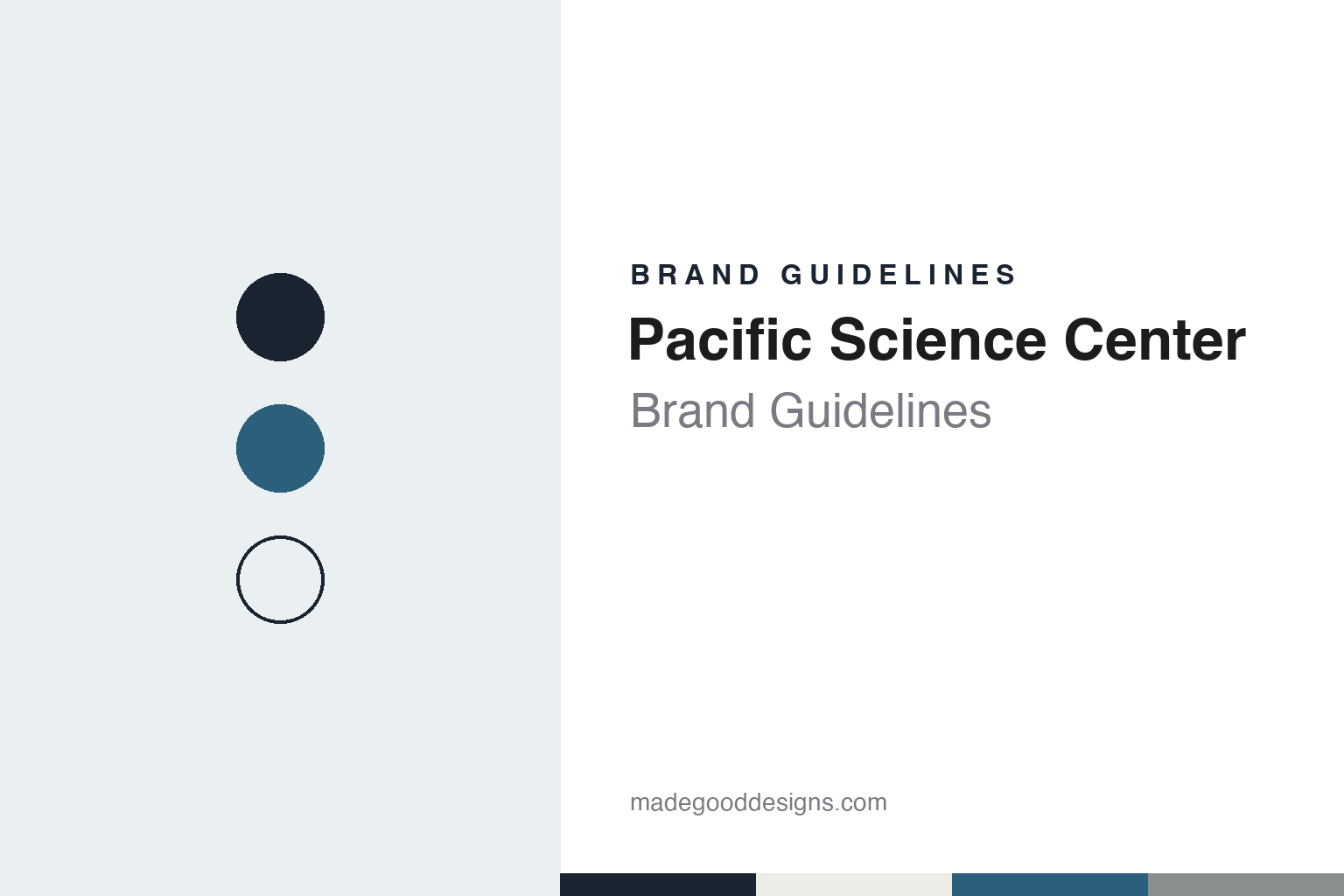
This guide’s Pacific Science Center palette is Night ink #1A2431, Pool blue #2C5F7C, Precast white #EEECE6, Concrete grey #8A8E8C and Cedar moss #5C6B4D. The tones are the guide’s own unofficial interpretation, not official Pacific Science Center hex codes.
When did Pacific Science Center open?
Pacific Science Center opened in October 1962, in Seattle Center, Seattle.