Cité des sciences et de l’industrie Brand Guidelines
The Paris science centre at La Villette, with its mirrored sphere.
Aa
Two constants: a night blue, steel and brick red palette and a structural sans register. Abstract homage — not a Cité des sciences et de l’industrie mark; no logo, sign or building image is reproduced.
La Villette, 1986
An unfinished sales hall becomes a science centre.
The Cité des sciences et de l’industrie (City of Science and Industry) is a science centre in the Parc de la Villette, in the 19th arrondissement of Paris. It opened on 13 March 1986, timed to the passage of Halley’s Comet, according to Universcience, the public body that runs it today. French Wikipedia adds that the Cité was given the status of a public industrial and commercial establishment by a decree of 18 February 1985, at first under the minister responsible for research.
The site had a long earlier life. Universcience’s history says the abattoirs and livestock markets of Paris were brought together at La Villette from 1867, modernised in 1930 and again in 1950, and that construction of a vast sales hall beside the abattoirs began in the 1960s. Work on the hall stopped in 1971, and the last industrial abattoir closed in 1974. In 1977 a government mission began to study the site’s conversion, and in 1979 a public body was created to develop the 55-hectare park, the history says.
On 15 September 1980 the conversion of the unfinished hall into a museum of science and technology was entrusted to the architect Adrien Fainsilber, French Wikipedia says. His design kept part of the reinforced-concrete frame of the abandoned sales hall, and the Cité occupies three of its four bays. The Géode, the spherical cinema beside the main building, opened first, on 6 May 1985, according to Universcience.
In the years that followed the Cité added spaces for particular audiences. The Cité des enfants (Children’s City) opened in 1992, with new versions for children aged two to seven in 2007 and five to twelve in 2009, Universcience says; French Wikipedia dates the Cité des métiers, a careers information centre, to March 1993, and a fab lab and living lab in the Cité’s digital space to March 2014. Since January 2010 the Cité has belonged to Universcience, the public establishment created by decree on 3 December 2009 that groups it with the Palais de la découverte, under the ministries of higher education and research and of culture, Universcience says. Universcience gives the Cité’s attendance in 2025 as 1.7 million visitors.
Colour
A concrete block, a moat and a mirrored sphere.
Universcience describes the building as a monumental concrete block, 250 metres long, 150 metres wide and 50 metres high, set against the 36-metre sphere of the Géode. A 2020 notice in the French culture ministry’s Mérimée heritage database, which lists the Cité under the Architecture contemporaine remarquable (Remarkable Contemporary Architecture) label, adds the details: the building stands in a moat of clear, shallow water; three glazed greenhouses, 32 metres high, project from the south façade in self-supporting structural glass; and the entrance hall was lit by two domes that originally rotated. The same notice credits the landscape plan of the park to the architect Bernard Tschumi and describes the Cité as the façade of the park, the first building seen from its north entrance.
The Géode is linked to the main building by footbridges, the Mérimée notice says, and its geodesic shell is clad in mirror-polished stainless steel; French Wikipedia counts 6,433 steel triangles on the sphere. It first showed films in the OMNIMAX dome format on a giant hemispherical screen. Pathé was selected to take over the cinema in September 2017; it closed from December 2018 and reopened in December 2024 after renovation, French Wikipedia says. The Cité’s own page now describes it as rethought and modernised by Pathé, with science and nature documentaries on the hemispheric screen by day and feature films in IMAX Laser in the evenings and at weekends.
Inside the Cité, the permanent exhibitions, once called Explora, fill levels one and two, French Wikipedia says, with themes including mathematics, sound, space exploration, robots, the brain, genes, video games and climate. Level two also holds a planetarium, which the Cité says now projects with ten video projectors in 8K laser high definition; entry is included in the exhibitions ticket. On level minus two, an aquarium of three tanks shows Mediterranean species, French Wikipedia says.
The building also houses the Bibliothèque des sciences et de l’industrie (Library of Science and Industry), an auditorium, the Cité de la santé information space and the Carrefour numérique², a free digital space. For families, the Cité des enfants has an area for babies and zones for two-to-seven and five-to-ten-year-olds, and Universcience lists temporary and permanent exhibitions, shows, conferences and publications for visitors of all ages.
Typography
Science centres in Europe, Asia and Oceania.
Science centres in Europe, Asia and Oceania tend to introduce themselves first through the body that runs them. Some are foundations, such as Experimentarium in Denmark, which its own website describes as governed by a foundation board; some belong to a bank’s foundation, as CosmoCaixa in Barcelona belongs to the “la Caixa” Foundation; others are run by a city, a national agency or a charity. That name usually sits close to the centre’s own on signs and in print.
The building is often the second introduction. Several centres occupy reused sites: Experimentarium has used a former Tuborg bottling hall in Hellerup since 1991, and CosmoCaixa keeps part of an early twentieth-century modernist asylum in Barcelona. Some stand in new buildings on rivers, harbours or former industrial land, and their architects are part of the story they tell about themselves.
Inside, the vocabulary is shared. Hands-on galleries invite visitors to touch and try exhibits; some add a planetarium, a dome or a giant-screen theatre; and some keep living collections, such as the indoor Amazon forest at CosmoCaixa or rainforest and aquarium zones elsewhere. Programmes for schools and families sit beside the galleries: the Catalan government’s heritage pages say CosmoCaixa runs activities for state schools and families, and Experimentarium lists teaching rooms in its rebuilt house.
Names change too. CosmoCaixa took its present name when the Museu de la Ciència reopened in 2004, and Experimentarium ran a temporary branch, Experimentarium City, while its Hellerup building was rebuilt before reopening in 2017. This guide sets out, for each centre, who runs it, where it stands, what is inside and how its name has changed, using dated sources, and treats its colours and type as an unofficial interpretation.
Aa
A structural sans, plain like the exposed frame of the building. (Specimen set in IBM Plex Sans, a sans STAND-IN; NOT the Cité des sciences et de l’industrie logo.)
Cité des sciences et de l’industrie
From a red square to a new logotype.
The Cité’s graphic identity has changed along with its institutions. At its opening in 1986, French Wikipedia says, it used the shared identity created by Pierre Bernard of the Grapus collective for the public body of La Villette, which covered the park, the Cité de la musique and the Cité des sciences, with a square lit in red standing for the science centre. A few years later the Cité adopted its own logotype: the red square, tilted slightly to the left, with the name in white inside it. In November 2017 it adopted a new logotype designed by Atelier Doc Levin, which, French Wikipedia says, set out to give the Cité a contemporary identity like those of other cultural institutions while keeping a popular language.
The architecture carries the rest of the identity. The Mérimée notice places the building in the line of the Centre Pompidou of 1977, with an exposed rationalist structure, pure geometry and transparent façades, and describes the Géode as reflecting the sky, the water and the park. The Cité marks its 40th year in 2026, Universcience says.
For a design guide, the Cité des sciences et de l’industrie shows how a reused concrete frame and one mirrored sphere can stand for an institution as clearly as a logotype. Compare Philharmonie de Paris, which also stands in the Parc de la Villette, and NEMO Science Museum in Amsterdam, another European science centre. For this guide we use night blue, sphere steel and a brick red on pale concrete with a sans, an unofficial interpretation; no product or logo is reproduced.
Explore & save
Keep Cité des sciences et de l’industrie’s identity on hand — save it to a board in the Made Good inspiration library.
Cité des sciences et de l’industrie identity set
Pin the Cité des sciences et de l’industrie night blue, steel and brick red palette and the structural sans register to your own board.
Source & notes
Frequently Asked Questions
What font can I use to match the Cité des sciences et de l’industrie look?
This guide describes Cité des sciences et de l’industrie’s type as “A structural sans, plain like the exposed frame of the building”. Its type specimen is set in IBM Plex Sans from Google Fonts as a stand-in; IBM Plex Sans is not Cité des sciences et de l’industrie’s own lettering.
What colours are in the Cité des sciences et de l’industrie palette?
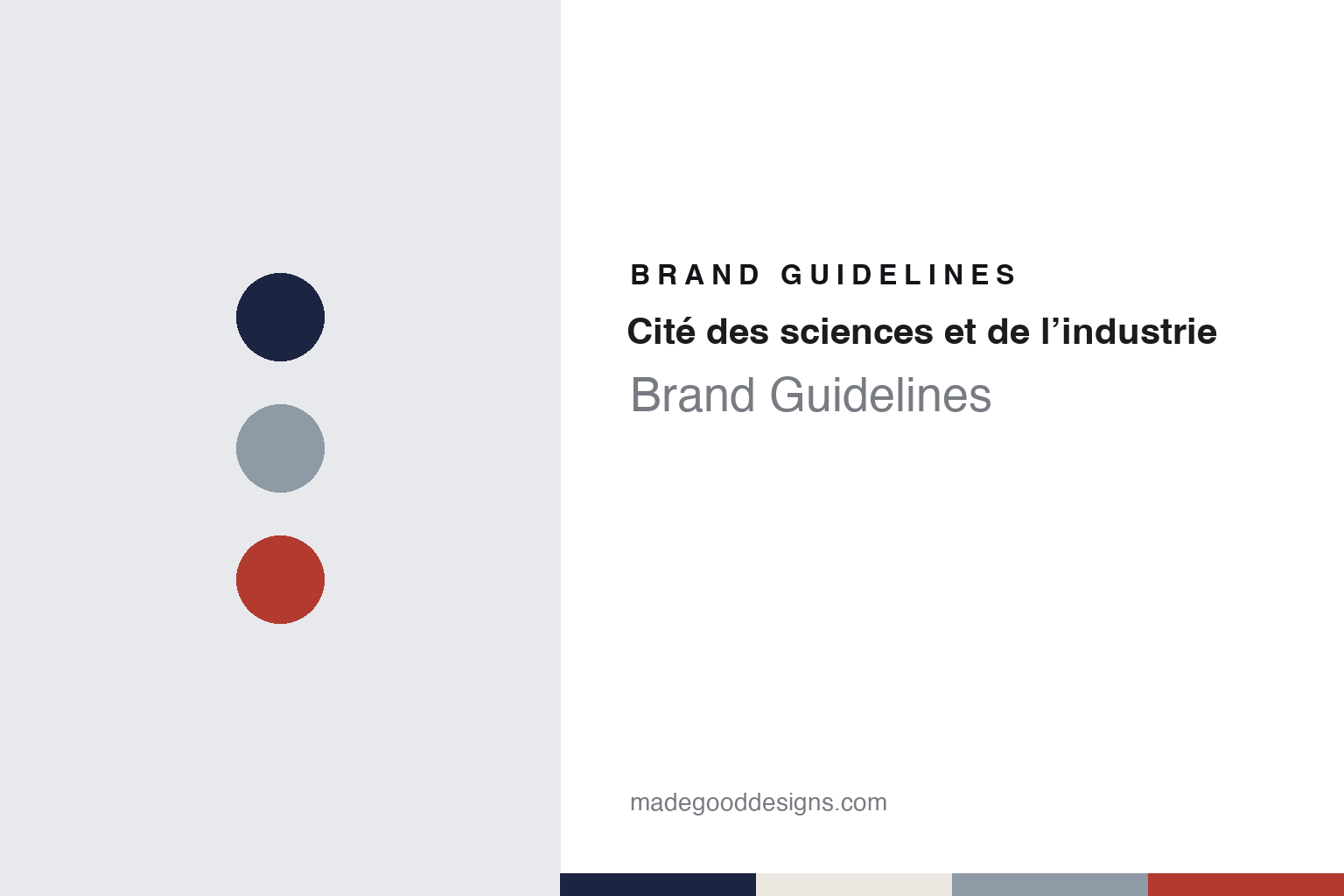
This guide’s Cité des sciences et de l’industrie palette is Villette night #1B2440, Ink #121418, Pale concrete #ECE8E1, Sphere steel #8E9AA6 and Brick red #B23A2E. The tones are the guide’s own unofficial interpretation, not official Cité des sciences et de l’industrie hex codes.
When did Cité des sciences et de l’industrie open?
Cité des sciences et de l’industrie opened on 13 March 1986, in Parc de la Villette, Paris.