Hampstead Theatre Brand Guidelines
A church-hall club that grew into a tilting zinc drum beside a park.
Aa
Two constants: a zinc, park-green and walnut palette and a grotesque sans register. Abstract homage — not a Hampstead Theatre asset; no logo, poster or signage is reproduced.
The Hampstead Theatre Club
A school hall, a prefab and a purpose-built home.
Hampstead Theatre began in 1959 as the Hampstead Theatre Club, in Moreland Hall on Holly Bush Vale in Hampstead, north London. Both the theatre’s own history page and English Wikipedia name its founder as the British theatre director James Roose-Evans, who was also its first artistic director; Wikipedia describes Moreland Hall as a parish church school hall. From the start the club staged contemporary plays for a local audience, and the theatre still describes new writing as the centre of its work.
In 1962 the company moved a short distance south to Swiss Cottage. English Wikipedia describes its new home as a “temporary” prefabricated building, standing on land now occupied by Swiss Cottage Library and the neighbouring leisure centre; the theatre itself calls it a small studio. The company stayed there for nearly forty years, the theatre says, supporting and producing the work of new and emerging writers.
In 2003 the company moved into a new purpose-built theatre close to the site of the old studio, at the Eton Avenue end of the Swiss Cottage open space. The building was designed by the London practice Bennetts Associates, which says on its website that Hampstead Theatre was its earliest cultural project and that it opened in 2003 as an adaptable home for new writing. The theatre credits the local community and its supporters for making the building possible. Hampstead Theatre is a registered charity, according to its website, and the organisation and the building share the same name.
Colour
Two stages for new plays.
The building holds two performance spaces. The Main Stage is a flexible auditorium that the theatre says can be arranged in different stage and seating layouts from one production to the next, including a traverse arrangement in which two banks of audience face each other. The theatre gave the capacity of the new building as 325 seats when it opened; English Wikipedia gives slightly higher figures for the main house depending on the layout, so the number varies with the configuration.
The second space, Hampstead Downstairs, is a studio theatre in the basement. The theatre describes it as fully equipped, with seating for about 80 people that can also be rearranged, and says the space is given over entirely to new writing. English Wikipedia says the studio was turned into a laboratory for new writing in 2010, and the theatre notes that work shown there is presented without formal press reviews. That two-tier structure, a larger flexible room for full productions and a smaller room for earlier-stage work, is how Hampstead describes its stages.
Beyond the stages, the theatre says it commissions and programmes new plays as well as revivals, runs a mentoring programme for early-career playwrights and offers programmes for early-stage artists and local communities. Its pages also describe a café bar on the ground floor that is open through the day, so that the foyer works as a public room for Swiss Cottage as well as a front of house for evening audiences.
Typography
Producing theatres and their buildings.
A producing theatre makes its own work rather than only hosting tours, and its public identity usually has two layers: the company and the building. The two names do not always match. A company may be founded years after its house was built, may take a lease on an older theatre, or may move into a hall first made for lectures, worship or industry, and the name on the façade can belong to the building, to the company or to both.
Most of these organisations trace their start to a founding person or group and to a dated opening, and many describe themselves as charities or non-profit companies. Inside, the usual pattern is a main house and a smaller studio. The main house may have a proscenium arch, with the audience facing a framed stage, or a thrust stage, with seating on three sides; the studio is often a flexible room whose seating changes from one production to the next.
The programme is described in general terms: new writing, classics in new versions, musicals, or a summer festival season. Alongside it sit learning and participation work with schools, young people and local communities, schemes for writers, directors and designers early in their careers, and, for some, tours of the building and libraries open to visitors.
Buildings change, and with them the visual identity. Refurbishments and rebuilds, each with its own dates and architects, often keep a listed auditorium or façade while replacing foyers, bars, box offices and backstage areas, and new signage and lettering arrive with them. Rebrands by design studios are usually reported by date in the design press. This guide records those dates, spaces and identity changes as the theatres and dated sources describe them; the colours and typefaces shown here are an unofficial interpretation.
Aa
A grotesque sans for a modern civic building. (Specimen set in Archivo, a sans STAND-IN; NOT the Hampstead Theatre logo.)
Hampstead Theatre
A zinc drum reached across bridges.
The architects’ own description of the 2003 building, quoted by the Manchester architecture site manchesterhistory.net, gives a clear picture of its character. A glazed foyer draws visitors in towards a view of the new park laid out by the landscape practice Gustafson Porter. The auditorium is a tilting zinc drum, reached across bridges over a void, and inside it lies an intimate room in a shallow ellipse that can take different sizes of audience and different stage formats while still feeling like a single complete space. Much of the building sits in a large basement so that it does not dominate the site, the architects said. The same page places the theatre in a group of public buildings around the park, alongside Basil Spence’s Swiss Cottage Library and the Swiss Cottage Leisure Centre.
Bennetts Associates has returned to the building twice. On its website the practice says the foyer was reimagined in 2016 as a brighter, more open space for people to meet, work or pause during the day, using warm walnut timber and integrated lighting that extend the language of the original architecture, and that the main auditorium followed in 2019 with smaller changes to comfort and access that kept the immediacy of the first design. The practice also describes the building’s sculptural form rising from a base of supporting spaces, which is what gives it its presence on the edge of the park.
Those elements suggest a calm, material palette for a design reading. The zinc drum gives a cool mid-grey, the glazed foyer a pale, almost colourless ground, and the 2016 walnut a warm brown for accents; the green of the park outside offers a deeper tone that can carry text. A clean grotesque sans suits a building of plain forms and glass, and the tilted ellipse of the auditorium can work as an abstract graphic device, a leaning oval or a cropped arc, without drawing the building itself. The split between the Main Stage and Hampstead Downstairs lends itself to a two-level system: a fuller treatment for main-house work and a sparer one for the studio.
For a design guide, Hampstead Theatre shows how a company that spent decades in a prefab can take on a confident modern building and still present itself above all through its new plays. Compare Royal Court Theatre, another London theatre known for new writing, and Lyric Hammersmith Theatre, a London producing theatre with a main stage and a studio. For this guide we use zinc grey, park green and walnut with a sans, an unofficial interpretation; no product or logo is reproduced.
Explore & save
Keep Hampstead Theatre’s identity on hand — save it to a board in the Made Good inspiration library.
Hampstead Theatre identity set
Pin the Hampstead Theatre zinc, park-green and walnut palette and the grotesque sans register to your own board.
Source & notes
Frequently Asked Questions
What font can I use to match the Hampstead Theatre look?
This guide describes Hampstead Theatre’s type as “A grotesque sans for a modern civic building”. Its type specimen is set in Archivo from Google Fonts as a stand-in; Archivo is not Hampstead Theatre’s own lettering.
What colours are in the Hampstead Theatre palette?
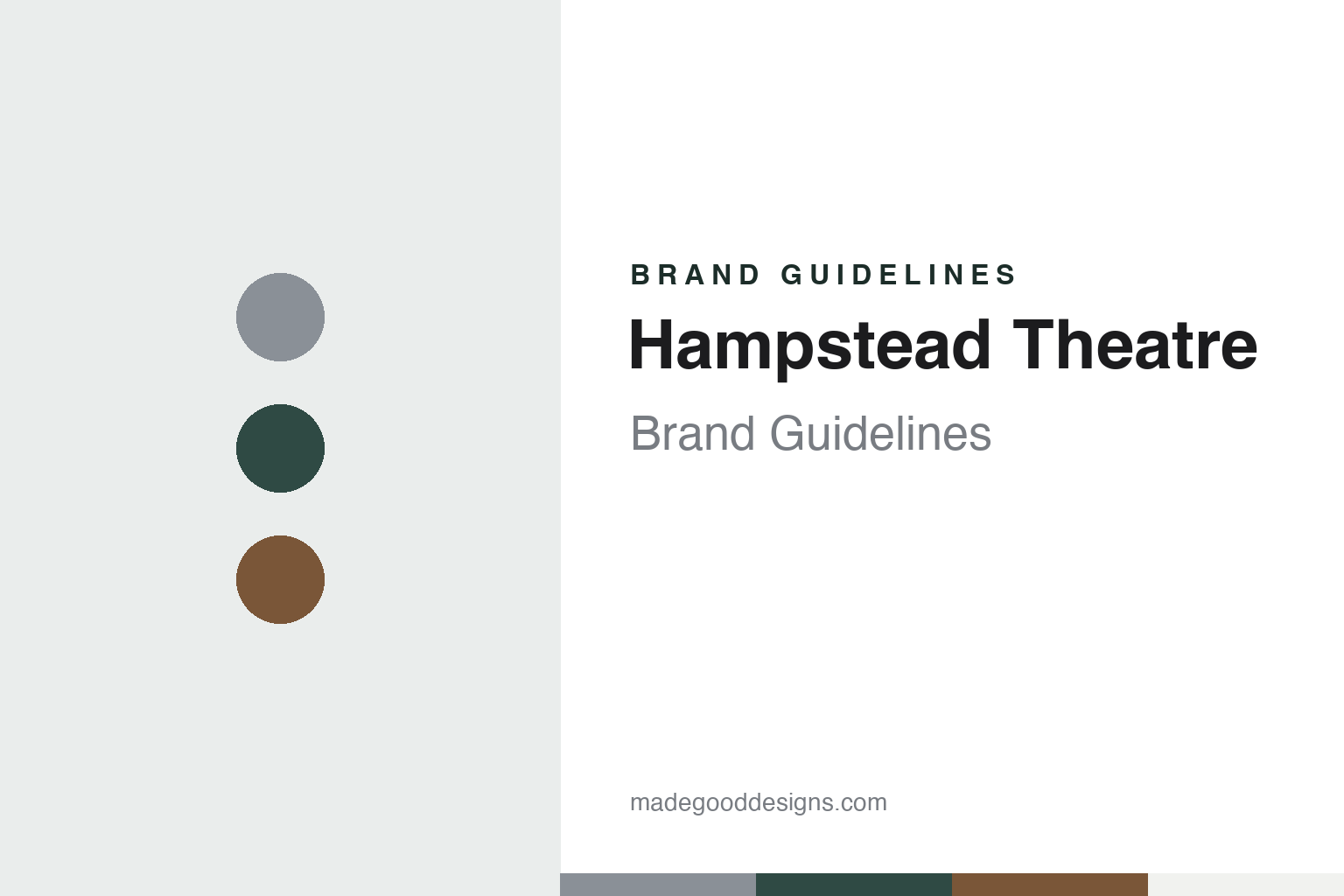
This guide’s Hampstead Theatre palette is Park green #2F4A44, Deep green #1C2D29, Zinc grey #8A9097, Walnut #7A5638 and Foyer glass #F1F2EF. The tones are the guide’s own unofficial interpretation, not official Hampstead Theatre hex codes.
When was Hampstead Theatre founded?
Hampstead Theatre was founded in 1959 (Hampstead Theatre Club), in Moreland Hall, Hampstead.
Who founded Hampstead Theatre?
Hampstead Theatre was founded by James Roose-Evans in 1959 (Hampstead Theatre Club).