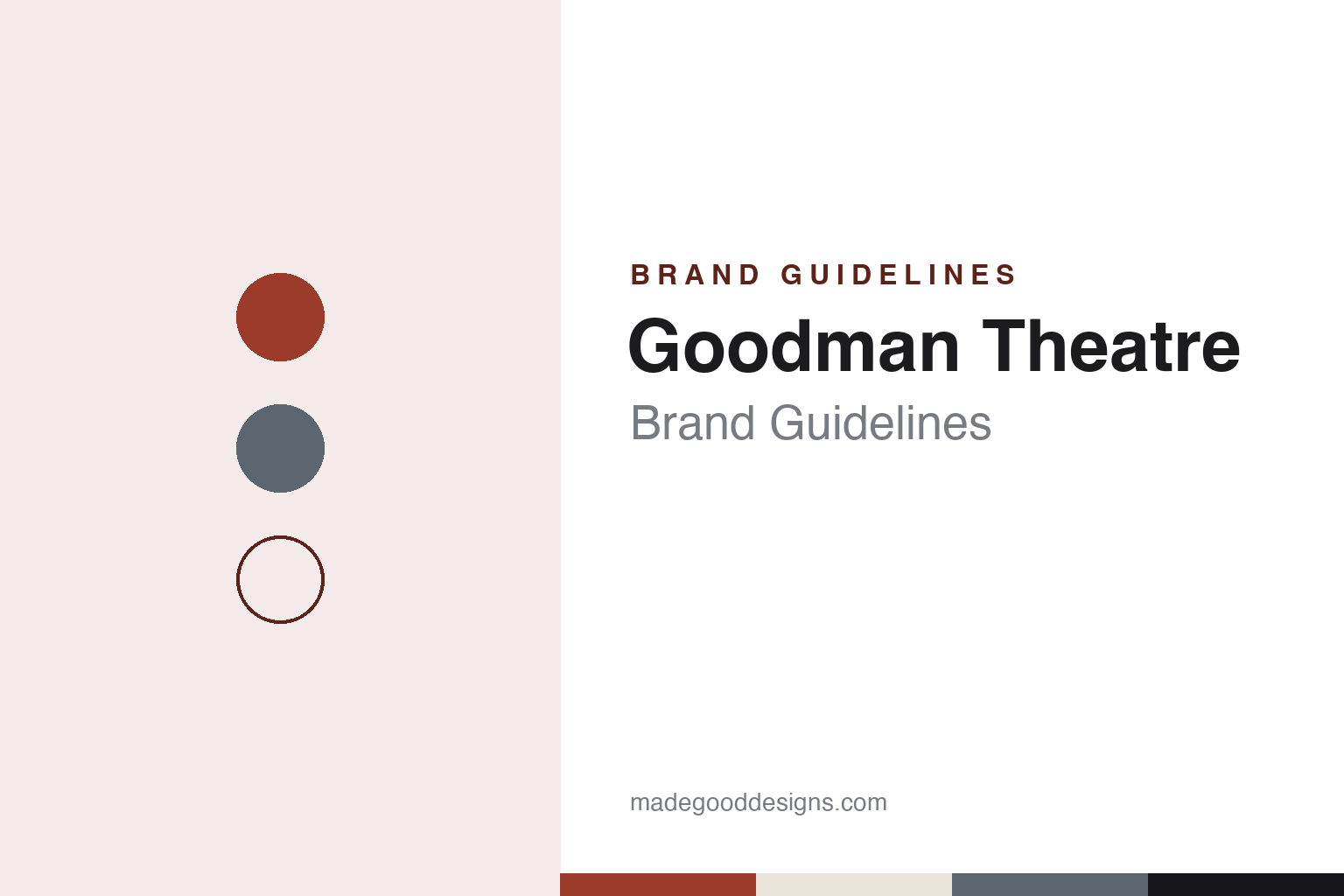
Goodman Theatre Brand Guidelines
A museum’s theatre of 1925 that moved behind two Loop theatre fronts in 2000.
Aa
Two constants: a Dearborn terracotta, Selwyn stone, Loop steel and ink palette and a civic sans register. Abstract homage — not a Goodman Theatre asset or mark; no logo, poster, photograph or lettering is reproduced.
A theatre at the Art Institute
A repertory company and a school of drama, opened on 20 October 1925.
Goodman Theatre is a non-profit theatre company in Chicago’s Loop. It began as part of the Art Institute of Chicago. English Wikipedia says it was founded in 1925 in honour of the Chicago playwright Kenneth Sawyer Goodman, through a gift from his parents to the Art Institute to establish a professional repertory company and a school of drama at the School of the Art Institute of Chicago. CBS Chicago reported in September 2014 that the Goodman began in 1925 as part of the Art Institute and had been independent of the museum for decades.
The theatre was dedicated on 20 October 1925, the date the company itself gives for opening its doors to its first audience, in a press release for its centennial in October 2025. The Theatre School at DePaul University, which grew out of the Goodman’s school, says the Goodman School of Drama admitted its first class alongside the opening of the theatre, with student actors training and performing beside professionals from the company.
The first building stood on the Art Institute’s own grounds by the lakefront. English Wikipedia says it was designed by the architect Howard Van Doren Shaw, on a site since occupied by the museum’s Modern Wing. A city ordinance limited the height of lakefront buildings, so the design used a low entrance and generous wing space to make up for the lack of a tall fly tower above the stage. ABC7 Chicago, marking the centennial in May 2026, described the company’s first stage as neighbouring the Art Institute and its present home as part of the Loop theatre district.
The school grew alongside the stage. English Wikipedia says a three-year conservatory training programme opened in September 1930, and that the Goodman became known over the next two decades for its children’s theatre. A professional company with a subscription season was rebuilt from 1957, with a resident acting company drawn from students and visiting performers, under a director who led both the theatre and its school.
Colour
Independence from the museum, and a move to Dearborn Street in 2000.
The theatre and the school went separate ways in the following decades. English Wikipedia says the two formally split in 1969 so that the theatre could become fully professional. In 1977 the Art Institute announced that it would withdraw its support for the theatre over three years, and a newly formed body, the Chicago Theatre Group, took over raising its funds. The school moved as well: DePaul University incorporated the Goodman School of Drama in 1978, DePaul says, moving its students and faculty to the Lincoln Park campus; it became The Theatre School at DePaul University, a name made official in 1985.
The company then looked for a new home with better acoustics and more room for scenery and effects, English Wikipedia says. In November 2000 it moved into a new theatre on North Dearborn Street, in the city’s theatre district. The 171,000-square-foot project was designed by the Toronto firm KPMB Architects with DLK Architecture and architects associated with the McClier Corporation. KPMB says the site is a half block bounded by Lake Street, West Randolph Street and Dearborn Street, and combined an empty lot with the abandoned Selwyn and Harris theatre buildings of 1923 by Crane & Franzheim; English Wikipedia describes the Harris and Selwyn property as a landmark. The architects say the new building responds to the old theatres and to the street, and that its scale deliberately contrasts with the surrounding high-rise towers so that it reads as an artistic institution.
Inside are two auditoriums named after members of the Goodman family. The theatre consultant Theatre Projects says the four-storey building holds the Albert Ivar Goodman Theatre, an 850-seat proscenium house with a full fly tower, and the Owen Bruner Goodman Theatre, a 450-seat courtyard theatre modelled on the Cottesloe at London’s National Theatre, with three levels of seating and a stage made of movable modules. The Goodman describes the Albert as the largest space in the building, with floor and balcony seating, home to its biggest productions, and the Owen, with three flexible levels of courtyard seating around a large stage, as the home of more intimate work. It also lists two rehearsal rooms, the Polk and the larger Healy, lobbies on the first and second floors, the ground-floor one with windows onto Dearborn Street, and a lounge at the north end of the Owen Lobby.
Typography
How producing theatres present themselves.
A producing theatre makes its own work rather than only hosting tours, and its public identity usually has two layers: the company and the building. The two names do not always match. A company may be founded years after its house was built, may take a lease on an older theatre, or may move into a hall first made for lectures, worship or industry, and the name on the façade can belong to the building, to the company or to both.
Most of these organisations trace their start to a founding person or group and to a dated opening, and many describe themselves as charities or non-profit companies. Inside, the usual pattern is a main house and a smaller studio. The main house may have a proscenium arch, with the audience facing a framed stage, or a thrust stage, with seating on three sides; the studio is often a flexible room whose seating changes from one production to the next.
The programme is described in general terms: new writing, classics in new versions, musicals, or a summer festival season. Alongside it sit learning and participation work with schools, young people and local communities, schemes for writers, directors and designers early in their careers, and, for some, tours of the building and libraries open to visitors.
Buildings change, and with them the visual identity. Refurbishments and rebuilds, each with its own dates and architects, often keep a listed auditorium or façade while replacing foyers, bars, box offices and backstage areas, and new signage and lettering arrive with them. Rebrands by design studios are usually reported by date in the design press. This guide records those dates, spaces and identity changes as the theatres and dated sources describe them; the colours and typefaces shown here are an unofficial interpretation.
Aa
A civic sans — for a Loop theatre set behind 1920s theatre fronts. (Specimen set in Libre Franklin, a sans STAND-IN; NOT the Goodman Theatre logo or any Goodman lettering.)
Goodman Theatre
New plays, classics, musicals and a centre for learning.
The newest space is for learning. Architect magazine’s project gallery describes The Alice at Goodman Theatre as 10,000 square feet of vacant office space adapted into a dedicated home for the theatre’s free education and community programmes. It is entered through a wood portal from the second-floor lobby, with rehearsal rooms along the building’s perimeter and acoustically isolated studios behind a meandering wall of double-sided wooden slats. The Goodman calls it the Alice Center and describes floor-to-ceiling windows over downtown Chicago.
The Goodman describes its programme in general terms: new plays developed through festivals, residencies, labs and commissions; reimagined classics and large-scale musical works; international collaborations and tours; and education work that includes after-school programmes, hands-on workshops, summer programmes and performances for children under five and their families. Its centennial release of 20 October 2025 described a School Matinee Series for Chicago Public Schools students and teachers, a teen studio series, a storytelling festival for people aged 55 and over, and 100 Free Acts of Theater, a citywide series begun in July 2025 with the city’s Department of Cultural Affairs and Special Events. Susan V. Booth became artistic director in 2022, English Wikipedia says.
The documented visual material is architectural: an arts centre set behind two theatre fronts of the 1920s, a scale kept lower than the Loop’s towers, and an interior built around a proscenium house and a courtyard room, with the family name carried on both stages. For a design guide, Goodman Theatre shows how a company can keep a founding name through a century and two homes while older street facades frame a new building. Compare the National Theatre, whose Cottesloe served as the model for the Owen, and Lyric Opera of Chicago, another Chicago company. For this guide we use terracotta, stone, steel grey and ink with a sans, an unofficial interpretation; no product or logo is reproduced.
Explore & save
Keep Goodman Theatre’s identity on hand — save it to a board in the Made Good inspiration library.
Goodman Theatre identity set
Pin the Goodman Theatre terracotta, stone and steel palette and the civic sans register to your own board.
Source & notes
Frequently Asked Questions
What font can I use to match the Goodman Theatre look?
This guide describes Goodman Theatre’s type as “A civic sans — for a Loop theatre set behind 1920s theatre fronts”. Its type specimen is set in Libre Franklin from Google Fonts as a stand-in; Libre Franklin is not Goodman Theatre’s own lettering.
What colours are in the Goodman Theatre palette?
This guide’s Goodman Theatre palette is Dearborn terracotta #9C3B2A, Ink #17161A, Selwyn stone #E9E3D8, Loop steel #5B6670 and Paper #F8F6F2. The tones are the guide’s own unofficial interpretation, not official Goodman Theatre hex codes.
Where is Goodman Theatre based?
Goodman Theatre is based in Dearborn Street, Chicago Loop (2000).