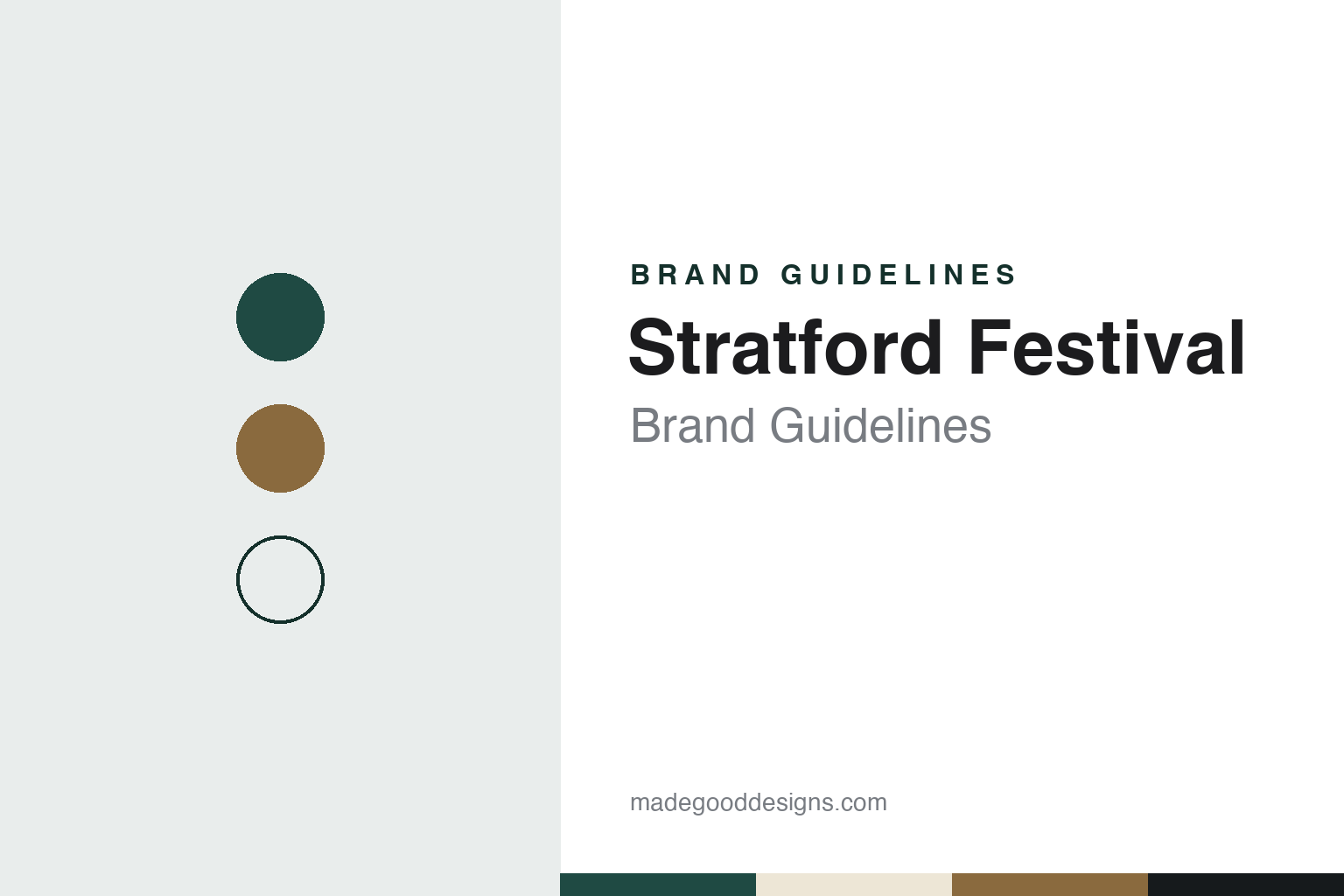
Stratford Festival Brand Guidelines
A tent on the Avon that became a round theatre around a thrust stage.
Aa
Two constants: a river green, canvas, patina bronze and ink palette and a classical serif register. Abstract homage — not a Stratford Festival asset or mark; no logo, poster, photograph or lettering is reproduced.
A festival for a railway town
Tom Patterson’s idea, a 1952 incorporation and a canvas tent on the Avon in 1953.
The Stratford Festival is a repertory theatre organisation in Stratford, Ontario, Canada, with a season that runs from April to November, according to English Wikipedia. It has worked under several names over the years: the Stratford Shakespearean Festival, the Shakespeare Festival and the Stratford Shakespeare Festival. It is a separate organisation from the Royal Shakespeare Company in England; the Ontario city shares the name of Shakespeare’s birthplace, and its river is also called the Avon.
The idea came from Tom Patterson, a journalist born in Stratford. English Wikipedia says he thought of a Shakespeare festival for his home town in 1951, at a time when the city, a railway junction with a large locomotive shop, faced the loss of that work as steam power came to an end. With encouragement from the mayor and the local council, an Ontario corporation, the Stratford Shakespearean Festival of Canada Foundation, received its articles of incorporation on 31 October 1952. Parks Canada, in plaque text approved by the Historic Sites and Monuments Board of Canada in 2018, dates the start to 1953, when Patterson launched an annual festival of Shakespearean theatre; the festival was designated a national historic event that year.
Patterson brought in the English director Tyrone Guthrie as the festival’s first artistic director, together with the designer Tanya Moiseiwitsch. Parks Canada says the two conceived the festival’s thrust stage, which the audience surrounds on three sides. Guthrie went on to help found the Guthrie Theater in Minneapolis, which dates its founding to 1963, English Wikipedia says.
The first season opened on 13 July 1953 and lasted six weeks. For its first four seasons the festival played in a concrete amphitheatre covered by a large canvas tent on the banks of the Avon. The Toronto architects Rounthwaite & Fairfield received the commission in January 1953, English Wikipedia says, and planned the theatre around Moiseiwitsch’s stage: a circular concrete bleacher sweeping through 252 degrees in seven sections, under a square tent held up by four masts. With the festival’s future uncertain, the architects kept the structure temporary and the costs low.
Colour
The 1957 Festival Theatre, the Avon of 1901 and a riverside theatre of 2022.
The tent came down for the last time on 25 August 1956, and construction of a permanent building began that month on the existing bleachers, English Wikipedia says. Rounthwaite & Fairfield designed this building too. The Festival Theatre was dedicated on 30 June 1957 and opened the next day. The round building, 200 feet across and made up of 34 bays, was deliberately designed to resemble a huge tent. The architects trimmed the original bleachers to 220 degrees and added a cantilevered balcony, bringing capacity to 2,192 at the time. Parks Canada says the theatre allows more than 1,800 people to watch from a semicircle around the stage, and English Wikipedia says no seat is more than 65 feet from it.
The stage itself is Moiseiwitsch’s thrust, which English Wikipedia describes as resembling both a classical Greek amphitheatre and Shakespeare’s Globe. It projects into the auditorium so that the audience sits on three sides, an arrangement Parks Canada credits with allowing a fluid, dynamic style of performance.
The festival now has four permanent venues: the Festival Theatre, the Avon Theatre, the Tom Patterson Theatre and the Studio Theatre. The Avon is older than the festival. English Wikipedia says it was built in 1901 as the Theatre Albert, served for decades as a cinema and vaudeville house, and already carried the Avon name when the festival bought it in 1963; it was rebuilt and reopened in 1967, and modernised in 2002, for the festival’s fiftieth anniversary, by Davidson-Langley Incorporated Architects with Marklevitz Architect of Stratford. The Avon is connected to the Studio Theatre, which the festival also owns and runs.
The newest building is the Tom Patterson Theatre, named after the founder. Dezeen reported on 10 June 2022 that the Toronto studio Hariri Pontarini Architects had designed the 7,150-square-metre building on the banks of the Avon, on the site of a demolished theatre of the same name. It was completed in the summer of 2020, and the festival officially opened it in May 2022, English Wikipedia says. The main room is a horseshoe-shaped auditorium of 600 seats, planned so that no one sits more than 28 feet from the stage, with walnut on the curved walls and ceiling and a stage of Canadian birch. Beside it, Lazaridis Hall, a smaller space for 250, looks out over the river but can be closed for full blackout, Dezeen reported. Behind the theatre are a green room, a rehearsal hall and loading docks.
Typography
How producing theatres present themselves.
A producing theatre makes its own work rather than only hosting tours, and its public identity usually has two layers: the company and the building. The two names do not always match. A company may be founded years after its house was built, may take a lease on an older theatre, or may move into a hall first made for lectures, worship or industry, and the name on the façade can belong to the building, to the company or to both.
Most of these organisations trace their start to a founding person or group and to a dated opening, and many describe themselves as charities or non-profit companies. Inside, the usual pattern is a main house and a smaller studio. The main house may have a proscenium arch, with the audience facing a framed stage, or a thrust stage, with seating on three sides; the studio is often a flexible room whose seating changes from one production to the next.
The programme is described in general terms: new writing, classics in new versions, musicals, or a summer festival season. Alongside it sit learning and participation work with schools, young people and local communities, schemes for writers, directors and designers early in their careers, and, for some, tours of the building and libraries open to visitors.
Buildings change, and with them the visual identity. Refurbishments and rebuilds, each with its own dates and architects, often keep a listed auditorium or façade while replacing foyers, bars, box offices and backstage areas, and new signage and lettering arrive with them. Rebrands by design studios are usually reported by date in the design press. This guide records those dates, spaces and identity changes as the theatres and dated sources describe them; the colours and typefaces shown here are an unofficial interpretation.
Aa
A classical serif — for a festival rooted in Shakespeare and the classics. (Specimen set in Cormorant Garamond, a serif STAND-IN; NOT the Stratford Festival logo or any festival lettering.)
Stratford Festival
Shakespeare, the classics and musicals, a conservatory and four stages.
The programme reaches beyond Shakespeare. English Wikipedia says the festival’s main focus remains his plays, but its seasons range from Greek tragedy to musicals and contemporary work, with at least one musical alongside the classical repertory each year. Parks Canada described in 2019 how French classics and musicals had been added over the years, and gave the season as running from May to October with more than 700 performances. The festival trains theatre artists through the Birmingham Conservatory for Classical Theatre Training, runs the Stratford Festival Forum of concerts, readings, lectures and talks during the season, and is an industry partner of the University of Waterloo’s Stratford campus, English Wikipedia says. In October 2020 it launched Stratfest@Home, a streaming service for its filmed productions and documentaries. An early touring offshoot, the Canadian Players, ran from 1954 to 1966.
The buildings carry most of the documented visual detail. Dezeen described the Tom Patterson Theatre as wrapped in six-metre double-glazed panels with a ceramic frit, accented with bronze extrusions fabricated in Spain and given a patina in Toronto, with pale Danish brick, Ontario limestone and a large wooden canopy over the entrance promenade. Inside, oak walkways and slatted oak ceilings run between the auditorium and the glass, and three bars are each made from a different stone. Gardens and a terrace with 25 varieties of plants and trees, many of them native to Ontario, stretch between the building and the river. The Festival Theatre, by contrast, keeps the round, many-bayed form that recalls the 1953 tent.
For a design guide, the Stratford Festival shows how a theatre company can take its cues from a stage shape and a riverside setting as much as from any one building. Compare the Royal Shakespeare Company, a separate company in England’s Stratford-upon-Avon, and the Guthrie Theater, which Tyrone Guthrie helped found in Minneapolis. For this guide we use river green, canvas, patina bronze and ink with a serif, an unofficial interpretation; no product or logo is reproduced.
Explore & save
Keep Stratford Festival’s identity on hand — save it to a board in the Made Good inspiration library.
Stratford Festival identity set
Pin the Stratford Festival river green, canvas and bronze palette and the classical serif register to your own board.
Source & notes
Frequently Asked Questions
What font can I use to match the Stratford Festival look?
This guide describes Stratford Festival’s type as “A classical serif — for a festival rooted in Shakespeare and the classics”. Its type specimen is set in Cormorant Garamond from Google Fonts as a stand-in; Cormorant Garamond is not Stratford Festival’s own lettering.
What colours are in the Stratford Festival palette?
This guide’s Stratford Festival palette is River green #1F4A43, Ink #161A1C, Canvas #EDE6D6, Patina bronze #8A6A3E and Paper #F8F6F1. The tones are the guide’s own unofficial interpretation, not official Stratford Festival hex codes.
When was Stratford Festival founded?
Stratford Festival was founded in 1952 (incorporated); first season 1953, in Stratford, Ontario, Canada.
Who founded Stratford Festival?
Stratford Festival was founded by Tom Patterson in 1952 (incorporated); first season 1953.