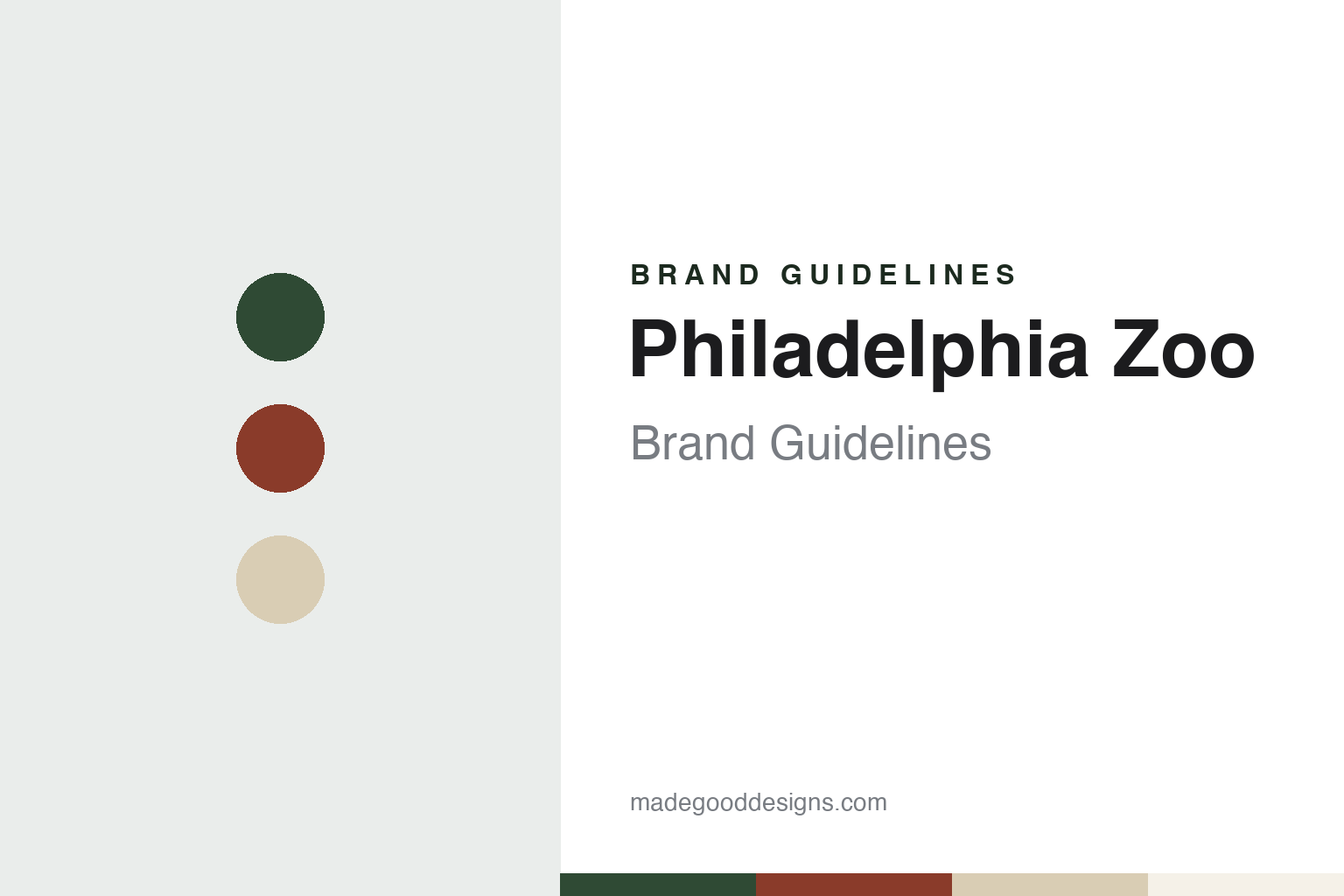
Philadelphia Zoo Brand Guidelines
A Victorian garden zoo on the Schuylkill, behind Furness gates.
Aa
Two constants: a Fairmount green, Furness brick and gatehouse stone palette and a Victorian serif register. Abstract homage — not a Philadelphia Zoo asset; no logo, sign or animal image is reproduced.
A Charter and a Delay
Incorporated in 1859, opened fifteen years later.
Philadelphia Zoo began on paper. On 21 March 1859 the Pennsylvania legislature incorporated the Zoological Society of Philadelphia, English Wikipedia says, quoting a charter that set out to collect living animals “for the instruction and recreation of the people.” The idea came from William Camac of Philadelphia, who had visited the Zoological Society of London in the early 1850s; the zoo’s own staff retold that story to 6abc in September 2026, adding that the charter specifically named education and the study of animals as its purpose.
The society secured a site on the West Philadelphia side of the Schuylkill River, land once owned by John Penn, a grandson of William Penn, English Wikipedia says. The American Civil War then pushed the opening back, and the Philadelphia Zoological Garden did not open its gates until 1 July 1874, fifteen years after the charter. English Wikipedia counts more than 3,000 visitors on the first day. When the Centennial Exposition filled nearby Fairmount Park in 1876, the zoo was a few blocks away, and its attendance that year set a record that stood until 1951, the same source says.
Visitors could arrive by rail. A Zoological Garden station at 34th Street and Girard Avenue served the zoo from its opening in 1874 until the station closed in 1902, according to English Wikipedia. The address still frames the zoo today: its entrance stands at that corner, on the edge of what Philadelphia now calls the Centennial District.
In its own words the zoo is “America’s first zoo,” a phrase that runs through its website, and WHYY’s NewsWorks described it in 2012 as the first zoo in the United States. The operator has stayed the same since 1859: the zoo’s website gives its status today as a 501(c)(3) nonprofit organization, and a 2011 zoo release carried by 6abc said it was accredited by the Association of Zoos and Aquariums.
Colour
Gatehouses, a Penn mansion and a garden plan.
The zoo’s oldest architecture is at its front door. The main entrance gate was designed by Frank Furness in 1875, a year after the zoo opened, WHYY’s NewsWorks reported in a November 2012 survey of the architect’s Philadelphia buildings. The Athenaeum of Philadelphia’s American Architects and Buildings database lists the structures as the Philadelphia Zoological Gardens Entrance Pavilions, also known as the gatehouse, at 34th Street near Girard Avenue, documented by the Historic American Buildings Survey and entered on the Philadelphia Register of Historic Places on 26 June 1956.
Inside the grounds stands an older building. The Solitude, a house built by John Penn in 1785, held reptiles and small mammals when the zoo opened, English Wikipedia says, and 6abc reported in September 2026 that Solitude and the gatehouses at the entrance both still stand. English Wikipedia also describes the original landscaping and architecture as imitating a Victorian garden, an atmosphere it says the grounds still keep.
The site has grown in steps rather than moved. English Wikipedia gives the original area as 33 acres and today’s as 42 acres. The PECO Primate Reserve opened in 1999, a new big cat exhibit in 2006 and a new aviary in 2009. On 13 April 2013 the zoo opened KidZooU, the Hamilton Family Children’s Zoo and Faris Family Education Center, on the site of the old Pachyderm House; English Wikipedia calls it the zoo’s first LEED-certified exhibit, with rain gardens, cisterns, geothermal wells and green roofs. Penguin Point followed in June 2018 in a remodelled habitat, and 6abc described Cary Bear Country as one of the newest additions in 2026.
Habitat areas are laid out as named zones around the walkways: African Plains, Bird Valley, Flamingo Cove, Outback Outpost, Raptor Ridge, a Reptile and Amphibian House and a Rare Animal Conservation Center among them. Education is built into the children’s zoo and its education centre, and the calendar adds seasonal events such as Boo at the Zoo in October and LumiNature, a walking night-time light show in the winter season.
Typography
Zoos and how they present themselves.
A zoo usually presents itself through the body that stands behind its name. Some are run by a zoological society founded for the purpose, some by a charity, a company or a city, and some by a state agency that took over from an older society; the Encyclopedia of Melbourne, for example, describes how Melbourne’s acclimatisation society handed its zoo to a state board in 1937. The founding date matters as much as the owner, and many zoos give it a prominent place, whether it falls in the 18th or 19th century or in the decades of the modern site.
The grounds tell the same story in buildings. Older zoos keep historic gates, animal houses and pavilions, some of them on a heritage register, next to large landscaped habitat areas built much later. English Wikipedia describes how Chester Zoo’s founder followed Carl Hagenbeck’s use of moats and ditches in place of bars, an approach that shaped many 20th-century layouts, while the Encyclopedia of Melbourne notes that many 19th-century zoological gardens followed the example of London Zoo.
A large site also needs to be read on the move. Maps, signposts and named areas or zones guide visitors between houses and habitats, and several zoos group their animals by region or climate, so that a path leads from one landscape to the next. Education is part of the offer too, with programmes for schools and families described in general terms on the zoos’ own websites.
Visual identities draw on these layers. Logos often use an animal silhouette or a simple wordmark, signage follows the paths and zones of the site, and the buildings themselves, old and new, carry much of the character. This guide describes each zoo through what dated sources say about its founders, operators, buildings and grounds, and uses colours and type of its own choosing.
Aa
A Victorian serif for a zoo of gatehouses and garden paths. (Specimen set in Fraunces, a serif STAND-IN; NOT the Philadelphia Zoo logo or any zoo typeface.)
Trails Over the Paths
Zoo360 and a campus-wide network of mesh.
The zoo’s most distinctive recent feature runs over visitors’ heads. In 2011 it opened Treetop Trail, the first part of a system it calls Zoo360, English Wikipedia says: see-through mesh trails, some elevated and some at ground level, along which animals can travel away from their usual enclosures. A zoo release carried by 6abc in July 2011 said the stainless-steel mesh of the first trail circled Impala Plaza through an existing ring of trees, crossed the visitor path on each side and was shared by different species on different days; it named CLR Design among the architects and designers.
Later trails followed. English Wikipedia lists the Great Ape Trail, Big Cat Crossing, Gorilla Treeway and Meerkat Maze, and CLR Design’s own project page adds paths in the Water is Life exhibit. The zoo’s website calls Zoo360 “a campus-wide network of see-through mesh trails” and frames it with a short line: as you move around the zoo, “the Zoo moves around you.”
The result is a visual mix that a design guide can read plainly. At the entrance are Furness’s Victorian pavilions and, inside, a house of 1785; around them, curving paths and named habitat zones; overhead, the thin grid of mesh tunnels. The zoo’s maps reflect the same layering, with versions for parking, accessibility and seasonal events published on its website.
For a design guide, Philadelphia Zoo shows how a nineteenth-century charter, a registered historic gatehouse and a modern trail system can sit inside one compact urban site. Compare Bronx Zoo, another American zoo, and Saint Louis Zoo, a zoo in another American city. For this guide we use a deep green, a brick red and a warm stone with a serif, an unofficial interpretation; no product or logo is reproduced.
Explore & save
Keep Philadelphia Zoo’s identity on hand — save it to a board in the Made Good inspiration library.
Philadelphia Zoo identity set
Pin the Fairmount green, Furness brick and gatehouse stone palette and the Victorian serif register to your own board.
Source & notes
Frequently Asked Questions
What font can I use to match the Philadelphia Zoo look?
This guide describes Philadelphia Zoo’s type as “A Victorian serif for a zoo of gatehouses and garden paths”. Its type specimen is set in Fraunces from Google Fonts as a stand-in; Fraunces is not Philadelphia Zoo’s own lettering.
What colours are in the Philadelphia Zoo palette?
This guide’s Philadelphia Zoo palette is Fairmount green #2F4A34, Furness brick #8A3B2A, Gatehouse stone #D9CDB4, Garden paper #F5F1E8 and Ink #1B1D1A. The tones are the guide’s own unofficial interpretation, not official Philadelphia Zoo hex codes.
When did Philadelphia Zoo open?
Philadelphia Zoo opened on 1 July 1874 (West bank of the Schuylkill, Philadelphia).