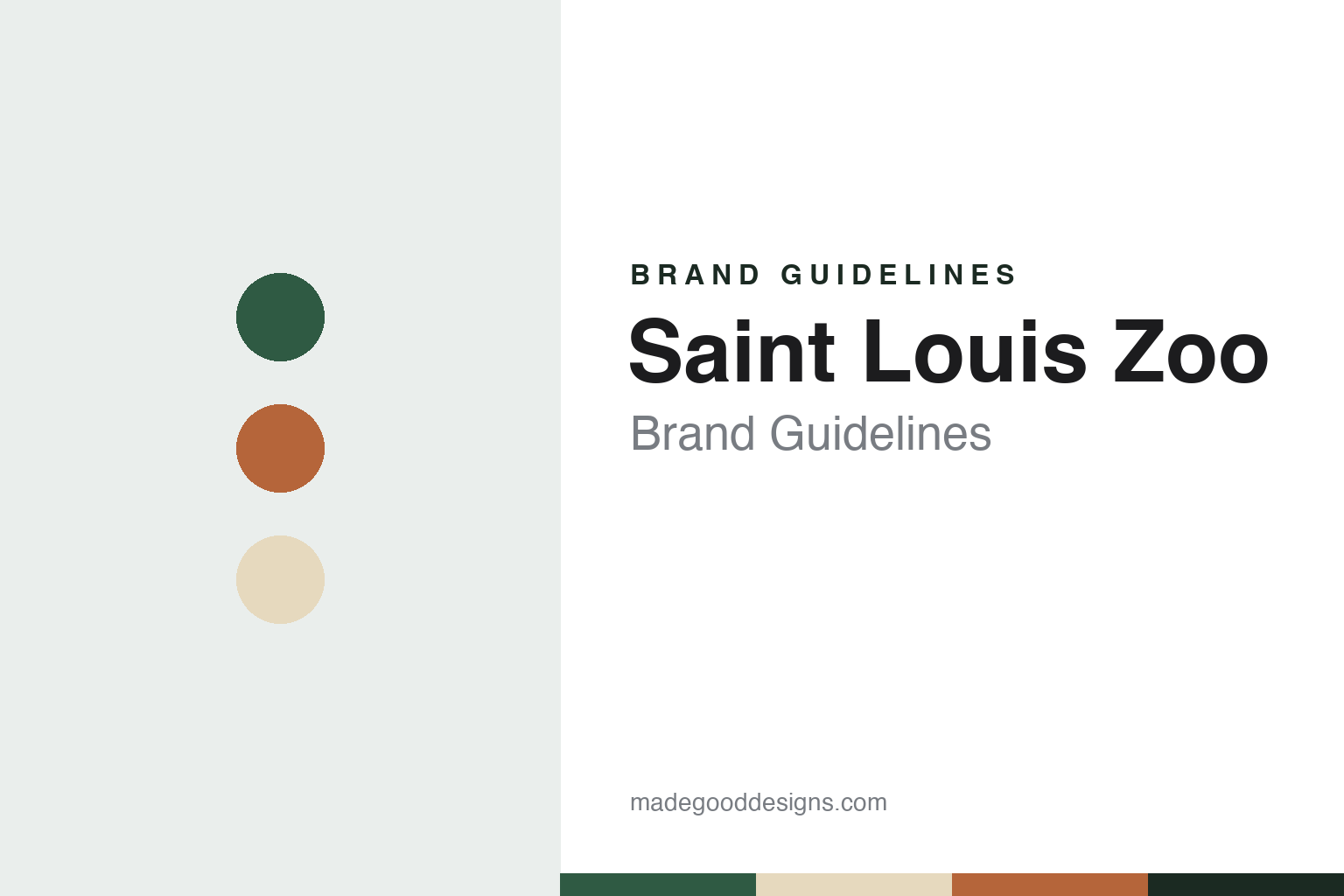
Saint Louis Zoo Brand Guidelines
A World’s Fair aviary, Spanish-style animal houses and a zoo paid for by a tax district.
Aa
Two constants: a forest green, terracotta and buff stone palette and a civic serif register. Abstract homage — not a Saint Louis Zoo asset; no logo, sign or building is reproduced.
From a fair to a zoo
An aviary that stayed behind after 1904.
The Saint Louis Zoo, officially the Saint Louis Zoological Park, sits in Forest Park in St. Louis, Missouri. Its story begins before the zoo itself. For the 1904 World’s Fair, the Louisiana Purchase Exposition, the Smithsonian Institution commissioned a walk-through aviary, the Flight Cage, and intended to move it to the National Zoo in Washington, D.C., once the fair closed. The zoo says St. Louisans rallied to keep it and that the City of St. Louis bought the structure; English Wikipedia describes it as the start of what would become the zoo.
The zoo dates its formal beginning to 1910, when a group of citizens organised the Zoological Society of St. Louis. English Wikipedia says the society was incorporated in 1914 as an independent civic organisation. Several sites were debated in the press, among them Fairground Park, Carondelet Park and Tower Grove Park, before the city set aside about 77 acres in Forest Park, according to the same article, and a five-member Zoological Board of Control was appointed. In 1916, the zoo says, St. Louis voters approved a mill tax for building the zoo; Wikipedia adds that the board grew to nine members that year.
The 1920s and 1930s gave the zoo its oldest animal houses. English Wikipedia lists the Bear Pits of 1921, the Reptile House of 1927, the Bird House of 1930, the Antelope House of 1935, built with help from the New Deal’s Civil Works Administration, and the Ape House of 1939. The zoo says the Primate House, then called the Monkey House, opened to the public on 13 January 1925; Wikipedia gives its construction as 1923. After the Second World War came a sea lion arena in 1954, the Elephant House with its moated yards in 1957 and the Emerson Zooline Railroad, a narrow-gauge line that circles the grounds, in 1963.
The funding model changed in the early 1970s. As residents moved to the suburbs in the 1950s and 1960s, civic leaders proposed a Metropolitan Zoological Park and Museum District, known as the ZMD, in which St. Louis County would join the city in supporting cultural institutions through property tax. Voters in the city and county approved the district in 1971, the zoo says, and English Wikipedia dates the zoo’s entry to 1972.
Colour
Historic Hill and the habitat zones.
The zoo’s oldest quarter is the zone it calls Historic Hill. The zoo describes it as running from the 1904 Flight Cage to “the Spanish architectural flavor of the 1920s” in the Bird House, the Primate House and the Herpetarium. The Primate House, it says, was built with a buff stucco exterior and terra-cotta trim ornamented with monkey figures, and a 1977 renovation kept the structure while redesigning the interior with rockwork, trees and foliage. The Herpetarium began in 1927 as the Reptile House, with a wing for small mammals, and was renovated about fifty years later.
The Bird House has the fullest independent record. An article in the bird-keeping journal AFA Watchbird in 1980 described a building opened in the fall of 1930 in which Spanish architecture shaped both the exterior and the interior: heavy wooden beams, balconies, terracotta tiles and hanging brass light fixtures gave it a “hacienda” character, and small sculptures of birds were worked into the capitals and cornices of its columns and walls. The article reported a renovation worked out from 1977 with the architects Peckham-Guyton, Albers & Vietz, which removed the old interior while keeping the structure and its architectural features. The zoo added a two-acre Bird Garden beside the building in 1996.
The Flight Cage itself has been reworked three times, the zoo says: a boardwalk interior in 1967, a restoration of its superstructure in 1996 and, for the fair’s centennial in 2004, a cypress swamp with a floating bridge and a viewing pier. English Wikipedia gives its size as 228 feet long, 84 feet wide and 50 feet high.
Later decades added larger landscaped areas around that core. English Wikipedia dates Big Cat Country to 1976 and Jungle of the Apes to 1986, and credits the Living World of 1989, a two-storey education building with classrooms, a reference library, a teacher resource centre, an auditorium and two exhibit halls, to the architects Hellmuth, Obata and Kassabaum. River’s Edge opened in phases from 1999, with habitats themed on Asia, North America, South America and Africa; Penguin and Puffin Coast followed in 2003, Polar Bear Point in 2015, Grizzly Ridge in 2017 on the site of the 1921 bear grottoes, and the Primate Canopy Trails, joined to the Primate House, in July 2021.
Today the zoo divides its grounds into six zones: Lakeside Crossing, River’s Edge, The Wild, Discovery Corner, Historic Hill and Red Rocks. Its education work runs through school field trips, classroom programmes, educational tours, camps and a library with teacher resources, as listed on its website.
Typography
How zoos present themselves.
A zoo usually presents itself through the body that stands behind its name. Some are run by a zoological society founded for the purpose, some by a charity, a company or a city, and some by a state agency that took over from an older society; the Encyclopedia of Melbourne, for example, describes how Melbourne’s acclimatisation society handed its zoo to a state board in 1937. The founding date matters as much as the owner, and many zoos give it a prominent place, whether it falls in the 18th or 19th century or in the decades of the modern site.
The grounds tell the same story in buildings. Older zoos keep historic gates, animal houses and pavilions, some of them on a heritage register, next to large landscaped habitat areas built much later. English Wikipedia describes how Chester Zoo’s founder followed Carl Hagenbeck’s use of moats and ditches in place of bars, an approach that shaped many 20th-century layouts, while the Encyclopedia of Melbourne notes that many 19th-century zoological gardens followed the example of London Zoo.
A large site also needs to be read on the move. Maps, signposts and named areas or zones guide visitors between houses and habitats, and several zoos group their animals by region or climate, so that a path leads from one landscape to the next. Education is part of the offer too, with programmes for schools and families described in general terms on the zoos’ own websites.
Visual identities draw on these layers. Logos often use an animal silhouette or a simple wordmark, signage follows the paths and zones of the site, and the buildings themselves, old and new, carry much of the character. This guide describes each zoo through what dated sources say about its founders, operators, buildings and grounds, and uses colours and type of its own choosing.
Aa
A civic serif for a city institution in a park. (Specimen set in Fraunces, a serif STAND-IN; NOT the Saint Louis Zoo logo.)
A public subdistrict
Governed by a commission, supported by a district.
The zoo describes itself as legally a tax-supported political subdistrict of the State of Missouri, “essentially” a government agency with rules on how it raises and spends money. Its governing body is the Saint Louis Zoological Park Subdistrict Commission, set up by the Missouri legislature, with five members who live in the city and five in the county. Fundraising runs through a private nonprofit partner, the Saint Louis Zoo Association, whose volunteer board is drawn from business and community leaders. The ZMD itself has an eight-member board, four appointed by the Mayor of St. Louis and four by the County Executive, and it now supports five subdistricts: the zoo, the Saint Louis Art Museum, the Saint Louis Science Center, the Missouri Botanical Garden, which joined in 1983, and the Missouri History Museum, which joined in 1988.
The district is the reason general admission is free. English Wikipedia says admission is free because of the public subsidy, with fees for some special attractions, and the zoo describes itself as “free to all” in what it calls a public-private partnership. The zoo is accredited by the Association of Zoos and Aquariums (AZA), English Wikipedia says.
On identity, English Wikipedia says the symbol of the zoo is the head of a male lesser kudu, an antelope with spiralled horns. The website pairs the name with the line “Animals Always.” Much of the rest of the zoo’s visual character comes from its buildings, which the zoo itself presents through the stucco, terra cotta and Spanish detailing of Historic Hill.
For a design guide, the Saint Louis Zoo shows how a city institution can carry a World’s Fair structure and a group of Spanish-style animal houses into a modern zoo of themed zones. Compare Missouri Botanical Garden, which belongs to the same tax district, and Lincoln Park Zoo, another free-admission zoo in the Midwest. For this guide we use a deep forest green, a terracotta and a buff stone with a serif, an unofficial interpretation; no product or logo is reproduced.
Explore & save
Keep Saint Louis Zoo’s identity on hand — save it to a board in the Made Good inspiration library.
Saint Louis Zoo identity set
Pin the forest green, terracotta and buff stone palette and the civic serif register to your own board.
Source & notes
Frequently Asked Questions
What font can I use to match the Saint Louis Zoo look?
This guide describes Saint Louis Zoo’s type as “A civic serif for a city institution in a park”. Its type specimen is set in Fraunces from Google Fonts as a stand-in; Fraunces is not Saint Louis Zoo’s own lettering.
What colours are in the Saint Louis Zoo palette?
This guide’s Saint Louis Zoo palette is Forest green #2F5A43, Ink #1B2A22, Buff stone #E6D9BE, Terracotta #B5653A and Paper #F7F4EC. The tones are the guide’s own unofficial interpretation, not official Saint Louis Zoo hex codes.
When was Saint Louis Zoo founded?
Saint Louis Zoo was founded in 1910 (Zoological Society of St. Louis), in St. Louis, Missouri.