FIFA Museum Brand Guidelines
Football’s trophies inside a rebuilt 1970s tower in Zurich.
Aa
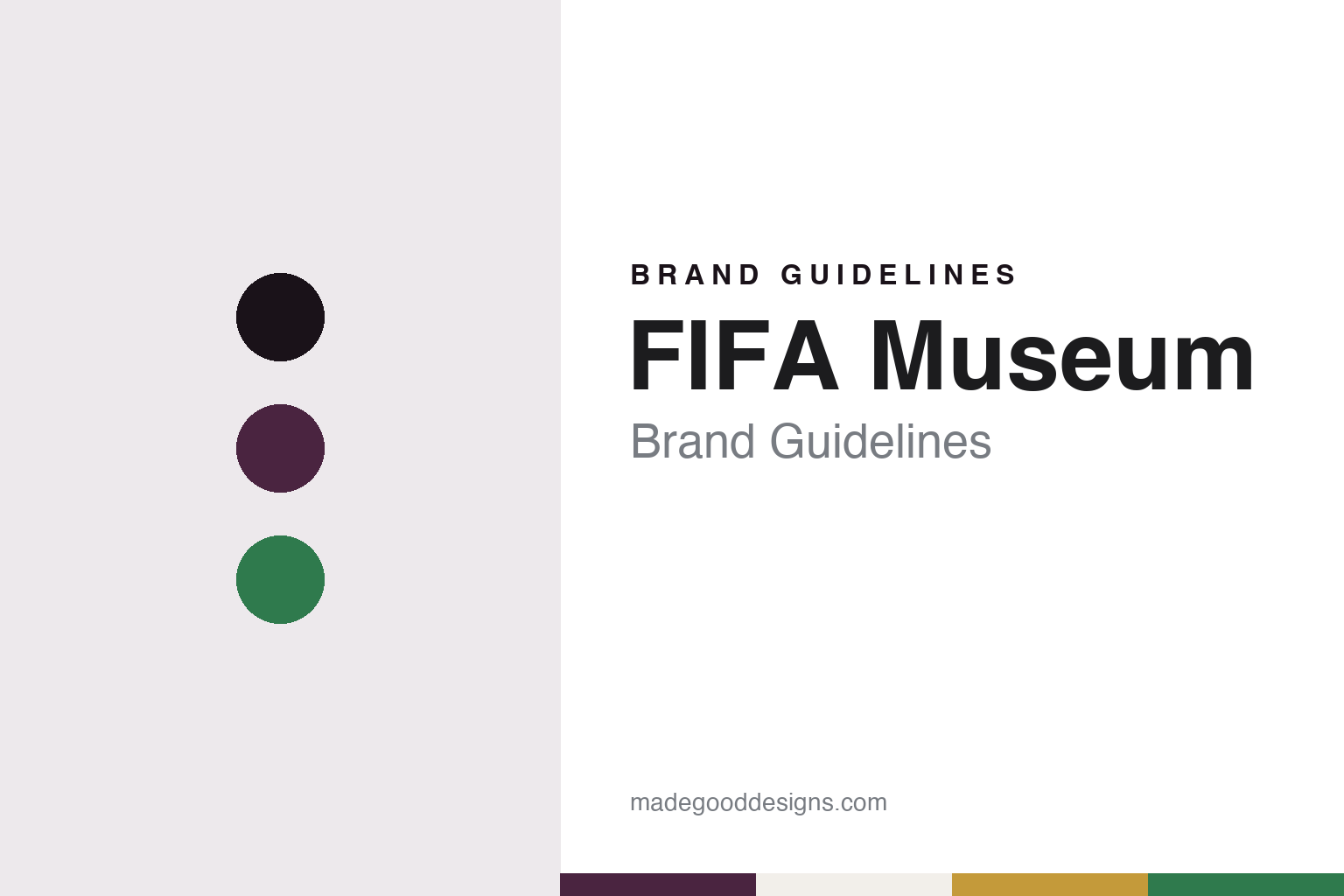
Two constants: a deep aubergine, pitch green and trophy gold palette and a Compact sans register. Abstract homage — not a FIFA Museum or FIFA mark; no trophy, emblem or shirt is reproduced.
Haus zur Enge
A 1978 tower, rebuilt for football.
The FIFA Museum is the football museum created by FIFA, the Fédération Internationale de Football Association, in Zurich, the city where the federation has its headquarters. It opened to the public at noon on Sunday 28 February 2016 under the name FIFA World Football Museum, FIFA reported that day; German Wikipedia records the shorter name, FIFA Museum, which the museum uses today. It stands on Tessinerplatz in the Enge district, opposite Zürich Enge station. German Wikipedia says Zurich was chosen because Switzerland was among FIFA’s founding members and the city is home to its headquarters, and swissinfo.ch reported in January 2016 that FIFA had taken the Olympic Museum in Lausanne as its model.
The museum occupies the lower floors of the Haus zur Enge (“House at the Enge”), a building named after its district. The Swiss architecture portal Architectes.ch, in a report published in December 2018, describes it as a high-rise designed by the architect Werner Stücheli and completed in 1978. It rises from a two-storey base that fills a whole block on the south side of Tessinerplatz, and its elongated upper part, aligned north to south, is laid out on a 135-degree grid that also shapes each floor plan. FIFA laid the museum’s foundation stone in April 2013, and construction was approved a year later, the federation reported in 2016; it also said that it rents the building under a long-term contract with its owners.
The conversion was planned by SAM Architekten und Planer of Zurich, with HRS as general contractor, according to HRS, which names the client as FIFA Museum AG. Architectes.ch reports that the tower was raised from six to eight storeys and that the rebuilt house now holds the museum, shops, restaurants, seminar rooms, offices and 34 apartments. The museum sits in the base and extends down to the two upper basement levels, with its entrance turned towards the station and the square. The outer cladding is made of dark, aubergine-coloured graduated ceramic tiles, chosen, the report says, to give the building an upmarket look; new window frames stand out from the tiles, and the two added top floors are slightly set back. FIFA put the conversion of the house at about 20 months.
Colour
Planet Football and the Rainbow.
Inside, the museum covers about 3,000 square metres over three floors. At its opening it showed more than 1,000 objects, more than 1,400 photographs, about 500 videos, 60 screens and 15 interactive stations, FIFA reported in 2016. The entrance hall is called Planet Football. Its centrepiece is The Rainbow, a round glass case holding the national-team shirts of FIFA’s member associations, sorted by colour — 211 of them, both in the museum’s media kit and in German Wikipedia’s count of May 2018. Large LED screens surround the hall, and an eight-metre timeline traces association football since 1863.
From the hall, visitors go down to The Foundations, the smallest gallery, on the early years of the game, the Laws of the Game and early international competition. Its highlight, the museum says, is the Jules Rimet Cup, including part of the original trophy made by the French sculptor Abel Lafleur in 1930. Also on this level is a 180-degree cinema, which German Wikipedia says shows an eight-minute film of scenes from World Cup finals.
At the heart of the museum, in its own words, is the FIFA World Cup Gallery, devoted to the men’s and women’s World Cups, with a showcase for every tournament staged, interactive stations and audiovisual content. Since the opening it has been the home of the FIFA World Cup Trophy and the FIFA Women’s World Cup Trophy, which, the museum says, leave only when they are being competed for. Before 2016 the two trophies were kept in a Zurich bank vault, FIFA reported at the opening.
The upper floor has a special-exhibition space whose shows change twice a year, a permanent exhibition on football video games and esports that German Wikipedia dates to July 2020, and a walk-in football pinball machine. A library, open by appointment according to the media kit, holds more than 7,500 publications on football, German Wikipedia says. The building also houses a bistro, a shop and rooms for events and seminars, and the bistro and shop can be visited without an entry ticket, the museum says.
Typography
Halls, museums and their honours.
A hall of fame or a sports or music museum usually has an organisation behind its name. Some are independent non-profit foundations that work alongside a league without belonging to it; others are run by a private foundation set up by a founding family, by a body linked to a league or an international federation, or with the support of a city. The founding body, the operator today and the date of the present building are often different things, and each is worth checking separately.
Many halls are tied to a place through a founding story. A town may be where a league was organised, where a sport is said to have begun, or where a musical genre took shape, and halls often present that story themselves, sometimes openly as a legend rather than as settled history. Local campaigns, newspaper headlines and civic fundraising feature in several of these histories, as cities competed to be chosen as the site.
The buildings range widely. Some halls moved into converted buildings, from a former bank to a nineteenth-century casino; others were purpose-built, from a modest red-brick hall on a village main street to rotundas, spheres and lakeside towers designed by named architects. Most have been extended or renovated several times, often to mark an anniversary, and the dates of each expansion are part of the record.
The honours themselves shape how these places look. Members may be marked with plaques bearing a likeness in relief, sculpted busts, jackets or rings, usually presented at an annual ceremony after a vote by writers, committees or panels. Identities in the category tend to borrow from those honours and from trophies, stars and crests, so a hall’s visual language often begins with the object it gives to each new member.
Aa
A compact sans — a nod to scoreboards, shirt numbers and tiled façades. (Specimen set in Inter Tight, a sans STAND-IN; NOT the FIFA Museum logo.)
FIFA Museum
Education, a conference and travelling shows.
The museum runs education programmes built on playful learning, with workshops and themed tours on football-related cultural and social topics for families, clubs, school classes and other groups, and it offers public guided tours in English and German, according to its media kit. Its cultural programme brings debates and panel discussions to the building; German Wikipedia adds film evenings, book presentations and a football quiz, and notes that the museum takes part in Zurich’s annual Long Night of Museums. The museum says it set up the FIFA Museum Conference in 2020 as a two-day summit held in October.
Its exhibitions have also travelled. The museum’s website lists a permanent presence at the Freedom Tower in Miami, where the exhibition “Unidad – The World’s Game” is shown in partnership with Miami Dade College, and an exhibition in Hong Kong with Asia Partners, which it announced in March 2026. In its tenth year, the museum said in May 2026, it launched a digital exhibition, The Magic 10, on the number ten shirt, and its media kit counts visitors from more than 140 countries since the opening. In November 2026 objects from the FIFA World Cup 2026 went on display in Zurich, the museum announced.
For a design guide, the FIFA Museum shows how a converted 1970s tower can frame a sport’s trophies: dark ceramic outside, a rainbow of shirts inside. Compare FIFA, the federation that created it, and The Olympic Museum in Lausanne, which FIFA took as its model, swissinfo.ch reported in January 2016. For this guide we use a deep aubergine, a pitch green and a trophy gold with a sans, an unofficial interpretation; no product or logo is reproduced.
Explore & save
Keep FIFA Museum’s identity on hand — save it to a board in the Made Good inspiration library.
FIFA Museum identity set
Pin the deep aubergine, pitch green and trophy gold palette and the Compact sans register to your own board.
Source & notes
Frequently Asked Questions
What font can I use to match the FIFA Museum look?
This guide describes FIFA Museum’s type as “A compact sans — a nod to scoreboards, shirt numbers and tiled façades”. Its type specimen is set in Inter Tight from Google Fonts as a stand-in; Inter Tight is not FIFA Museum’s own lettering.
What colours are in the FIFA Museum palette?
This guide’s FIFA Museum palette is Deep aubergine #4A2440, Ink #1A1219, Pitch green #2F7A4D, Trophy gold #C49A3A and Paper #F2EFEA. The tones are the guide’s own unofficial interpretation, not official FIFA Museum hex codes.
When did FIFA Museum open?
FIFA Museum opened on 28 February 2016, in Enge, Zurich, Switzerland.
Who founded FIFA Museum?
FIFA Museum was founded by FIFA on 28 February 2016.