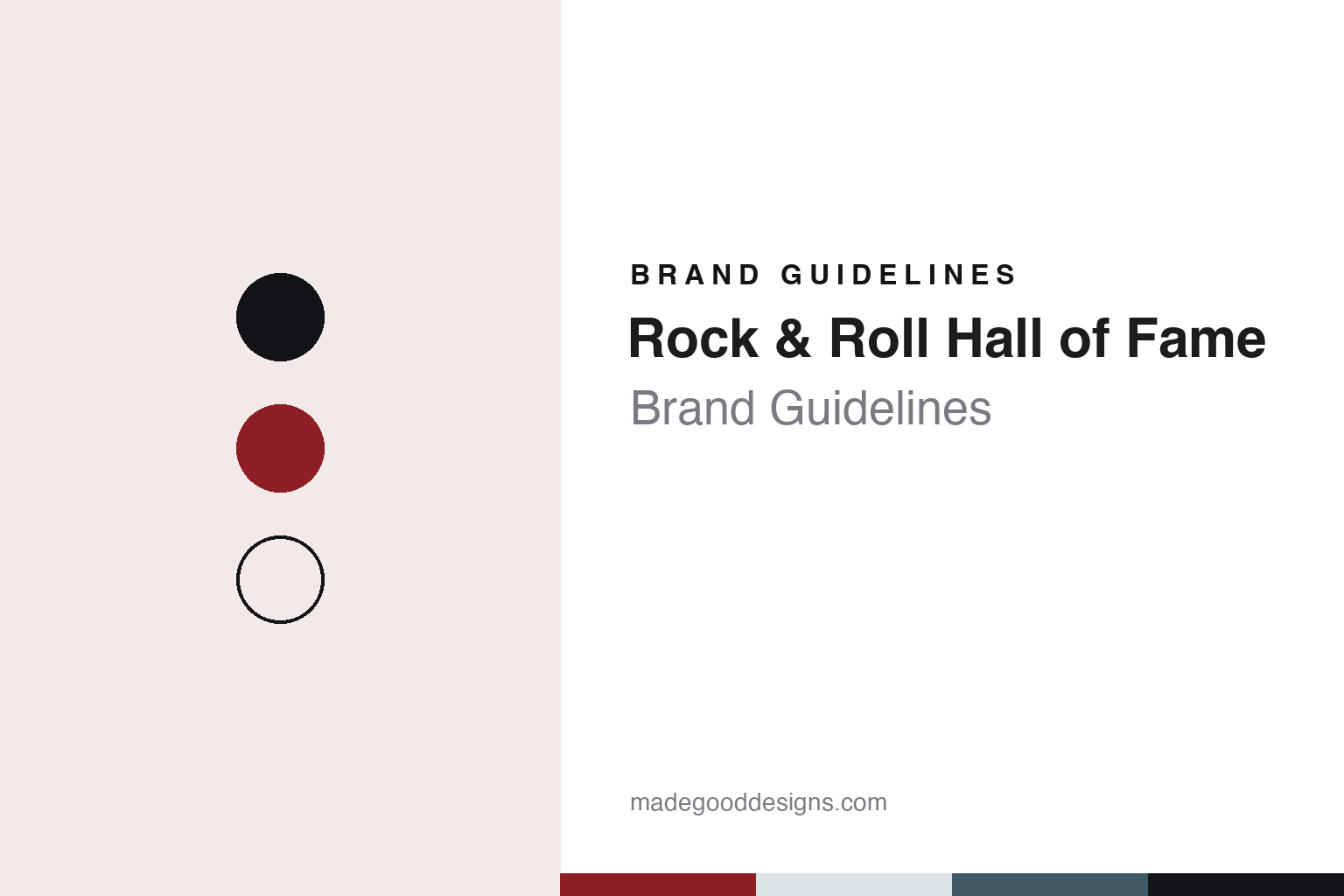
Rock & Roll Hall of Fame Brand Guidelines
The lakefront museum in I. M. Pei’s glass tent.
Aa
Two constants: a stage red, lake glass and ink palette and a grotesque sans register. Abstract homage — not a Rock & Roll Hall of Fame asset; no logo, plaque or building image is reproduced.
A foundation looks for a home
From a New York foundation to a site on Lake Erie.
The Rock & Roll Hall of Fame started as an organisation without a building. English Wikipedia dates the Rock and Roll Hall of Fame Foundation to 20 April 1983, and the Encyclopedia of Cleveland History, published by Case Western Reserve University, describes it as a parent organisation based in New York City. The foundation began inducting members in 1986 while it was still choosing a city for a museum.
Cleveland won that search. The Encyclopedia of Cleveland History says the foundation announced the choice on 5 May 1986, after a year of lobbying by city officials who pointed to the city’s place in early rock and roll radio and to the Moondog Coronation Ball of March 1952. The museum’s own history page says Cleveland was picked over New York, San Francisco, Memphis and Chicago, with strong public support behind the bid.
The site moved during planning. According to the Encyclopedia of Cleveland History, the museum was initially planned for the Tower City Center area; in the autumn of 1990 a new site was chosen between the East 9th Street pier and Cleveland Municipal Stadium, as part of the North Coast Harbor development on the lakefront. Ground was broken on 7 June 1993, a date given by both the museum and English Wikipedia.
The building opened at the start of September 1995. English Wikipedia gives 1 September 1995 as the dedication date, and the museum says it opened its doors to the public on 2 September 1995; the Encyclopedia of Cleveland History places the opening on Labor Day weekend, with a concert of about seven and a half hours at the neighbouring stadium. The Christian Science Monitor, reporting from Cleveland on 7 September 1995, described a seven-storey structure that had taken about ten years from conception to completion.
A short-lived branch followed. English Wikipedia records a Rock and Roll Hall of Fame Annex in Manhattan’s SoHo district, which opened on 18 November 2008 and closed on 3 January 2010. Today the museum describes itself as a registered 501(c)(3) non-profit in Cleveland.
Colour
A tower, a glass tent and a wing over the water.
The building is the work of the architect I. M. Pei, with structural engineering by Leslie E. Robertson Associates, according to English Wikipedia. Its central element is a tower of 162 feet that supports a glass “tent” built from two triangular forms, which opens at its base onto a plaza of about 65,000 square feet. English Wikipedia says the tower was initially drawn at 200 feet and lowered because of the nearby Burke Lakefront Airport.
Writers have read the building in musical terms. The Encyclopedia of Cleveland History says the glass-faced pyramid, which faces the downtown skyline, was meant to suggest the neck of a guitar rising to the sky, and that the plaza in front of it resembles a turntable. The Christian Science Monitor in 1995 described triangular, cubic and circular shapes bursting out from a tall rectangular base, and reported that Pei admitted at the opening press conference that he had been reluctant to take on the project because he was not a rock fan.
Inside, English Wikipedia counts seven levels and more than 55,000 square feet of exhibition space, and credits the exhibit space and opening exhibits to the San Francisco design firm The Burdick Group. The main gallery sits on the lower level, with exhibits on the roots of rock and roll in gospel, blues, rhythm and blues, folk, country and bluegrass, and on the cities that shaped the music. The upper two levels hold large temporary exhibitions.
The Hall of Fame itself occupies a wing that juts out over Lake Erie. The Christian Science Monitor described it at opening as a black room lit only by video screens and by inductees’ signatures etched on backlit glass plaques. The museum also keeps a permanent exhibit called The Songs That Shaped Rock and Roll, a list that English Wikipedia says was planned as part of the museum from its opening and has since grown to 660 songs.
Typography
Halls of fame as buildings.
A hall of fame or a sports or music museum usually has an organisation behind its name. Some are independent non-profit foundations that work alongside a league without belonging to it; others are run by a private foundation set up by a founding family, by a body linked to a league or an international federation, or with the support of a city. The founding body, the operator today and the date of the present building are often different things, and each is worth checking separately.
Many halls are tied to a place through a founding story. A town may be where a league was organised, where a sport is said to have begun, or where a musical genre took shape, and halls often present that story themselves, sometimes openly as a legend rather than as settled history. Local campaigns, newspaper headlines and civic fundraising feature in several of these histories, as cities competed to be chosen as the site.
The buildings range widely. Some halls moved into converted buildings, from a former bank to a nineteenth-century casino; others were purpose-built, from a modest red-brick hall on a village main street to rotundas, spheres and lakeside towers designed by named architects. Most have been extended or renovated several times, often to mark an anniversary, and the dates of each expansion are part of the record.
The honours themselves shape how these places look. Members may be marked with plaques bearing a likeness in relief, sculpted busts, jackets or rings, usually presented at an annual ceremony after a vote by writers, committees or panels. Identities in the category tend to borrow from those honours and from trophies, stars and crests, so a hall’s visual language often begins with the object it gives to each new member.
Aa
A grotesque sans with the weight of a concert bill. (Specimen set in Archivo, a sans STAND-IN; NOT the Rock & Roll Hall of Fame logo.)
The Rock Hall
An annual ceremony, a collection and a landmark programme.
The organisation now styles its name Rock & Roll Hall of Fame, with an ampersand, and uses the short form “Rock Hall” across its own pages; older sources, including English Wikipedia and the Encyclopedia of Cleveland History, spell out “and.”
Induction remains the centre of the calendar. New members are honoured at an annual induction ceremony, held over the years in New York, Los Angeles and Cleveland, English Wikipedia says, at which members receive their award from a presenter, both speak, and the evening includes musical performances. Members are honoured in several categories, including performers and musicians, and English Wikipedia says the ceremony has been televised. Inside the museum, the Hall of Fame wing displays the signatures and plaques of members.
The collection covers the music as a whole rather than members only. The Encyclopedia of Cleveland History lists original lyric sheets, personal mementos, costumes and recording-industry memorabilia, along with listening stations, short films and an archive and library. The museum also runs public programmes of concerts, interviews, lectures and film screenings, according to English Wikipedia, including an interview series that began in April 1996.
Outside Cleveland, the museum names places as Rock & Roll Hall of Fame Landmarks. Its own list includes venues, studios and radio stations such as the Ryman Auditorium in Nashville, designated in 2022, and Austin City Limits in Texas, designated in 2009.
For a design guide, the Rock & Roll Hall of Fame shows how a single building can carry an institution’s image: a glass tent, a tower and a wing over the lake make a silhouette that reads before any lettering does. Compare the Country Music Hall of Fame and Museum, whose Nashville building also uses musical forms, and the Pro Football Hall of Fame, another Ohio hall built around a distinctive structure. For this guide we use stage red, lake glass and ink with a grotesque sans, an unofficial interpretation; no product or logo is reproduced.
Explore & save
Keep Rock & Roll Hall of Fame’s identity on hand — save it to a board in the Made Good inspiration library.
Rock & Roll Hall of Fame identity set
Pin the Rock & Roll Hall of Fame stage red, lake glass and ink palette and the grotesque sans register to your own board.
Source & notes
Frequently Asked Questions
What font can I use to match the Rock & Roll Hall of Fame look?
This guide describes Rock & Roll Hall of Fame’s type as “A grotesque sans with the weight of a concert bill”. Its type specimen is set in Archivo from Google Fonts as a stand-in; Archivo is not Rock & Roll Hall of Fame’s own lettering.
What colours are in the Rock & Roll Hall of Fame palette?
This guide’s Rock & Roll Hall of Fame palette is Stage red #8E1F24, Ink #121417, Lake glass #DCE3E6, Erie slate #3E5866 and Paper #F6F7F7. The tones are the guide’s own unofficial interpretation, not official Rock & Roll Hall of Fame hex codes.