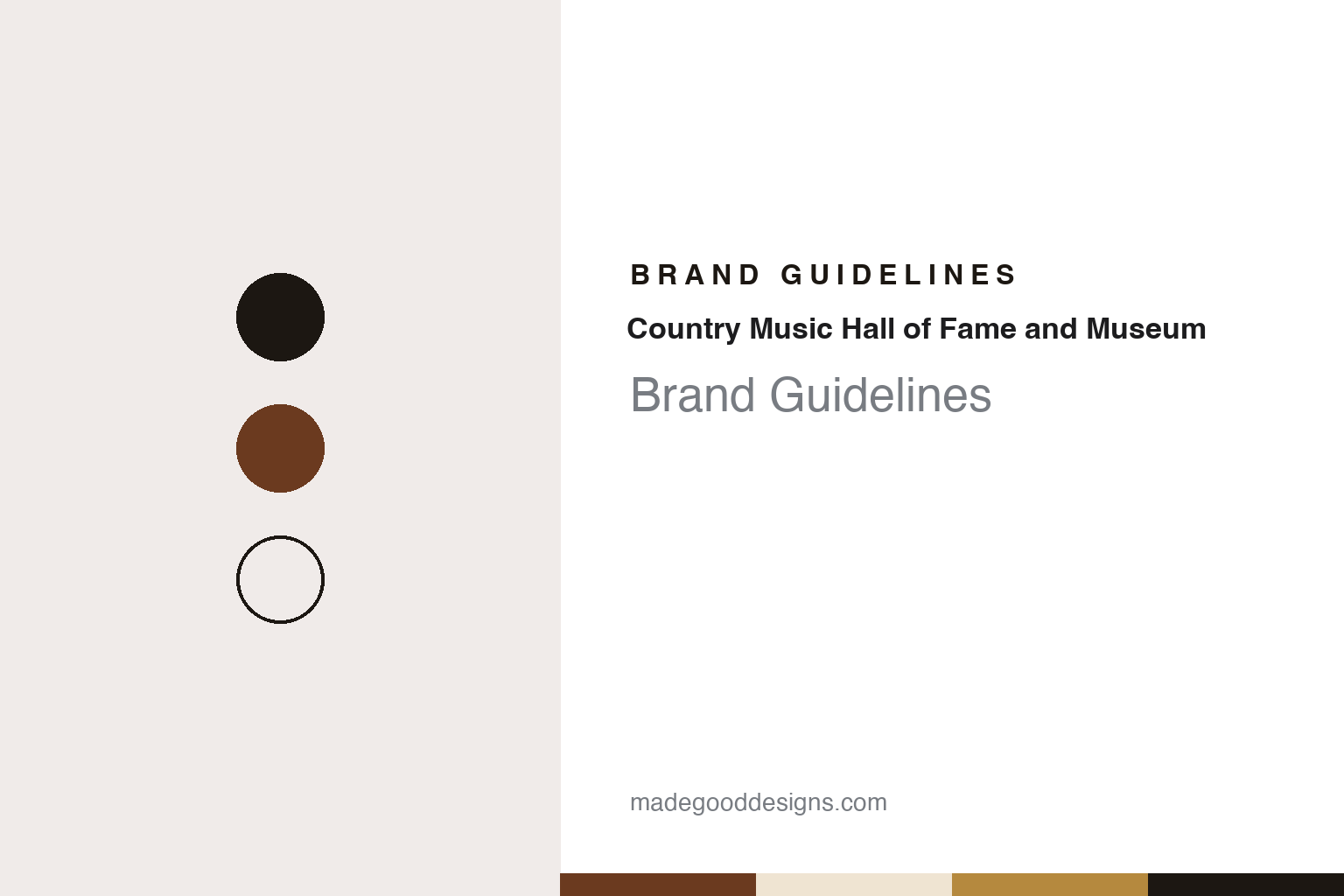
Country Music Hall of Fame and Museum Brand Guidelines
Nashville’s bass-clef building and its print shop.
Aa
Two constants: a barn timber, poster cream and pine gold palette and a slab serif register. Abstract homage — not a Country Music Hall of Fame and Museum asset; no logo, plaque, poster or building image is reproduced.
From Music Row to downtown
An honour, a foundation and a barn-shaped museum.
The Country Music Hall of Fame began as an honour before it had a home. The museum says the Country Music Association, the industry’s trade organisation, created the Hall of Fame honour, and that its opening members were inducted in 1961. To run a museum beyond the remit of a trade body, the non-profit Country Music Foundation was chartered by the State of Tennessee in 1964, according to both the museum and the Tennessee Encyclopedia, published online by the Tennessee Historical Society.
The original museum opened in 1967 at the head of Music Row. English Wikipedia gives the date as 1 April 1967 and describes a barn-shaped building by the firm W.B. Cambron & Co., built on the site of a small city park, with interior exhibits made in New York and assembled in Nashville. The same article says the hall was modelled on the National Baseball Hall of Fame and Museum in Cooperstown, and that its bronze plaques had been shown at the Tennessee State Museum until the new building opened.
The foundation grew around the building. The Tennessee Encyclopedia, in an entry published in 2017, says the foundation shared staff with the Country Music Association until 1971, when it gained its own staff and set up a library in the basement. New museum and library wings followed in the mid-1970s, with programmes for schools, an oral history project and the Journal of Country Music; English Wikipedia lists building expansions in 1974, 1977 and 1984.
In May 2001 the museum moved to a new building in downtown Nashville, designed by Tuck Hinton Architects of Nashville, the Tennessee Encyclopedia says. An expansion opened in April 2014; the theatre consultant Fisher Dachs Associates, which worked on its theatre, says the addition was also designed by Tuck Hinton and more than doubled the museum’s size. The museum now gives its total area as 350,000 square feet of galleries, archival storage, shops and event space, and says it has been accredited by the American Alliance of Museums since 1987.
Colour
A building drawn from music.
The 2001 building is full of musical references. English Wikipedia says that seen from the air it forms a bass clef, that the point of its sweeping arch suggests the tailfin of a 1959 Cadillac, and that its front windows resemble piano keys. A tower above the rotunda reproduces the diamond-shaped WSM radio tower built south of Nashville in 1932.
The Hall of Fame Rotunda carries most of the symbolism. According to the same article, its cylindrical exterior can be read as a drum kit, a rural water tower or a grain silo; the four disc tiers of its roof recall the 78, the LP, the 45 and the CD; and stone bars on the outside wall stand for the notes of the song “Will the Circle Be Unbroken,” whose title rings the interior. Members’ bronze plaques inside the rotunda are arranged like notes on a staff.
Materials point to the region. English Wikipedia lists wood, concrete, steel and stone, with Georgia yellow pine on the floors and Crab Orchard stone from the East Tennessee mountains on the rotunda walls, while steel beams under the glass of the conservatory recall rural railway bridges. Upstairs, hardwood floors, curtain-like case fronts and hanging lights suggest a backstage, and the second floor evokes a recording studio.
The galleries tell the story through the core exhibition Sing Me Back Home: A Journey Through Country Music, which the museum describes as permanent but constantly updated, using artifacts, photographs, recorded sound, archival film and touchscreens. English Wikipedia says the collection includes more than 250,000 sound recordings, about half a million photographic items, more than 30,000 moving images and over 900 instruments, with stage costumes and vehicles, and that material not on display is kept in storage rooms and in the Frist Library and Archives on the third floor.
Typography
Halls of fame as buildings.
A hall of fame or a sports or music museum usually has an organisation behind its name. Some are independent non-profit foundations that work alongside a league without belonging to it; others are run by a private foundation set up by a founding family, by a body linked to a league or an international federation, or with the support of a city. The founding body, the operator today and the date of the present building are often different things, and each is worth checking separately.
Many halls are tied to a place through a founding story. A town may be where a league was organised, where a sport is said to have begun, or where a musical genre took shape, and halls often present that story themselves, sometimes openly as a legend rather than as settled history. Local campaigns, newspaper headlines and civic fundraising feature in several of these histories, as cities competed to be chosen as the site.
The buildings range widely. Some halls moved into converted buildings, from a former bank to a nineteenth-century casino; others were purpose-built, from a modest red-brick hall on a village main street to rotundas, spheres and lakeside towers designed by named architects. Most have been extended or renovated several times, often to mark an anniversary, and the dates of each expansion are part of the record.
The honours themselves shape how these places look. Members may be marked with plaques bearing a likeness in relief, sculpted busts, jackets or rings, usually presented at an annual ceremony after a vote by writers, committees or panels. Identities in the category tend to borrow from those honours and from trophies, stars and crests, so a hall’s visual language often begins with the object it gives to each new member.
Aa
A slab serif in the spirit of a wood-type show poster. (Specimen set in Zilla Slab, a serif STAND-IN; NOT the Country Music Hall of Fame and Museum logo.)
The Medallion Ceremony
An election by the industry, a print shop and a studio.
The museum does not choose its members. Election is conducted solely by the Country Music Association, the museum says: an anonymous panel of voters chosen by the association elects new members each year, normally three, in a Modern Era Artist category, a Veterans Era Artist category and one of three rotating categories for musicians, songwriters and non-performers. New members are inducted at the invitation-only Medallion Ceremony in the museum’s CMA Theater, held in October in 2026, which ends with “Will the Circle Be Unbroken.” Through a licensing agreement with the association, the museum shows the bronze plaques in the rotunda.
Two historic properties extend the museum’s reach. Hatch Show Print, a letterpress shop, was opened in Nashville in 1879 by the brothers Charles R. Hatch and Herbert H. Hatch, according to the Tennessee Encyclopedia, which says its posters were printed from hand-carved maple and basswood blocks and that it has been a non-profit working museum and a division of the Country Music Foundation since 1986. The museum says the shop now sits inside its complex. Historic RCA Studio B on Music Row opened in 1957 and was operated by RCA Records until 1977, the museum says, calling it the oldest surviving recording studio in Nashville; it now serves as a classroom and a visitor attraction.
The foundation also publishes. The museum operates the reissue label CMF Records and the imprint CMF Press, and runs the songwriting programme Words & Music for schools.
For a design guide, the Country Music Hall of Fame and Museum shows a building that spells out its subject in architecture, from piano-key windows to a rotunda roof of stacked discs, alongside a print shop whose wood type has long shaped Nashville’s posters. Compare Hatch Show Print, the letterpress shop the museum operates, and the Rock & Roll Hall of Fame, a music museum in Cleveland also built around its building. For this guide we use barn timber, poster cream and pine gold with a serif, an unofficial interpretation; no product or logo is reproduced.
Explore & save
Keep Country Music Hall of Fame and Museum’s identity on hand — save it to a board in the Made Good inspiration library.
Country Music Hall of Fame and Museum identity set
Pin the Country Music Hall of Fame and Museum barn timber, poster cream and pine gold palette and the slab serif register to your own board.
Source & notes
Frequently Asked Questions
What font can I use to match the Country Music Hall of Fame and Museum look?
This guide describes Country Music Hall of Fame and Museum’s type as “A slab serif in the spirit of a wood-type show poster”. Its type specimen is set in Zilla Slab from Google Fonts as a stand-in; Zilla Slab is not Country Music Hall of Fame and Museum’s own lettering.
What colours are in the Country Music Hall of Fame and Museum palette?
This guide’s Country Music Hall of Fame and Museum palette is Barn timber #6B3A1F, Ink #1C1712, Poster cream #EFE4D2, Pine gold #B5893E and Paper #FAF6EF. The tones are the guide’s own unofficial interpretation, not official Country Music Hall of Fame and Museum hex codes.