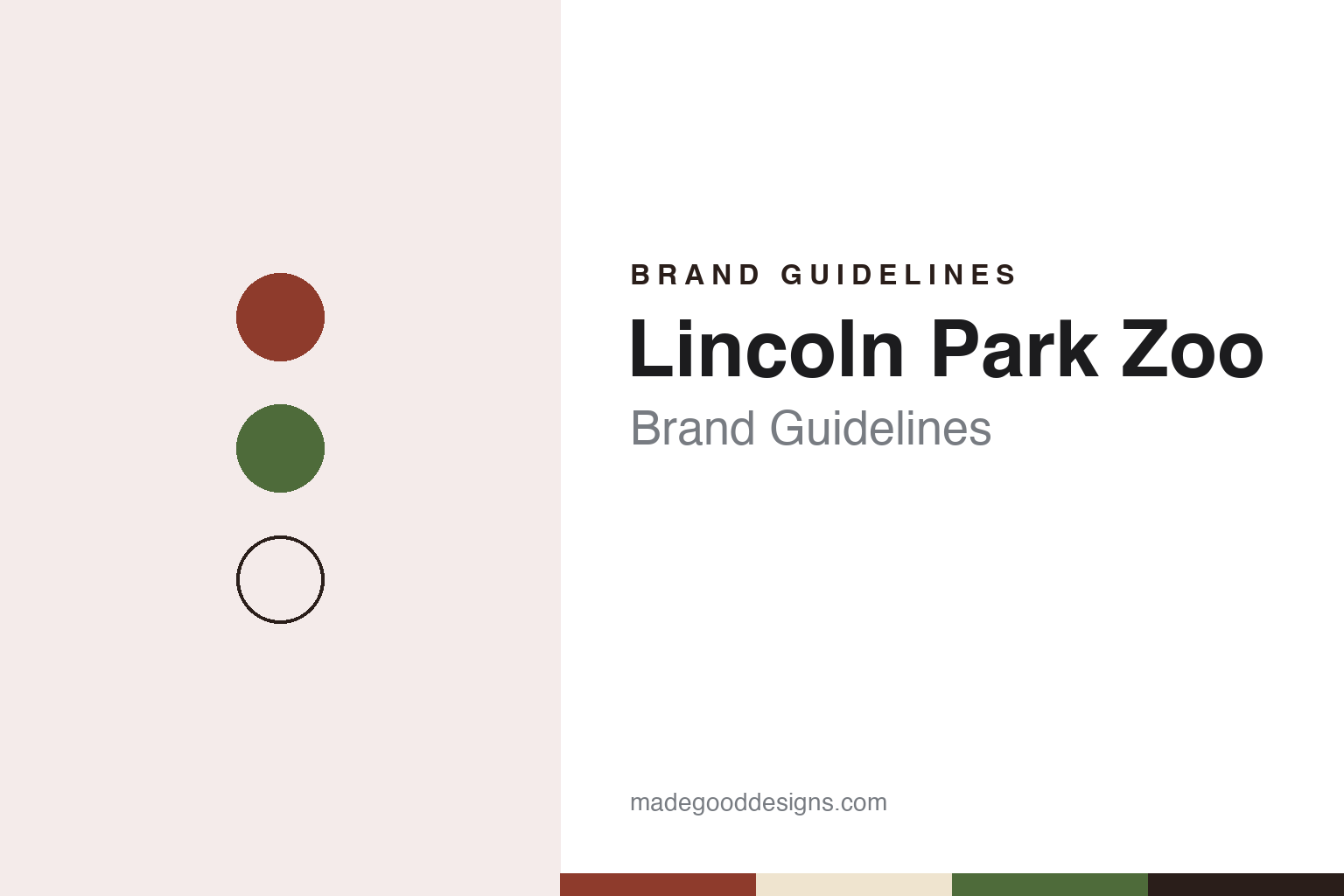
Lincoln Park Zoo Brand Guidelines
Swans from Central Park, a Victorian park landscape and a landmark Lion House.
Aa
Two constants: a brick red, prairie green and warm cream palette and a Prairie sans register. Abstract homage — not a Lincoln Park Zoo asset; no logo, sign or building is reproduced.
Swans in the park
A gift from Central Park in 1868.
Lincoln Park Zoo, historically the Lincoln Park Zoological Gardens, lies at the centre of Lincoln Park on Chicago’s North Side, beside Lake Michigan. It dates from 1868, when the commissioners of New York’s Central Park gave the commissioners of Lincoln Park two pairs of mute swans; the zoo, English Wikipedia, The Cultural Landscape Foundation and a 2009 American Planning Association profile of the park all trace the zoo to that gift. Other animals soon followed, and the zoo says the park authorities declared in 1878 that it must always remain free.
The grounds were laid out in the late nineteenth century by the landscape architects Swain Nelson and Olof Benson, according to The Cultural Landscape Foundation. It says Birch Canal was cut in 1877 to link the park’s North Pond to other waters, later reshaped as the Swan Pond and the Waterfowl Lagoon, and that the zoo grew around them with Victorian gardens, rolling ground, meandering paths, rustic bridges and stands of mature trees. The animal collections, it notes, were worked into the larger park “without fences or admission fees.”
By the early 1900s, the foundation says, enclosures for bears, bison, birds and sea lions sat among pavilions, restaurants and comfort stations, together with the Prairie-style Café Brauer, a refectory on the South Pond designed by Dwight H. Perkins and completed in 1908. Perkins and his partners, as Perkins, Fellows & Hamilton, then designed the Lion House of 1912. The Primate House followed in 1927, and in the 1930s the Works Progress Administration helped refine the landscape as buildings for reptiles and primates were added. By 1965, the foundation says, a year-round children’s zoo and a “Farm-in-the-Zoo” were in place.
For most of its life the zoo was run by the city. In 1995, the zoo says, after 127 years of management by the Chicago Park District within the city’s budget, it came under the management of the Lincoln Park Zoological Society and became a private institution. The Cultural Landscape Foundation says the society was formed as a citizens’ group during a director’s tenure between 1945 and 1962, and English Wikipedia says the Park District remains the landowner. Lincoln Park, with the zoo as a contributing feature, was listed on the National Register of Historic Places in 1994, according to the foundation and the planning association.
Colour
A landmark Lion House and a pond reworked.
The Lion House has the fullest architectural record. Preservation Chicago, writing in October 2021, described its decorative brickwork and terra-cotta ornament, its lion mosaics and a grand hall under a vaulted Guastavino-tile ceiling; the planning association’s 2009 profile picked out its geometric masonry ornament and brick lion mosaics. The city designated it a Chicago Landmark in 2005. It closed in 2019 for a two-year overhaul by the architects Goettsch Partners and reopened in October 2021 as the Pepper Family Wildlife Center, Preservation Chicago reported, citing Block Club Chicago. Landmark status ruled out major changes to the structure, so the work updated the façade and parts of the interior and added a “Lion Loop” route. ArchDaily wrote in November 2021 that the aim was to preserve the original building while increasing its usable area.
Other early buildings remain in use. The zoo says Park Place Café, at its centre, housed a public aquarium before the John G. Shedd Aquarium opened in 1930, and that its exterior still carries signs of that use. Its administrative offices occupy the Laflin Memorial Building, the former home of the Chicago Academy of Sciences, repurposed for zoo staff in the 1990s, the zoo says; Preservation Chicago dates that building to 1893 and lists it with the Primate House of 1927 among the zoo’s historic core.
Since 2000 the zoo has added a series of landscaped habitat areas. English Wikipedia dates Regenstein African Journey, a rebuilding of the former Large Mammal House, to 2003, and The Cultural Landscape Foundation credits that African habitat to the Portico Group. The Regenstein Center for African Apes followed in 2005, Regenstein Macaque Forest in 2014 and a penguin habitat in 2016, according to Wikipedia, and a new entry pavilion by Jacobs/Ryan Associates and Ross Barney Architects in 2018, according to the foundation.
A landscape project reworked the South Pond. In 2010 Studio Gang turned the pond, built in 1908, into the Nature Boardwalk, a 14-acre wetland habitat with a boardwalk, educational zones and an open-air classroom pavilion of prefabricated glue-laminated timber ribs and fibreglass domes, the firm says. The zoo calls the structure the Peoples Gas Education Pavilion and says its form is meant to evoke a turtle’s shell.
Typography
How zoos present themselves.
A zoo usually presents itself through the body that stands behind its name. Some are run by a zoological society founded for the purpose, some by a charity, a company or a city, and some by a state agency that took over from an older society; the Encyclopedia of Melbourne, for example, describes how Melbourne’s acclimatisation society handed its zoo to a state board in 1937. The founding date matters as much as the owner, and many zoos give it a prominent place, whether it falls in the 18th or 19th century or in the decades of the modern site.
The grounds tell the same story in buildings. Older zoos keep historic gates, animal houses and pavilions, some of them on a heritage register, next to large landscaped habitat areas built much later. English Wikipedia describes how Chester Zoo’s founder followed Carl Hagenbeck’s use of moats and ditches in place of bars, an approach that shaped many 20th-century layouts, while the Encyclopedia of Melbourne notes that many 19th-century zoological gardens followed the example of London Zoo.
A large site also needs to be read on the move. Maps, signposts and named areas or zones guide visitors between houses and habitats, and several zoos group their animals by region or climate, so that a path leads from one landscape to the next. Education is part of the offer too, with programmes for schools and families described in general terms on the zoos’ own websites.
Visual identities draw on these layers. Logos often use an animal silhouette or a simple wordmark, signage follows the paths and zones of the site, and the buildings themselves, old and new, carry much of the character. This guide describes each zoo through what dated sources say about its founders, operators, buildings and grounds, and uses colours and type of its own choosing.
Aa
A plain sans that sits beside patterned brick and terra cotta. (Specimen set in Libre Franklin, a sans STAND-IN; NOT the Lincoln Park Zoo logo.)
A private manager, a public park
Free, accredited and set in a historic landscape.
Today Lincoln Park Zoo describes itself as a privately managed nonprofit that is free and open every day of the year. It is accredited by the Association of Zoos and Aquariums, earned Level III arboretum accreditation in 2019 for the trees and woody plants across its 49-acre park, and in 2024 was accredited as a botanic garden by Botanic Gardens Conservation International, the zoo says. The Cultural Landscape Foundation also gives 49 acres and counts more than 1,100 animals; English Wikipedia gives the area as 35 acres. Its learning programmes run from school field trips and year-round camps to high-school internships and research apprenticeships, alongside community programmes co-created with partners in Chicago neighbourhoods including Austin, North Lawndale and Little Village. Each winter it holds ZooLights, which the zoo calls a 30-year Chicago tradition. A history of the zoo, The Ark in the Park: The Story of Lincoln Park Zoo, was published by the University of Illinois Press in 2003, English Wikipedia says.
On identity, the zoo’s website uses the line “For Wildlife. For All.” Much of its visual character, as preservation and planning groups describe it, comes from the park setting and from Dwight Perkins’s buildings: the Prairie-style Café Brauer, whose upper Great Hall the planning association calls a fine example of Arts and Crafts design, and the patterned brick, terra cotta and tile of the Lion House.
For a design guide, Lincoln Park Zoo shows how a free city zoo can let a Victorian park landscape, a 1912 landmark and a contemporary timber pavilion share one identity. Compare Shedd Aquarium, whose 1930 opening the zoo links to the story of its own early aquarium building, and Saint Louis Zoo, another free-admission zoo in the Midwest. For this guide we use a brick red, a prairie green and a warm cream with a sans, an unofficial interpretation; no product or logo is reproduced.
Explore & save
Keep Lincoln Park Zoo’s identity on hand — save it to a board in the Made Good inspiration library.
Lincoln Park Zoo identity set
Pin the brick red, prairie green and warm cream palette and the Prairie sans register to your own board.
Source & notes
Frequently Asked Questions
What font can I use to match the Lincoln Park Zoo look?
This guide describes Lincoln Park Zoo’s type as “A plain sans that sits beside patterned brick and terra cotta”. Its type specimen is set in Libre Franklin from Google Fonts as a stand-in; Libre Franklin is not Lincoln Park Zoo’s own lettering.
What colours are in the Lincoln Park Zoo palette?
This guide’s Lincoln Park Zoo palette is Brick red #8E3B2C, Ink #2A1E1A, Warm cream #EFE4CF, Prairie green #4E6B3A and Paper #F8F5EF. The tones are the guide’s own unofficial interpretation, not official Lincoln Park Zoo hex codes.
When was Lincoln Park Zoo founded?
Lincoln Park Zoo was founded in 1868, in Lincoln Park, Chicago, Illinois.