Mary Beale painted the clergy, gentry and friends of Restoration London, and she did it as a business. Her husband Charles primed canvases, logged sittings and kept the accounts, and his notebooks are one reason we know so much about how a seventeenth-century portrait studio worked. For a designer, that is the interesting part of Mary Beale: not a single masterpiece, but a system. A consistent format, a tight palette and a reliable process produced portrait after portrait for clients who knew exactly what they were getting.
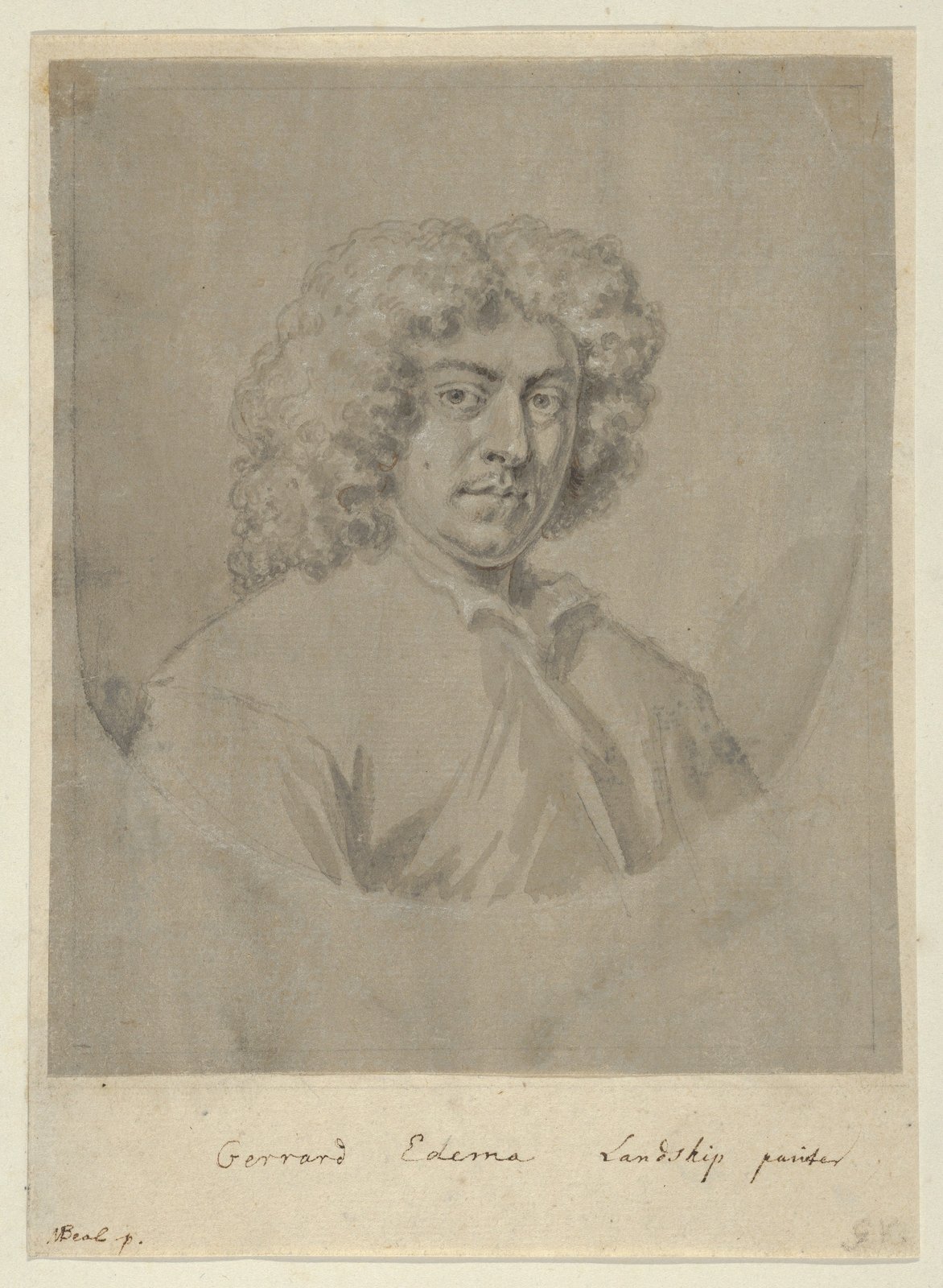
Only one public-domain work linked to her is available in the open-access collections this site uses, a small drawing at the Metropolitan Museum of Art catalogued as attributed to her. Her key paintings are described in text. For more images to study, browse the MGD museum inspiration collection.
Who was Mary Beale?
She was born Mary Cradock in Barrow, Suffolk, and baptised in 1633, according to the Met and the National Gallery of Victoria (NGV), whose essay gives her dates as 1632/3–1699. Her father, John Cradock, was rector of Barrow and an amateur painter; the NGV calls him her likely first tutor, and the Royal College of Physicians (RCP) notes that he became a freeman of the Painter-Stainers’ Company in 1648.
The RCP dates her marriage to Charles Beale to 1652 and says the couple settled in Covent Garden and had two sons. It also records that she appears in 1658 in a list of women painters in William Sanderson’s book Graphice. The NGV dates her acquaintance with Peter Lely, later court painter to Charles II, to 1659, and the National Museum of Women in the Arts (NMWA) says she watched Lely at work and copied many of his portraits. See our guide to Peter Lely for the style she learned from.
The NGV credits her with a short treatise, Observations, dated 1663, a theoretical text on painting. The RCP says the family moved to Allbrook in Hampshire around 1665, after Charles lost his post at the Patents Office, and returned to London around 1670. She died in London in 1699, as the Met and the NGV record, and the NGV says she was buried at St James’s Church, Piccadilly.
The Pall Mall studio as a system
By 1670, the NGV says, Charles had taken over the management of her studio in the family’s Pall Mall house. He primed canvases, recorded sittings and experimented with pigments; the NMWA adds that he bought supplies and handled the accounts. The RCP notes that she called her studio her “paynting roome” and that sittings were often followed by dinner with the family. The NGV describes sittings lasting from three hours to a day, with music and conversation to keep sitters at ease.
The RCP reports that only two of Charles’s notebooks survive, one at the Bodleian Library and one at the National Portrait Gallery. The NMWA, drawing on that record, counts 83 commissions in 1677, her peak year, and an average of 39 a year in the 1680s as Lely’s courtly manner went out of fashion. The NGV also dates the fall in demand to after Lely’s death in 1680. The NMWA names women among her pupils, including Keaty Trioche and Sarah Curtis.
The workshop also made replicas. The RCP says she copied Lely’s paintings and made versions of her own portraits for clients, and the NGV suggests that some of the decorative cartouches around her sitters may have been painted by her sons.
Key works
- Self-portrait with husband and son, about 1663–64, dated by the NGV.
- Self-portrait, about 1666, National Portrait Gallery, London (NPG 1687), as the NMWA records; the NGV dates it to 1666.
- Two oil sketches of her son Bartholomew, about 1660, Tate (T13245 and T13246).
- Portrait of a Woman with a Black Hood, about 1660, oil on canvas, NMWA, Washington, set in an oval and giving the sitter’s age in Latin.
- Portrait of Thomas Sydenham, dated 1688 by the NGV. The RCP holds a Beale portrait of Sydenham presented by his son in 1691, and describes it as unflattering and humane: grey hair, double chin, no props.
- Portrait of a lady, about 1680, oil on canvas, NGV, Melbourne.
These paintings are not in the open-access collections used here, so they are described in text only.
What to look at: format, light and line
- The oval. Many of her portraits set the head and shoulders inside an oval opening, as the NMWA describes for its Woman with a Black Hood. The Met drawing uses the same idea: the sitter sits in a soft oval that fades out at the bottom, so the eye goes straight to the face.
- A close, steady gaze. The RCP calls her approach honest and closely observed. In the Met drawing, the face is the most finished area, with crisp eyes and mouth, while the hair is built from loose looping strokes and the coat is barely suggested.
- Finish where it matters. Tate’s technical study of the Bartholomew sketches found the same priority in oil: profiles drawn lightly but confidently, eyes and mouth needing no correction, curls painted directly and shirts scarcely modelled.
- Lettering. The Met sheet carries a handwritten line beneath the oval naming the sitter as a landscape painter, and a small inscription at lower left that appears to read “Beal p.” It works like a caption bar under a profile photo.
Technique and materials
The Met catalogues its drawing as grey washes and touches of white gouache over graphite on a sheet about 13 by 11 centimetres. That is a compact, tonal technique: one colour family, built from light to dark, with white for the highlights.
In oil, Tate’s research on the two Bartholomew sketches records oil on paper, a thin oil wash laid in before a thicker layer for the main image, and probable yellow and brown ochres, lead white and bone black, with a vandyke brown background. Tate gives Bartholomew’s birth year as 1656, while the NGV says he was baptised in 1655 or 1656. The NMWA says that in her later years she also tried cheaper supports, including onion bags, sacking and bed-ticking, while Charles recorded how each support and primer performed.
Her look belongs to the wider world of seventeenth-century portraiture; our guide to Baroque art covers the broader context.
Palette from the Met drawing
These hex values are measured from the Met’s scan of this specific sheet, not from original materials, and the paper has aged.
- Light paper margin: #e9e4cd
- Pale wash ground: #d8ccb1
- Mid grey wash: #a29883
- Darkest wash and line: #787062
The range is narrow, a warm grey family with no strong accent, which is why the face reads so clearly. Sample your own reference images with the image colour picker and build a scheme in the colour palette generator.
How designers can borrow from Mary Beale
- Standardise the frame. An oval or rounded mask around a head and shoulders gives a team page, speaker list or author grid instant consistency, the way her painted ovals tied a body of portraits together.
- Finish the face, simplify the rest. Put detail where people look first and let clothing and background fall away into broad tone.
- Use a one-family palette. A set of warm greys from paper to dark line is enough for a portrait series and keeps attention on expression.
- Caption like a label. A single handwritten-style line under the image, name and role, is an old and effective device.
- Document the process. Charles Beale’s notebooks recorded sittings, supports and results. A short log of briefs, materials and outcomes is still the backbone of a reliable design studio.
Frequently asked questions
Who was Mary Beale?
Mary Beale was an English portrait painter, baptised in 1633 in Barrow, Suffolk, who died in London in 1699. From around 1670 she ran a professional portrait studio from her home in Pall Mall, with her husband Charles managing it.
What is Mary Beale known for?
She is known for closely observed portraits of clergy, gentry and friends, often in a painted oval, and for a studio whose workings are documented in her husband’s notebooks.
Where can I see paintings by Mary Beale?
Works are held by the National Portrait Gallery and Tate in London, the Royal College of Physicians, the National Museum of Women in the Arts in Washington and the National Gallery of Victoria in Melbourne. The Met holds a drawing attributed to her.
How was Mary Beale connected to Peter Lely?
The National Gallery of Victoria dates their acquaintance to 1659. The National Museum of Women in the Arts says she watched Lely work and copied many of his portraits, and the NGV notes her commissions fell after his death in 1680.