Li Cheng is a painter you meet mostly through other people’s hands. Museums list a handful of scrolls as “attributed to” him, and many more as landscapes “after Li Cheng” or “in the style of Li Cheng”, made by artists who lived centuries later and treated his name as a style to study. The pictures below are not by Li Cheng; they are public-domain works that the Metropolitan Museum of Art and the Cleveland Museum of Art catalogue as made after his compositions. Read them as evidence of a visual language that outlived its author.
For more open-access images to study, browse the MGD museum inspiration collection and its Chinese art theme.
Who was Li Cheng?
The Metropolitan Museum of Art, the Nelson-Atkins Museum of Art and the National Palace Museum in Taipei all give his dates as 919–967, which places him at the end of the Five Dynasties period and the start of the Northern Song. A Lithuanian national encyclopedia entry marks both dates with question marks, so treat them as traditional rather than exact.
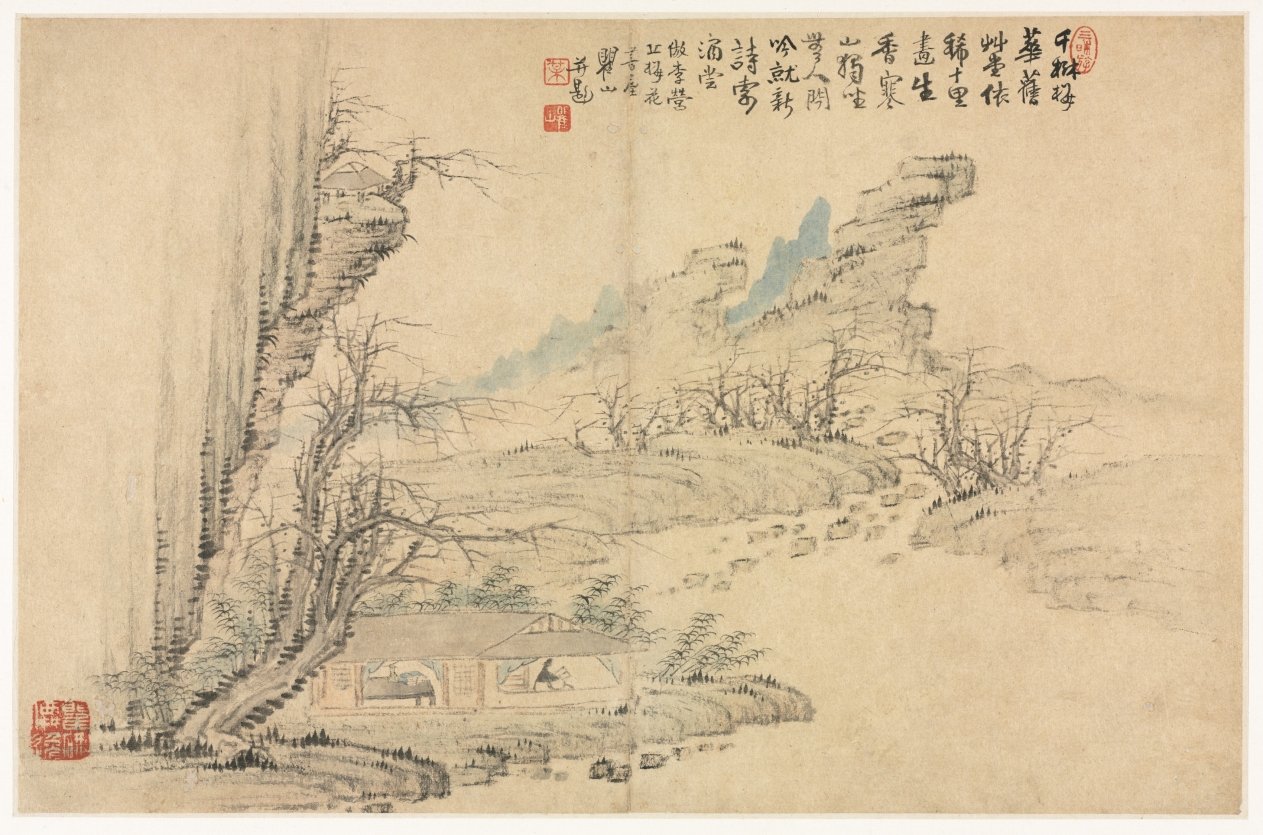
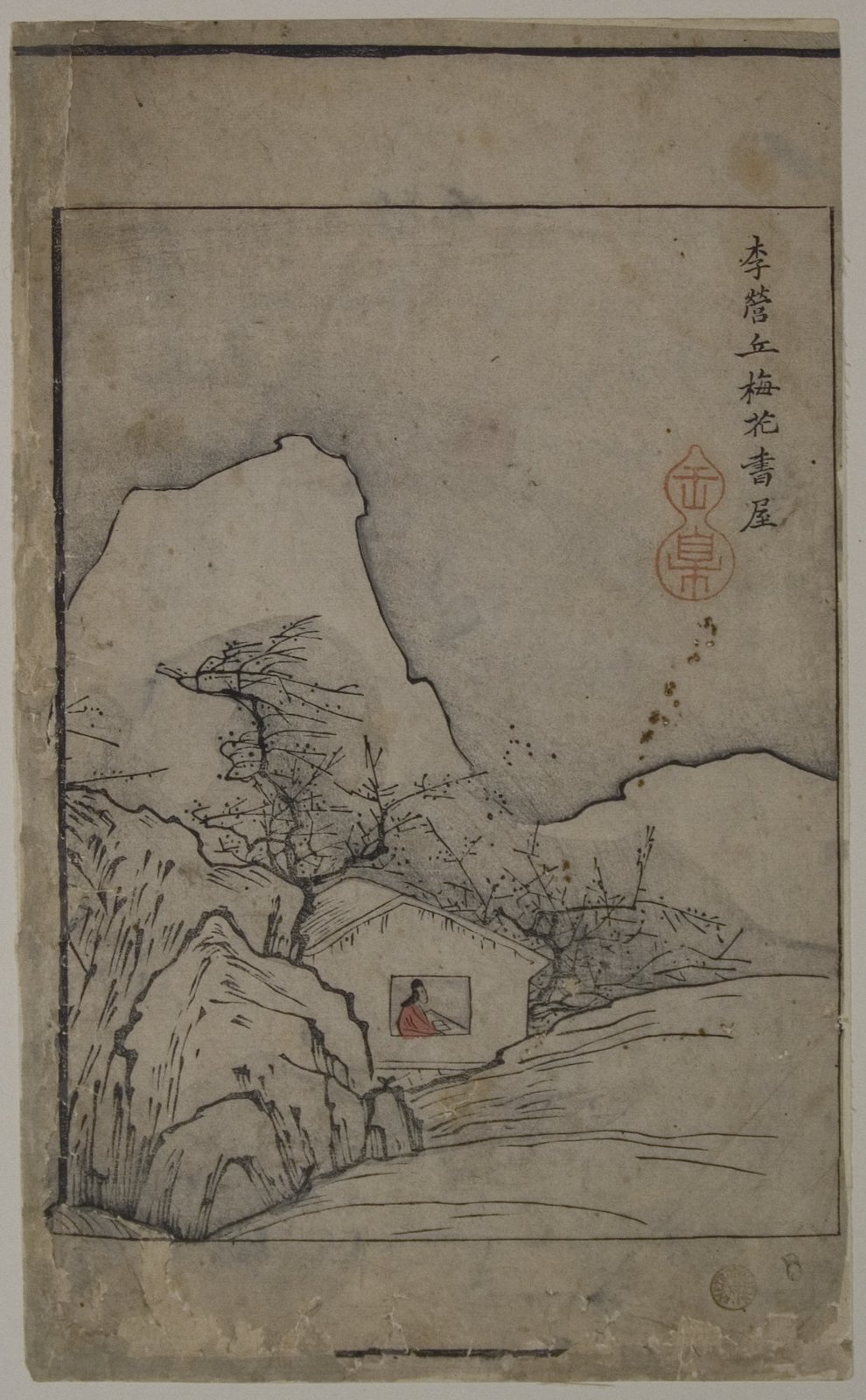
The Osaka City Museum of Fine Arts, in its Google Arts & Culture entry, says he was born into a family related to the Tang imperial house, and the Lithuanian encyclopedia also describes him as from the Tang imperial clan. The National Palace Museum describes him as originally from Chang’an (present-day Xi’an). Later inscriptions often call him Li Yingqiu, a name used both on the Cleveland album leaf above and on the Mustard Seed Garden page below.
The Osaka museum adds that he disliked being considered a painter, which it gives as one reason so little survives, and that as early as the Northern Song the connoisseur Mi Fu put forward a “no Li” theory: that no genuine works by Li Cheng remained even then. That is why careful catalogues of his work read like a list of hedges.
Works attributed to Li Cheng
Two paintings come up again and again, and both are catalogued with caution.
- A Solitary Temple Amid Clearing Peaks, Nelson-Atkins Museum of Art, Kansas City. The museum lists it as attributed to Li Cheng, Northern Song dynasty, hanging scroll in ink and slight colour on silk, about 112 by 56 centimetres. The museum’s notes record a Southern Song imperial seal and say it was in the Song imperial collection by 1210. Its gallery label describes a traveller entering wintry mountains at lower left, with the eye led up to a Buddhist temple and a pagoda rising toward the peak.
- Reading the Memorial Stele, Osaka City Museum of Fine Arts. The museum credits it to Li Cheng and the figure painter Wang Xiao. The stele in the picture is inscribed “Wang Xiao figures, Li Cheng trees and rocks”, but the museum says copying errors suggest the surviving scroll is a Yuan dynasty copy.
Neither is in the open-access collections used here, so both are described in text only.
What to look at in the Li Cheng tradition
The National Palace Museum sums up his manner in a few traits, and the later copies make them easy to spot.
- Crab-claw trees. Both the National Palace Museum and the Osaka museum describe his bare trees as drawn in a “crab-claw” manner: branches that bend and hook downward at the tips. In the Cleveland leaf, the trees at left are a tangle of these hooked lines, and they read clearly even at thumbnail size.
- Level distance. The National Palace Museum says he mostly painted level-distance views of bleak, expansive scenery: the eye travels back across flat ground and water rather than up a cliff. In the Cleveland leaf, most of the paper is low, open ground running to faint hills.
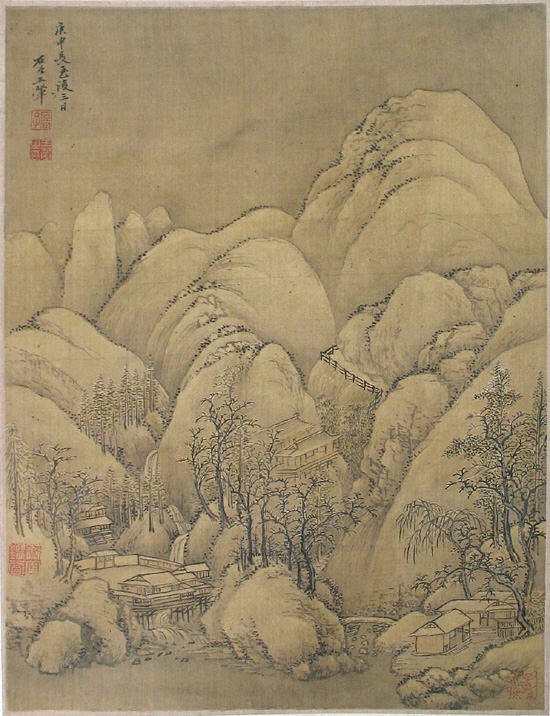
- Curled-cloud rocks. The same museum notes his rocks for “curled-cloud” texture strokes, soft rounded forms built up in layers. The snowy Met landscape below shows the idea in its billowing mountain shapes.
- Winter subjects. The Lithuanian encyclopedia describes detailed winter and autumn landscapes with bare trees and temples, and the National Palace Museum calls wintry trees his signature subject.
The plum-blossom study: one composition, three versions
One subject shows how Li Cheng’s name travelled. A composition called the Plum Blossom Study (or Prunus-Blossom Study) appears in at least three public-domain works linked to him.
- The Cleveland Museum of Art’s album by Mei Qing, dated 1690, includes a spring leaf whose inscription, in the museum’s translation, reads “Imitating Li Yingqiu’s [Li Cheng] ‘Prunus-Blossom Study.’” It is ink and colour on paper, about 29 by 44 centimetres.
- The Met holds a woodblock-printed page titled Study Pavilion and Plum Trees from The Mustard Seed Garden Manual of Painting, a painting manual whose first edition the Met dates to 1679. The Met lists Li Cheng as the painter of the original that the page reproduces.
- The Art Institute of Chicago holds The Plum Blossom Studio in the style of Li Cheng, a hanging scroll by Mei Chong of the late seventeenth century, in ink and light colours on paper. The museum’s open-access scan is too small to reproduce here.
Compare the two embedded versions. The manual page compresses the scene into a vertical panel: a steep peak, a plum tree and a little hut with a figure in the window, all outlined in firm black cut lines. Mei Qing turns it horizontal and loosens it, pushing the hut to the bottom corner and giving most of the leaf to empty ground and air. Same motif, two very different layouts.
Technique: ink, silk and the copying tradition
The two attributed scrolls are both ink with light colour on silk, according to the Nelson-Atkins and Osaka museums. The later works here use the same restrained materials: the Met’s snowy landscape is ink on silk, the Cleveland leaf is ink and colour on paper, and the Mustard Seed page is a polychrome woodblock print in ink and colour on paper.
Copying was not forgery in this tradition. Inscriptions such as Mei Qing’s openly announce that a picture imitates an older master’s brushwork, and the Met also holds Wang Hui’s Snow Clearing: Landscape after Li Cheng, dated 1669. The National Palace Museum says Guo Xi, a court painter of the following century, studied Li Cheng’s painting methods, and the museum repeatedly groups later works under a “Li Cheng and Guo Xi” school. See our guide to Guo Xi for the next step in that lineage, and our overview of landscape painting for how it compares with Western traditions.
Palette: pale grounds and one warm accent
These hex values are measured from the museums’ scans of these specific objects, not from original pigments, and aged silk and paper have shifted over time.
- Cleveland leaf (Mei Qing, 1690): warm paper ground #e3cca8, mid tan #c2af8f, ink grey #726756 and a seal red averaging #c58467.
- Met snowy landscape: silk ground #a0906d, ink #4e4736 and seal red averaging #b17f66.
- Mustard Seed Garden page: grey-brown paper #8c8171 with black-brown line #332c25.
Almost everything sits in a narrow band of warm neutrals, dark ink is saved for branches and contours, and the only saturated colour is a small seal red. Try the scheme in the colour palette generator.
How designers can borrow from Li Cheng
- Give the space to the ground. Level distance is a layout idea: a low horizon and a wide, quiet middle. Use it for hero images, banners and book covers where the type needs air.
- Make one silhouette carry the picture. A single bare tree with hooked branches reads at any size. In a logo or spot illustration, a strong outline against a pale field does more than detail.
- Work in tints, accent once. Keep most of a palette within one warm neutral family and reserve a small red, like a seal, for the call to action or signature.
- Reformat a motif. The plum-blossom study works as a vertical print page and as a horizontal album leaf. Practise turning one composition into portrait, landscape and square crops.
Frequently asked questions
When did Li Cheng live?
The Met, the Nelson-Atkins Museum of Art and the National Palace Museum give his dates as 919–967, at the transition from the Five Dynasties to the Northern Song. Some reference works mark those dates as uncertain.
Are there any original paintings by Li Cheng?
None is securely his. A Solitary Temple Amid Clearing Peaks in Kansas City is catalogued as attributed to him, and the Osaka museum considers its Reading the Memorial Stele a Yuan dynasty copy. Already in the Northern Song, Mi Fu doubted that any genuine works survived.
What does “after Li Cheng” mean on a museum label?
It means a later artist made the work in imitation of a composition or style associated with Li Cheng. It is not by Li Cheng himself, and the label is an honest record of that relationship.
What are crab-claw trees?
It is a name for bare winter trees whose branches bend and hook at the tips, like a crab’s claws. The National Palace Museum and the Osaka City Museum of Fine Arts both associate the manner with Li Cheng.