Epicurean Brand Guidelines
Cutting boards from skate ramps.
Aa
Two constants: a composite-slate palette and a composite-sans register. Abstract homage — not an Epicurean product or mark; no board, block or logo is reproduced.
Cutting boards from skate ramps
Epicurean is the paper-composite cutting board spun out of a Wisconsin skatepark-ramp builder — still made in Superior from the same material as skate ramps.
Epicurean follows Teakhaus as the round’s composite node — a paper-and-resin cutting board that spun out of a skatepark-ramp builder, made from the off-cuts of the ramp surfaces, and still made in Wisconsin. Its answer to a round about the material and where it is made is a composite one: a genuine US maker of a non-wood, non-plastic paper composite with an unlikely origin.
Its identity is cutting boards from skate ramps. The skatepark origin, the paper composite and the Wisconsin making are the story here. Ramps to boards. Cutting boards from skate ramps.
(Honest notes, so the origin, the material and the claims are framed accurately, with a trap avoided. Epicurean sells wood-fibre paper-composite cutting boards as its heroes — dishwasher-safe, non-porous, heat-resistant and maintenance-free, with a strong commercial presence; we report its language as the brand’s own. On origin: Epicurean was founded in 2003, spun out of TrueRide, a skatepark builder, when its owners made cutting boards as gifts from the paper-composite off-cuts of skate-ramp surfaces, and when TrueRide wound down it split into Epicurean, for boards, and Loll Designs, for recycled-plastic furniture, its sister company. On headquarters, corrected: Superior, Wisconsin, not Duluth, Minnesota, the adjacent twin city. On where it is made: made in the USA in Superior, from a paper composite that is US-made from locally-sourced materials, with the honest caveat that some silicone and nylon accessory parts are sourced from China. On the material and a naming trap: the board is layers of kraft paper saturated with a food-safe phenolic resin, fused under heat and pressure, and while retailers often call it Richlite, Richlite is a separate trademarked company, and Epicurean makes its own composite, so we call it a Richlite-style phenolic paper composite rather than Richlite. On claims, separated: it is NSF-certified for commercial food service, a real certification; it holds a low-emissions certification with formaldehyde tested well below limits, so we say low, third-party-tested emissions rather than formaldehyde-free, since the phenolic resin contains trace formaldehyde; and its solar and biomass figures are the company’s own. Its designs and the Epicurean name are IP we describe but do not reproduce; there is no official brand hex; these tones are an unofficial interpretation.)
Colour
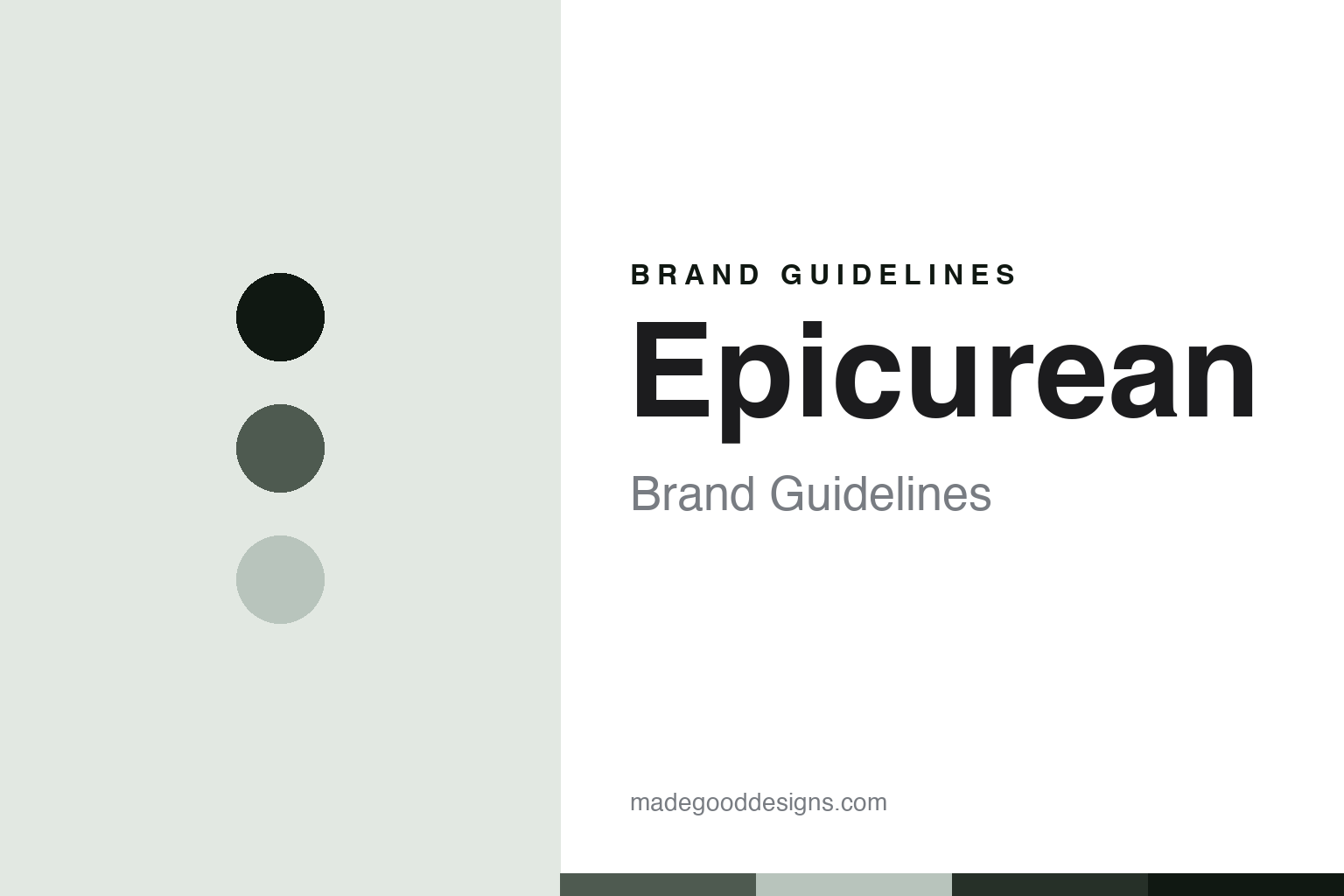
Epicurean lives in a composite slate. Click a swatch to copy the hex.
Epicurean’s identity is skatepark-born, independent and Wisconsin-made — a composite slate, an ink, a pale sage, a deep slate, and a paper. The palette leans composite slate and deep slate: a cool, engineered register that nods to a non-wood, non-plastic composite rather than a loud logo colour. It signals cutting boards from skate ramps — skatepark-born, independent and Wisconsin-made. The honest caveat: with no official brand hex, these values are a composite, unofficial interpretation, not first-party colours.
The lesson is a composite slate signals a material-innovation, engineered identity. Epicurean’s world is the paper composite. For designers, it is a reminder that a composite slate and a pale sage can carry a material-led, engineered brand — a cool tone held as an accent, not a product shot. Because a neutral hue can read flat, keep type dark and let the tone live in the accents, palette and band. The takeaways: credit the 2003 skatepark spin-out from TrueRide; correct the headquarters to Superior, Wisconsin; describe the material as a Richlite-style phenolic paper composite, not Richlite; state the NSF certification; and say low, tested emissions rather than formaldehyde-free.
Typography
The register is a composite sans — skatepark-born, independent, Wisconsin-made.
Epicurean’s identity carries a skatepark-born, independent, Wisconsin-made spirit — a material innovation from an unlikely place. A composite sans captures the mood: clean, exact and modern, the register of an engineered material. Set in a composite-slate palette, the composite sans feels precise and current — exactly the personality Epicurean carries. It behaves like a pressed, made thing rather than a loud logo, mirroring a plank-band and an end-grain-grid. (Epicurean’s real products and the name are things we describe but do not reproduce, and the exact typeface is not ours to use.) Because it is not ours to use, the honest description is “a composite-sans brand,” shown here in a stand-in. The type behaves like the brand: skatepark-born, independent and Wisconsin-made.
Aa
A composite-sans brand — precise and current. (Specimen set in Space Grotesk, a composite-sans STAND-IN; NOT the Epicurean logo or products.)
The cutting-board node
Epicurean stands for cutting boards from skate ramps.
Epicurean sits sixth in the round as its composite node. A composite-slate palette, a composite sans and a 2003 founding make one thing — cutting boards from skate ramps — the whole identity: skatepark-born, independent and Wisconsin-made. The skatepark origin is the pitch, the paper composite is the material, and the Wisconsin making is the pride. The point is a genuine US maker of a non-wood, non-plastic composite with an unlikely origin, in a round about the material and where it is made.
Put to work, the identity is the brand told straight, the material described precisely and the claims separated. A brand in this spirit would credit the 2003 skatepark spin-out, correct the headquarters to Superior, describe the material as a Richlite-style phenolic paper composite, state the NSF certification, and say low, tested emissions rather than formaldehyde-free. A reader in this spirit would keep the facts right: Epicurean sells paper-composite boards; it was founded in 2003, spun out of the skatepark builder TrueRide from the ramp off-cuts, with Loll Designs its sister company; it is headquartered in Superior, Wisconsin, not Duluth; it is made in the USA, with some accessory parts from China; and its material is a Richlite-style phenolic paper composite, NSF-certified, with low, tested emissions. Epicurean sits after Teakhaus and before Material Kitchen. The honest editorial moves are to credit the origin, to correct the headquarters, to describe the material precisely, and to separate the claims.
For designers and brand-builders, Epicurean carries the cutting-board node: own an unlikely material origin — and don’t borrow another company’s trademark. The lessons: a brand can be born from an unrelated industry, here Epicurean from a skatepark-ramp builder; a founding is dated to 2003 as a spin-out of TrueRide, the cutting boards first made from the paper-composite off-cuts of skate ramps, with Loll Designs its sister company; a headquarters is corrected to Superior, Wisconsin rather than the adjacent Duluth, Minnesota; a material is described precisely as a Richlite-style phenolic paper composite rather than Richlite, since Richlite is a separate trademarked company and Epicurean makes its own; and the claims are separated, the NSF a real certification, the low-emissions certification stated as low, third-party-tested emissions rather than formaldehyde-free given the phenolic resin’s trace formaldehyde, and the solar and biomass figures kept as the company’s own. It is also a reminder to stay precise: Epicurean is the independent, Wisconsin-made paper-composite board brand — with the palette here an unofficial interpretation and the Richlite trademark not borrowed. The hook is that origin: Epicurean’s cutting board is made from the same paper-and-resin composite as skatepark ramps, the company having spun out of a Wisconsin skatepark builder in 2003 from the ramp off-cuts, and it still makes them in Superior, Wisconsin. Read that way, Epicurean is less a single board than cutting boards from skate ramps: skatepark-born, independent, Wisconsin-made. The lesson for a brand is that owning an unlikely origin and not borrowing another company’s trademark reinforce each other, and separating the claims keeps the story earned. Epicurean made cutting-boards-from-skate-ramps the identity — proof that an unlikely material origin can anchor a node.
Explore & save
Keep Epicurean’s identity on hand — save it to a board in the Made Good inspiration library.
Epicurean identity set
Pin the composite-slate palette and the composite-sans register to your own board.