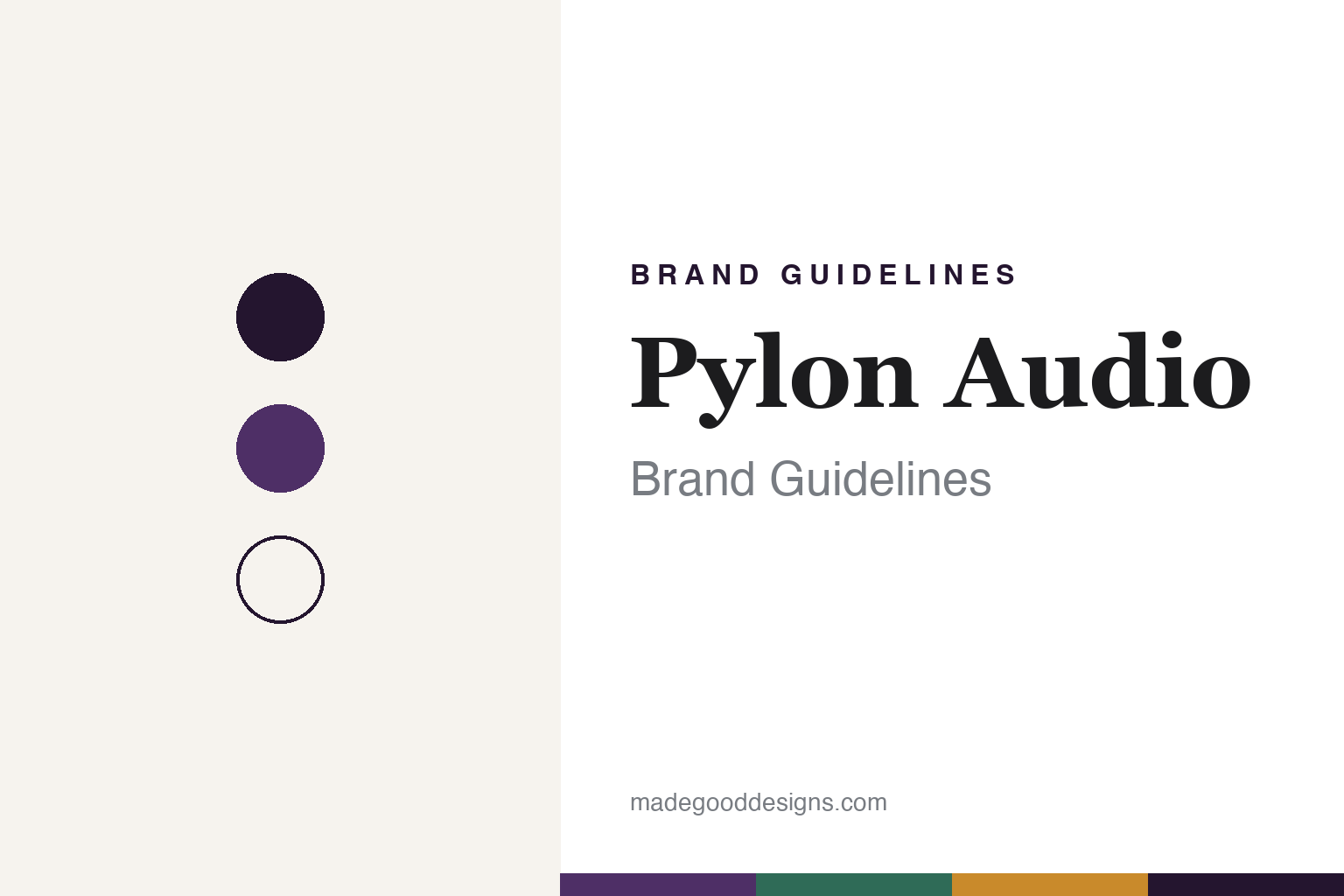
Pylon Audio Brand Guidelines
The Jarocin loudspeaker factory that names its speakers after stones.
Aa
Two constants: a Pylon Audio amethyst, jade and amber palette and a Classic serif register. Abstract homage — not a Pylon Audio product or mark; no loudspeaker, logo or nameplate is reproduced.
Two friends and a furniture trade
Cabinets first, then a brand of its own.
Pylon Audio is the loudspeaker brand of a company set up in May 2011 as Pylon S.A. The company’s own history says it was founded that year by two childhood friends, Mateusz and Mikołaj — named in its stock-market profile as Mateusz Jujka, president of the board, and Mikołaj Rubeńczyk, vice-president. The company says the idea grew out of a family trade: Mateusz’s mother and Mikołaj’s father had founded a furniture company known for its woodworking, and the friends’ first business was making speaker cabinets before they put their own name on complete loudspeakers.
First, a correction. Pylon is sometimes placed elsewhere in Poland — one retailer calls it a Poznań company founded in 2007 — but the company’s own address and the Polish trade press put its factory in Jarocin, a town in Wielkopolska, western Poland, best known to Polish music fans for its rock festival. The registered office is in Warsaw, on Grzybowska Street, where archived versions of the website show it in the Pylon S.A. years too.
The first product was modest. The Polish magazine High Fidelity, which says Pylon made its debut in its pages, recalled in 2022 that the first model, the Pearl 20 of 2011, was a small, inexpensive floorstanding speaker fitted with two drivers made by Tonsil, the long-established Polish loudspeaker maker. Pylon’s reports to investors, as summarised in the financial press, say production began at Przyborki near Września and later moved about 50 kilometres to Jarocin; the company bought its own factory there in January 2016 and moved production into it that September, the business service of Interia reported.
Pylon went public early. Pylon S.A. has been listed on NewConnect, the Warsaw Stock Exchange’s market for smaller companies, since 2013, Interia reported, and its headcount grew from four people in 2013 to 49 in 2024, according to the company profile published by money.pl.
Colour
Gemstones, drivers and a very quiet room.
Pylon names its speakers after stones. High Fidelity noted in 2024 that ever since the Pearl, the company has named its series after precious and semi-precious stones — and pearls: Pearl at the entry point, then Amber, Emerald, Sapphire, Opal, Diamond, Ruby and Jade, with the newer Zirkon replacing Emerald and the Jasper series at the top. Today’s website lists Jasper, Jasper Active, Amber mkII, Jade, Zirkon 20, Diamond and Opal, an audio rack called Obsidian, and a flagship called Amethyst.
What sets Pylon apart from many small makers is scale and in-house production. The company says its cabinet factory covers 3,300 square metres and employs about 50 specialists, that it buys parts from suppliers including Mundorf, Seas and Scan-Speak, and that it makes key components itself, among them drivers and crossover coils. High Fidelity wrote in 2022 that Pylon now designs and makes the large majority of the drivers it uses, and its editor, Wojciech Pacuła, called it the only large-series loudspeaker production in Poland. In the same interview Jujka described a second paint booth, a robotic sanding arm and 200 square metres of solar panels on the factory roof, and said the brand, until then passive-only, would add active speakers; a Jasper Active series is now listed.
Then there is the chamber. In about 2016 Pylon won PLN 4.47 million from Poland’s Ministry of Development towards a PLN 8.36 million research-and-development centre for loudspeaker and cabinet design, Interia reported; stock-market profiles place that centre in Zambrów, in north-eastern Poland, and the factory in Jarocin. The company calls its anechoic chamber the largest in Poland, a claim we have not checked. Jujka told High Fidelity in 2022 that it measures 10 by 10 by 10 metres outside, with a 6-metre-cube working space and more than four thousand acoustic wedges; the website now says 6,543 wedges, a floor of 300 steel ropes and absorption above 97 percent.
The vintage-styled Jade 20 of 2022 shows the house style: a two-way speaker with a large paper-coned woofer and a compression driver in a 3D-printed Tractrix horn, in American walnut veneer. Jujka suggested partnering it with push-pull valve amplifiers “such as the Fezz Audio Titania.” In September 2026 the company reported that High Fidelity had given its Opal 30 mkII a RED Fingerprint award.
Typography
Central European hi-fi.
Central Europe’s audio industry has a long state-era record. In Poland, Unitra, the association of consumer-electronics makers, was set up in 1961 and kept its original structure until 1989, English Wikipedia says; the Tonsil loudspeaker works in Września, founded in 1945, ran as a state enterprise until 1990, according to Polish Wikipedia. In Czechoslovakia, Tesla was the state conglomerate that monopolised electronic appliances and components from 1946 until its privatisation in 1991.
The region has since become a workshop for Western brands as well as its own. Pro-Ject, founded in 1991 in Mistelbach, Austria, designs at home and makes its products in Germany, the Czech Republic and Slovakia, English Wikipedia says; the German magazine lowbeats reported after a factory visit that Canor’s plant in Prešov makes all of Pro-Ject’s electronic components, and those of IsoTek and Musical Fidelity.
The trade meets in Warsaw, where the Audio Video Show holds its 28th edition in October 2026; its organisers call it the world’s second-largest audio show.
The seven makers in this guide are spread across the region, according to their websites and business listings: Pylon Audio in Jarocin and Fezz Audio near Białystok, in Poland; Ancient Audio in Kraków; Mytek, founded in New York in 1992, with a European branch in Warsaw; Xavian at Hostivice, outside Prague; Canor in Prešov, in eastern Slovakia; and Ayon at Gratkorn, near Graz, in Austria.
This guide sets out what can be checked about each brand — who founded it, who owns it, and what it says about where its products are made — and marks clearly what rests only on the company’s own word.
Aa
A classic serif for a maker of veneered cabinets. (Specimen set in Cormorant Garamond, a serif STAND-IN; NOT the Pylon Audio logo.)
Pylon Audio
A listed company with a factory floor.
The company has since changed its name but not its business. In 2022 Pylon S.A. became JRC Group S.A. — money.pl dates the change to 10 October 2022, other market profiles to November — and still describes itself as a maker of Pylon Audio loudspeakers, drivers, accessories and cabinets, with the Jarocin factory and the Zambrów research centre. The Pylon Audio website names JRC Group S.A. as its data controller. The founders still run it: money.pl lists Jujka and Rubeńczyk on the board and, as of February 2026, shareholders led by Łukasz Chojnacki with about 24 percent, with Jujka holding about 13 percent. JRC Group told investors that a project called “Pylon Audio Amethyst” had been selected for funding under Poland’s FENG technology-credit programme, with a project value of PLN 2.754 million. The company says its products are sold in more than 20 countries.
Pylon is also a contract manufacturer. Jujka told High Fidelity that the factory builds cabinets and assembles complete loudspeakers for other audio companies, makes crossovers for some of them in Jarocin, and that some clients keep it secret who builds their speakers. Pylon also often appears alongside a neighbour that began as a supplier: at the HIGH END show in Vienna in June 2026, the first edition in its new home, and at the Hong Kong Audio Visual Show that August, it shared a stand with Fezz Audio, the company says.
For a design guide, Pylon Audio shows how a naming system can carry a brand: a cabinet factory turned loudspeaker maker that gives every series the name of a stone. Compare Fezz Audio, its frequent show partner, and Vienna Acoustics, another Central European loudspeaker maker. For this guide we use amethyst, jade, amber and walnut tones with a serif, an unofficial interpretation; no product or logo is reproduced.
Explore & save
Keep Pylon Audio’s identity on hand — save it to a board in the Made Good inspiration library.
Pylon Audio identity set
Pin the Pylon Audio amethyst, jade and amber palette and the Classic serif register to your own board.