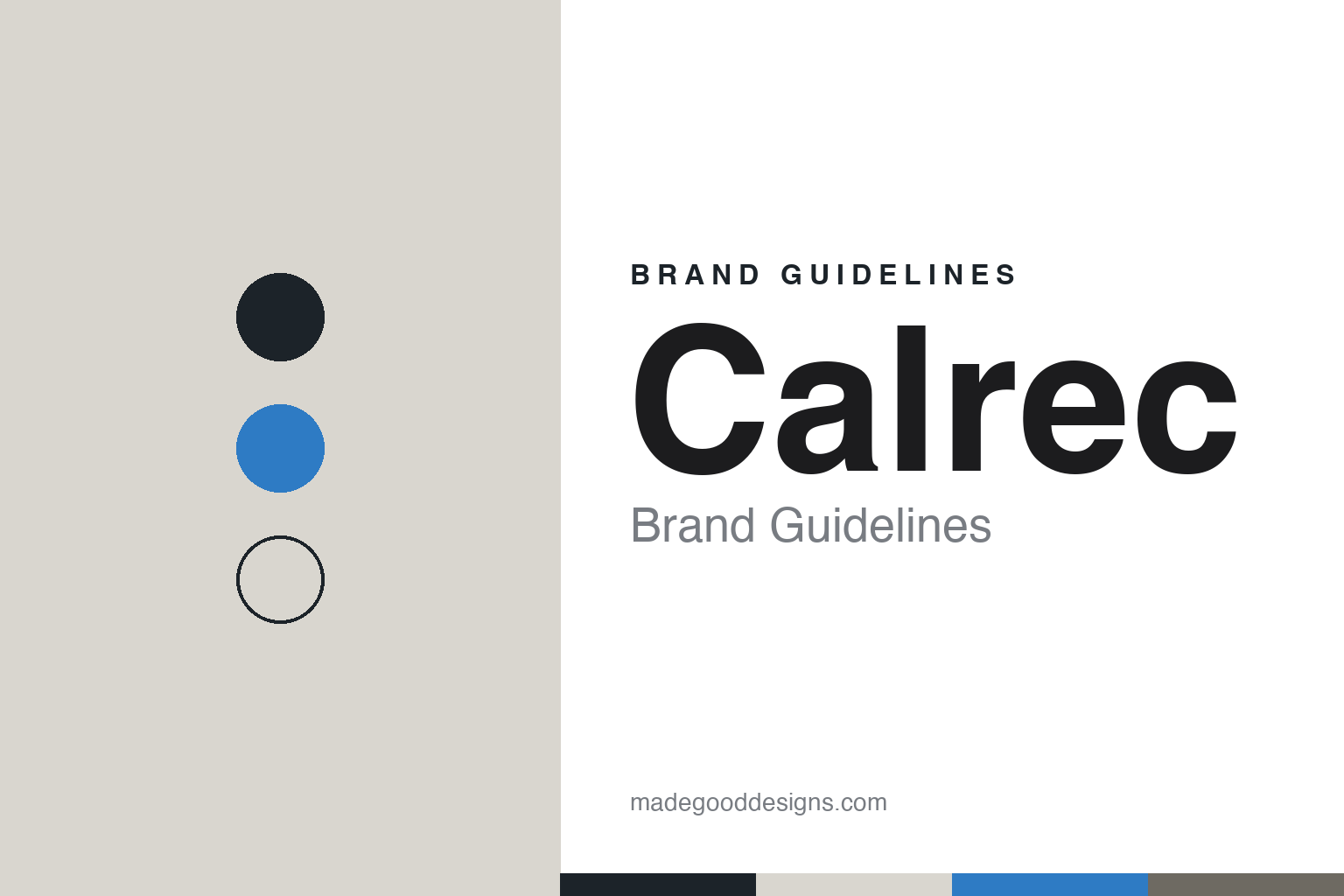
Calrec Brand Guidelines
The Hebden Bridge mill that builds broadcast consoles.
Aa
Two constants: a Calrec slate, stone and blue palette and a Technical sans register. Abstract homage — not a Calrec product or mark; no console, logo or nameplate is reproduced.
Nutclough Mill
A Hebden Bridge firm with three founding dates.
Calrec makes broadcast audio consoles at Nutclough Mill in Hebden Bridge, West Yorkshire, a Pennine town between Manchester and Leeds. English Wikipedia places the firm on the A6033 at Nutclough, on the edge of the town. Its founding date depends on which version of its own website you read. Today it says it was “formed as a microphone manufacturer in 1964,” and it marked 60 years in 2024. In 2004 its timeline began earlier, in 1956: “Calrec founded as a recording studio in Hebden Bridge,” with microphone production from 1964 and console manufacturing from 1971, with early sales to Angus McKenzie, the BBC and Tyne Tees Television. Its 2010 site dated everything from its first console in 1971. We found no independent source for any of these dates, or for the names of its founders, so we give them as the company’s own.
The building has its own history. Nutclough Mill is Grade II listed; English Wikipedia’s list of listed buildings in Hebden Royd, drawing on Historic England, describes an early-19th-century stone mill of five storeys with a six-stage tower, “originally a fustian mill” — fustian being a hard-wearing cotton cloth. Calrec says that in the 1800s it was the world’s first workers’ cooperative textile mill; we give that as its claim. It also likes to quote The Times, which it says named Hebden Bridge the coolest place to live in Britain in 2013.
Colour
Stereo, Soundfield and the assignable desk.
Calrec’s history is a list of firsts, by its own account. It says it supplied the world’s first true stereo broadcast console to BBC Television’s Studio 1 in 1977, and the world’s first digitally controlled assignable mixing console to BBC Radio outside broadcasts in 1981. Those claims are Calrec’s; we have not seen them tested independently.
The best-documented episode is the Soundfield microphone. English Wikipedia records that it was invented by Michael Gerzon and Peter Craven and developed into a practical system by Calrec, which launched the first one in 1978 — a single microphone able to capture sound in three dimensions. In 1993 the Soundfield business was separated out as SoundField Ltd.
From there Calrec concentrated on consoles. Its 2004 timeline lists the VCS assignable console of 1985, the T Series of 1993, the analogue S Series of 1994, the Q2 for American outside-broadcast trucks in 1996 and the X Series radio console of 1997, its first all-digital product, followed by the Alpha 100, first shipped in February 2000, and the Sigma 100 of 2002. Its Bluefin card — dated 2006 or 2007, depending on the page — put a whole console’s signal processing on one FPGA-based board; Bluefin2 and the Hydra2 routing network followed in 2009. The current range — the Argo family launched in 2022, Type R, Apollo, Artemis, Summa and Brio, with ImPulse processing cores — reflects broadcasting’s move to IP networks; Type R, shown at NAB in 2018, was its first native IP product, the company says.
Calrec also points to awards and training. It says the Argo range won a third award with a NAB Show Product of the Year prize in 2024, for a reduced-height Argo S designed for outside-broadcast trucks, and that the compact Argo M was named Best of Show the same year. In 2020 it launched the Calrec Sound Institute, offering free certified training on its consoles, with modules on immersive mixing in Dolby Atmos. Those details come from its own timeline.
Typography
Consoles and their owners.
The mixing consoles and processors behind concerts, theatres and broadcast studios come from a small number of makers, and most of them now sit inside larger groups.
The biggest of those groups is Audiotonix, formed in 2014 by combining Allen & Heath, Calrec and DiGiCo, according to Wikipedia, citing The Wall Street Journal. It bought Solid State Logic in 2017, and the investment firm Ardian took a majority stake in 2019, the Financial Times reported. In 2024 Audiotonix announced an agreement with the investment firm PAI Partners, with Ardian and Astorg keeping minority stakes. DiGiCo gives its address as Chessington, in Surrey; Calrec’s is a mill in Hebden Bridge, West Yorkshire. Harrison, which presents itself as a Nashville brand, was bought by Solid State Logic, which announced the deal in April 2023; Harrison’s own history gives 2022.
Soundcraft, founded in Britain in 1973 by Phil Dudderidge and Graham Blyth, describes itself as part of Harman’s professional division. Samsung Electronics completed its purchase of Harman in 2017.
Midas and Klark Teknik have shared owners since Klark Teknik, of Kidderminster, bought Midas in 1987. Since December 2009 both have belonged to Music Group, now Music Tribe, the company chaired by Uli Behringer and based in Makati, in the Philippines; Midas says it opened a research centre in Manchester.
Lawo, of Rastatt in Germany, was founded in 1970 by Peter Lawo, according to Wikipedia; its website lists his son Philipp on the supervisory board. We found no outside group owner in the sources we checked.
This guide sets out what can be checked about each brand — who founded it, who owns it, and what it says about where its products are made — and marks clearly what rests only on the company’s own word.
Aa
A technical sans — the register of a broadcast control room. (Specimen set in IBM Plex Sans, a sans STAND-IN; NOT the Calrec logo.)
Calrec
Designed and built under one roof, it says.
Calrec has changed hands more than once. Its 2004 timeline says it was acquired by AMS Industries in 1987 and that in 1989 AMS sold it to “several of the original Directors,” after which it “returns to Hebden Bridge as an independent company” focused on broadcast consoles. In March 2014 it was bought by funds managed by Epiris, which joined it with Allen & Heath and DiGiCo in the group renamed Audiotonix, according to Electra Private Equity’s 2017 report. Audiotonix has since passed between private-equity owners — Astorg in 2017, Ardian in 2019 and, under an agreement announced in 2024, PAI Partners — and in 2017 it integrated Group One, the American distributor of Calrec and DiGiCo.
On manufacturing, Calrec makes the strongest claim in the group. Its about page says all Calrec products are “designed, engineered and tested” at Nutclough Mill, and its Explore Calrec page goes further: all its equipment is “designed, prototyped, built, tested, sold and supported in the same building.” In 2010 the wording was “designed, manufactured and tested.” We give these as the company’s statements; we found no independent check. The site also says its desks mix everything from Premiership football to Dancing with the Stars: “if it’s live, it’s probably mixed on a Calrec.”
For a design guide, Calrec shows how a technical brand can anchor itself in one building. Compare AMS Neve, which carries the name of its former owner AMS, and Allen & Heath, its sister brand in Audiotonix. For this guide we use a slate, a mill-stone grey and a broadcast blue with a sans, an unofficial interpretation; no product or logo is reproduced.
Explore & save
Keep Calrec’s identity on hand — save it to a board in the Made Good inspiration library.
Calrec identity set
Pin the Calrec slate, stone and blue palette and the Technical sans register to your own board.