Lexicon Brand Guidelines
The Massachusetts reverb maker behind the 224 and 480L.
Aa
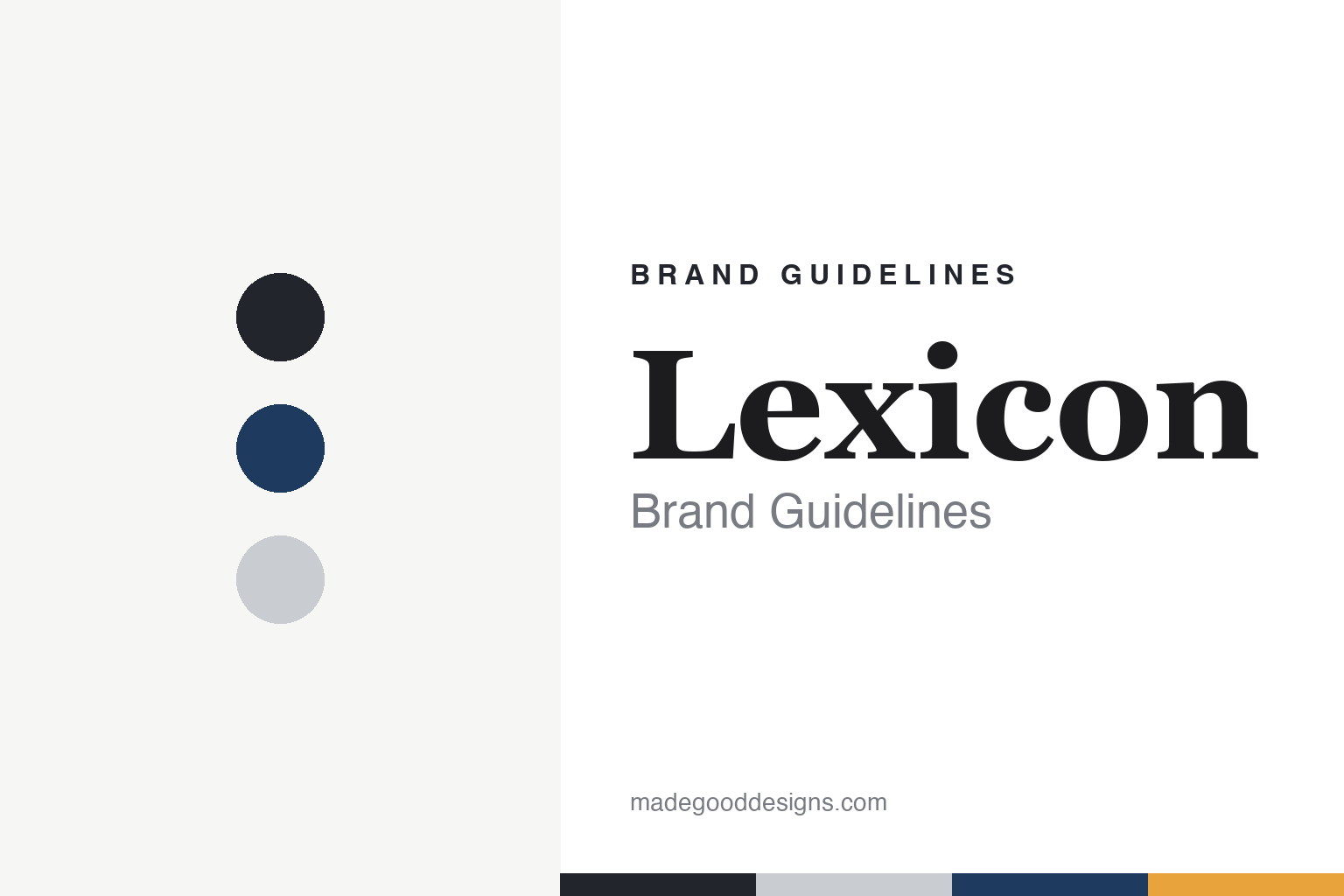
Two constants: a Lexicon graphite, silver and deep blue palette and a text serif register. Abstract homage — not a Lexicon product or mark; no unit, logo or nameplate is reproduced.
American Data Sciences
An MIT professor and a heart monitor.
Lexicon began as American Data Sciences. MIT’s Department of Electrical Engineering and Computer Science, in its January 2024 obituary of the company’s founder, says Francis Fan Lee, then an MIT professor, set up the firm in 1969 with the engineer Charles (Chuck) Bagnaschi, and later changed its name to Lexicon, Inc. Steven Schoenherr’s history of recording technology dates the change to 1971 and says the company grew out of a digital delay Lee had built for medical heart monitoring. Lexicon itself gives 1971 as its founding year.
The company was based in Massachusetts. Harman’s 1993 announcement described it as “based in Waltham, Mass.”; by 2000 its website gave an address in Bedford, in the same state. A third name belongs in the founding story: the TECnology Hall of Fame essay published for the 2007 inductions says the digital-audio pioneer Barry Blesser “helped launch Lexicon in 1971,” and Schoenherr says Blesser developed a 100-millisecond digital delay and, with Steven Temmer of the distributor Gotham Audio, sold digital processors to recording studios.
The early products were delays and speech tools. English Wikipedia lists the Gotham-branded Delta T-101 delay of 1971, and the Delta T-102 of 1972 as the first product to carry the Lexicon name. MIT credits the company with “the first commercially available speech compressor and pitch shifter,” sold for education — the Varispeech, which English Wikipedia dates to 1972. A later Time Compressor let broadcasters speed up recorded programmes without distorting the sound; English Wikipedia says it won an Emmy for technical achievement in 1984.
Colour
The 224 and the 480L.
Lexicon’s lasting name is in reverb. The Model 224 was unveiled at the AES convention in 1978. It was not the first digital reverb — EMT’s 250 came first — but Mix, inducting it into the TECnology Hall of Fame in 2006, called the 224 and its 224X and 224XL successors “the most ubiquitous and popular high-end studio reverb in history.” The idea came from David Griesinger, described by Mix as a nuclear physicist, musician and classical recording engineer, who built a prototype that merged a microcomputer with his reverb design; Lexicon bought the invention and took him on. The 224 cost $7,500 with two programs or $7,900 with four — about half the price of the EMT 250, Mix says — and its separate control unit, later the LARC remote, became a familiar object in control rooms.
The 480L followed in 1986, according to English Wikipedia, as successor to the 224XL. Around them came the Prime Time delay of 1979, the PCM-60 and PCM-70 of the 1980s, the PCM-80 and PCM-90 of the 1990s and, later, the PCM92 and PCM96, alongside cheaper lines such as the LXP, MPX and MX ranges. Lexicon also tried hard-disk recording with the Opus system of 1988, and its LARES system, from the same year, used microphones, processors and loudspeakers to change the acoustics of performance halls.
In 2014 the Recording Academy gave Lexicon a Technical Grammy, according to the company and Wikipedia’s list of recipients. Lexicon’s website goes further, saying it has “helped create 80% of the world’s recorded music” and made “the world’s first commercially available digital effects processor.” Those are its own claims; Eventide, its New Jersey rival, makes a similar one for its H910 Harmonizer of 1975.
Typography
Effects, studios and documentation.
Studio outboard — the reverbs, delays, compressors, equalisers and preamps that sit in racks beside a mixing console — is a small trade, much of it started by engineers working for themselves. The seven makers in this guide span digital effects, valve processing and licensed recreations of vintage studio equipment.
Two are American digital pioneers of the early 1970s. Eventide began that year in New York City and now dates its press releases from Little Ferry, New Jersey; we found no record of a sale to a larger group. Lexicon began in 1969 as American Data Sciences, took the Lexicon name in 1971, was based in Waltham, Massachusetts, and was bought by Harman in 1993, Harman announced at the time; Samsung completed its purchase of Harman in March 2017.
TC Electronic was founded in Aarhus, Denmark, in 1976 by the brothers Kim and John Rishøj. In April 2015 MusicRadar reported that its parent, TC Group, had been bought by Music Group, the Behringer owner now called Music Tribe.
The analogue makers are smaller. Empirical Labs, founded by Dave Derr, who had helped design Eventide’s H3000, lists a New Jersey address and says all its products are made in the USA. Manley Laboratories builds valve equipment in Chino, California, and was bought in July 2025 by Rockforce Tech Holding, a company founded by Dirk Ulrich, Mix reported. Tube-Tech is the brand of Lydkraft, near Copenhagen. Chandler Limited, which Wade Goeke founded in 1999, is in Shell Rock, Iowa, and the company names him as its owner.
This guide sets out what can be checked about each brand — who founded it, who owns it, and what it says about where its products are made — and marks clearly what rests only on the company’s own word.
Aa
A text serif for a name that means a dictionary. (Specimen set in Source Serif 4, a serif STAND-IN; NOT the Lexicon logo.)
Lexicon
A Harman brand since 1993.
Lexicon has not been independent for more than thirty years. On 16 April 1993 Harman International announced that it had completed the purchase of Lexicon, Inc., which joined JBL Professional, DOD and Soundcraft in Harman’s professional group. English Wikipedia’s article on Francis Lee gives the year as 1995; Harman’s own release says 1993, and we follow it. Harman was in turn bought by Samsung Electronics, which announced on 11 March 2017 that it had completed the acquisition and would run Harman as a standalone subsidiary.
Under Harman, Lexicon grew a home-cinema side. The company’s timeline says its first home product, the CP-1 surround processor, came in 1988, and that the MC-1 of 1999 introduced its Logic7 surround algorithm. Not every product was its own design: the timeline says the NT amplifiers of 1995 were made in partnership with the Canadian brand Bryston, and in January 2010 the review site Audioholics reported that Lexicon’s $3,500 BD-30 Blu-ray player used the same chassis and internal parts as Oppo’s $500 BDP-83.
The brand is still active. In October 2026 two Harman sites carried the name: lexiconpro.com, part of Harman Professional Solutions, sells the PCM Native reverb and effects plug-ins and lists the PCM92 and PCM96 processors; lexicon.com, the consumer site, shows a single product family, the DD-8 and DD-8+ multichannel amplifiers. English Wikipedia says Lexicon has offices in Salt Lake City; neither site says where its hardware is made, so we do not. The name is also used by unrelated businesses, including a DJ software company and a Singapore computer shop.
For a design guide, Lexicon shows how a reverb can define a brand long after the company has changed hands. Compare Bricasti Design, founded by two Lexicon veterans, and Eventide, its rival from the days of the first digital delays. For this guide we use graphite, aluminium silver and a deep blue with a serif, an unofficial interpretation; no product or logo is reproduced.
Explore & save
Keep Lexicon’s identity on hand — save it to a board in the Made Good inspiration library.
Lexicon identity set
Pin the Lexicon graphite, silver and deep blue palette and the text serif register to your own board.