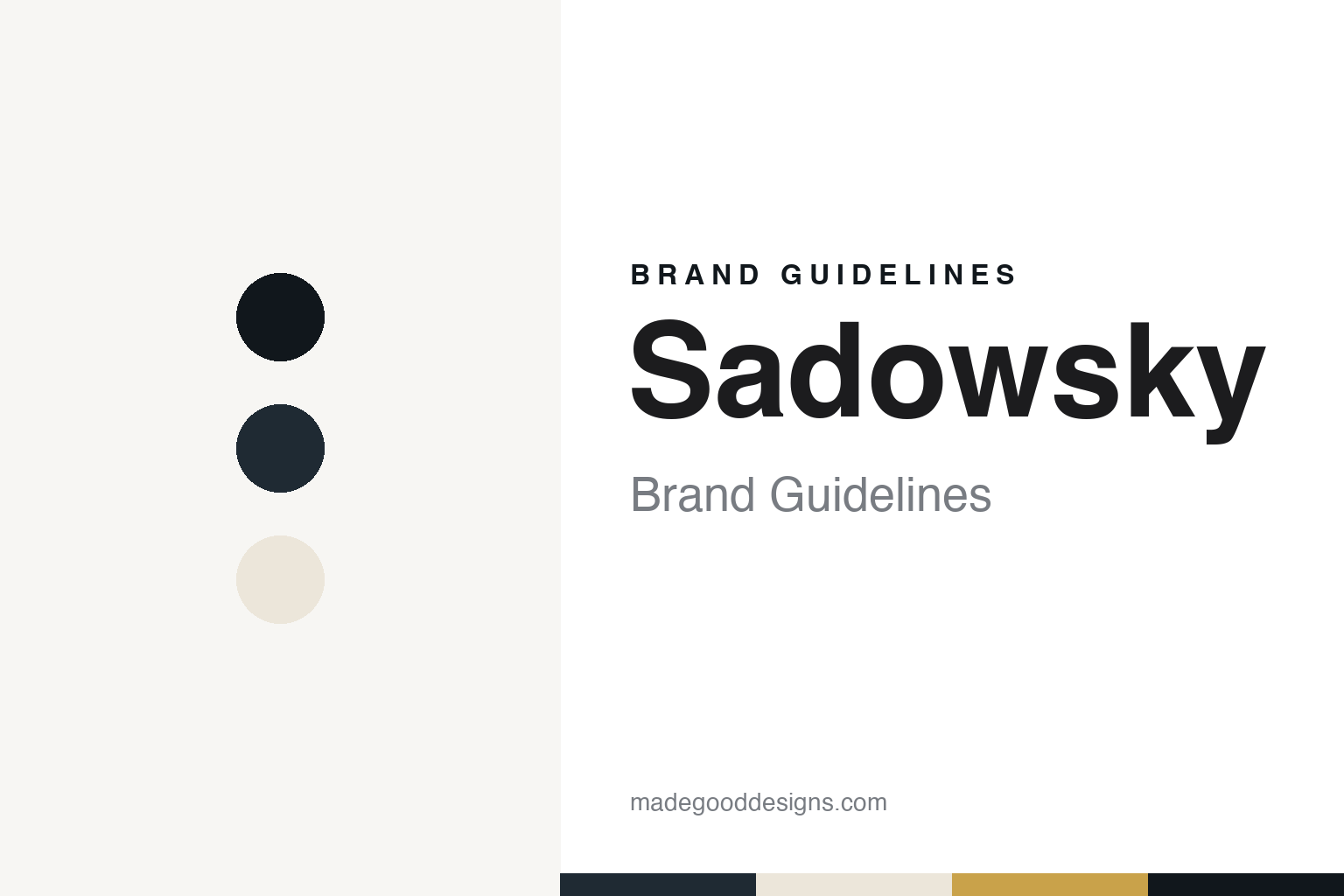
Sadowsky Brand Guidelines
The New York repairman whose basses Warwick now builds.
Aa
Two constants: a Sadowsky slate, white and brass palette and a workshop sans register. Abstract homage — not a Sadowsky product or mark; no instrument, headstock or logo is reproduced.
A Manhattan repair bench
From psychobiology to studio basses.
Sadowsky Guitars grew out of a repair shop. English Wikipedia, citing a 2008 profile in Bass Musician, dates the company to 1979 and says it took its name from its founder, Roger Sadowsky. The company’s own biography fills in the background: Sadowsky grew up in New York in the 1950s, began playing guitar in college and left a PhD programme in psychobiology at Rutgers University to apprentice with the New Jersey acoustic-guitar maker Augie LoPrinzi, starting in 1972. From 1974 he ran the repair department at Medley Music in Ardmore, Pennsylvania, near Philadelphia.
In August 1979, the company’s timeline says, he opened a repair shop in Manhattan to serve the city’s studio players. Session bassists including Will Lee and Neil Jason, the company says, had him customise their instruments and fit an active treble-and-bass boost circuit, and the company dates the “Sadowsky Sound” to those years. In the early days, its biography says, he had players buy early-1960s Fenders for about $800 and modified them; as vintage prices rose in the early 1980s, he began building instruments from scratch around the same ideas. The timeline dates his first electric guitars to 1980, under the name “Dr. Frets,” and his first bass to 1982.
The shop moved several times. The company lists a move to Broadway at 48th Street in 1986; to Brooklyn in 2002; and to Long Island City, in Queens, in 2011. English Wikipedia’s infobox gives the headquarters as “Long Island, New York,” which is a different place; its own text, and the company, say Long Island City.
Colour
Session players, a preamp and a Japanese line.
Sadowsky’s reputation was built among New York session musicians rather than through mass production. The company names guitarists including Jim Hall, Pat Metheny and Lee Ritenour, and bassists including Will Lee, Verdine White and Jason Newsted, as players of its instruments; the NAMM Oral History Library, which interviewed Sadowsky in January 2016, repeats a similar list, adding Marcus Miller. The company’s timeline says it customised a 1977 Jazz Bass for Miller in 1980, made six guitars for Prince’s Purple Rain tour in 1984, and introduced a Will Lee signature bass in 2009.
The constant across those instruments is the electronics. Sadowsky’s active onboard preamp, which the current makers describe as a circuit “Roger Sadowsky developed himself decades ago,” is sold separately and in two pedal versions. In a 2025 interview with Bass Magazine, Sadowsky named his original electronics designer as Alex Aguilar, who he said was later a big part of Aguilar Amplification. In the same interview he said he was introduced to Morado, or Bolivian rosewood, for fingerboards by Stuart Spector in 1979.
From 2003, the company says, Sadowsky began manufacturing in Japan, introducing the MetroLine basses and the Jim Hall archtop guitar; the lower-priced MetroExpress followed in 2018. In his 2020 note on the change of partner, Sadowsky credited the Japanese instruments to Yoshi Kikuchi, whom he called his protégé since 1982. The NYC shop, meanwhile, added a Single Cut bass, the Satin Series and the Broadway Line of guitars in 2016, alongside archtops and an Electric Nylon guitar.
Typography
Design and documentation.
The basses in this guide come from small workshops, most started in the 1970s and 1980s by a luthier or a luthier-and-player partnership. Several are connected: English Wikipedia says Vinny Fodera was Spector’s first full-time employee, in 1977, and that he and Joey Lauricella started Fodera after working with Ken Smith Basses.
Three are in New York State. Fodera says it has been in Brooklyn since 1983 and is now a family business with Laura Fodera as partner and chief executive. Sadowsky, founded by Roger Sadowsky in 1979, gives an address in Long Island City, Queens; since 2019, under a licence with Germany’s Warwick, its MetroLine, MasterBuilt and Custom Shop basses have been made in Germany, Wikipedia and Warwick’s Sadowsky website say. Spector, founded by Stuart Spector in Brooklyn in 1976, was bought by Korg in 2019, Bass Magazine reported in 2021; it builds its US basses near Woodstock.
Lakland, founded in Chicago in 1994, was bought in 2010 by a group led by Hanson Musical Instruments, according to the announcement of the deal. It says its USA Series basses are built in Chicago.
Ken Smith Basses says every instrument is handmade at its shop in Perkasie, Pennsylvania. Dingwall, founded by Sheldon Dingwall in 1987, is based in Saskatoon, Canada; its own spec sheets list most models as made in Canada and a few lower-priced ones as built in China or Indonesia and finished in Canada. Alembic is run by the Wickersham family in Rohnert Park, California, the company says.
This guide sets out what can be checked about each brand — who founded it, who owns it, and what it says about where its products are made — and marks clearly what rests only on the company’s own word.
Aa
A workshop sans — for a brand built on New York session work. (Specimen set in Archivo, a sans STAND-IN; NOT the Sadowsky logo.)
Sadowsky
A licence, not a sale.
The biggest change came in 2019. On 15 December that year Bass Magazine published the announcement that Warwick, the German maker whose owner Sadowsky named as Hans-Peter Wilfer, would be the exclusive licensee for Sadowsky, building and distributing the Metro and MetroExpress instruments and distributing strings and accessories, with Sadowsky continuing to run the NYC Custom Shop. Sadowsky later told the magazine that he decided in early January 2019 to approach Wilfer, met him at that month’s NAMM show and had a signed agreement by August; the new lines were shown at NAMM in January 2020. English Wikipedia dates the agreement to 2019.
It was a licence, not a sale. “I am not retiring! This is a licensing and distribution agreement only,” Sadowsky wrote in a note Bass Magazine published in January 2020, adding that he remained behind decisions on design, quality and branding. We found no source saying Warwick owns the Sadowsky brand. Warwick runs a separate website for the licensed lines, sadowskybass.com, while sadowsky.com remains the NYC shop’s.
Where the instruments are made now depends on the line. Warwick’s site says the Custom Shop, MasterBuilt and MetroLine basses are made in its workshop in Germany — in Markneukirchen, Saxony, according to Bass Magazine — and that the MetroExpress is “manufactured in Asia.” Sadowsky himself has been more specific: in 2020 he wrote that Warwick works with a factory in China, and in 2025 he told Bass Magazine that the MetroExpress basses “are made in China.” In 2020 he also wrote that a third party had registered the Sadowsky trademark in China before him, so the MetroExpress carried an “RSD” (Roger Sadowsky Design) logo while he contested it; we have not checked how that dispute ended. In Long Island City, he said in 2025, the shop had been cut by half and made a dozen to 15 basses a month, custom and direct orders only.
For a design guide, Sadowsky shows how a maker’s name can cover both a one-man bench and a licensed factory range. Compare Warwick, its licensee, and Fender, whose basses Sadowsky first modified. For this guide we use slate, vintage white and brass with a sans, an unofficial interpretation; no product or logo is reproduced.
Explore & save
Keep Sadowsky’s identity on hand — save it to a board in the Made Good inspiration library.
Sadowsky identity set
Pin the Sadowsky slate, white and brass palette and the workshop sans register to your own board.