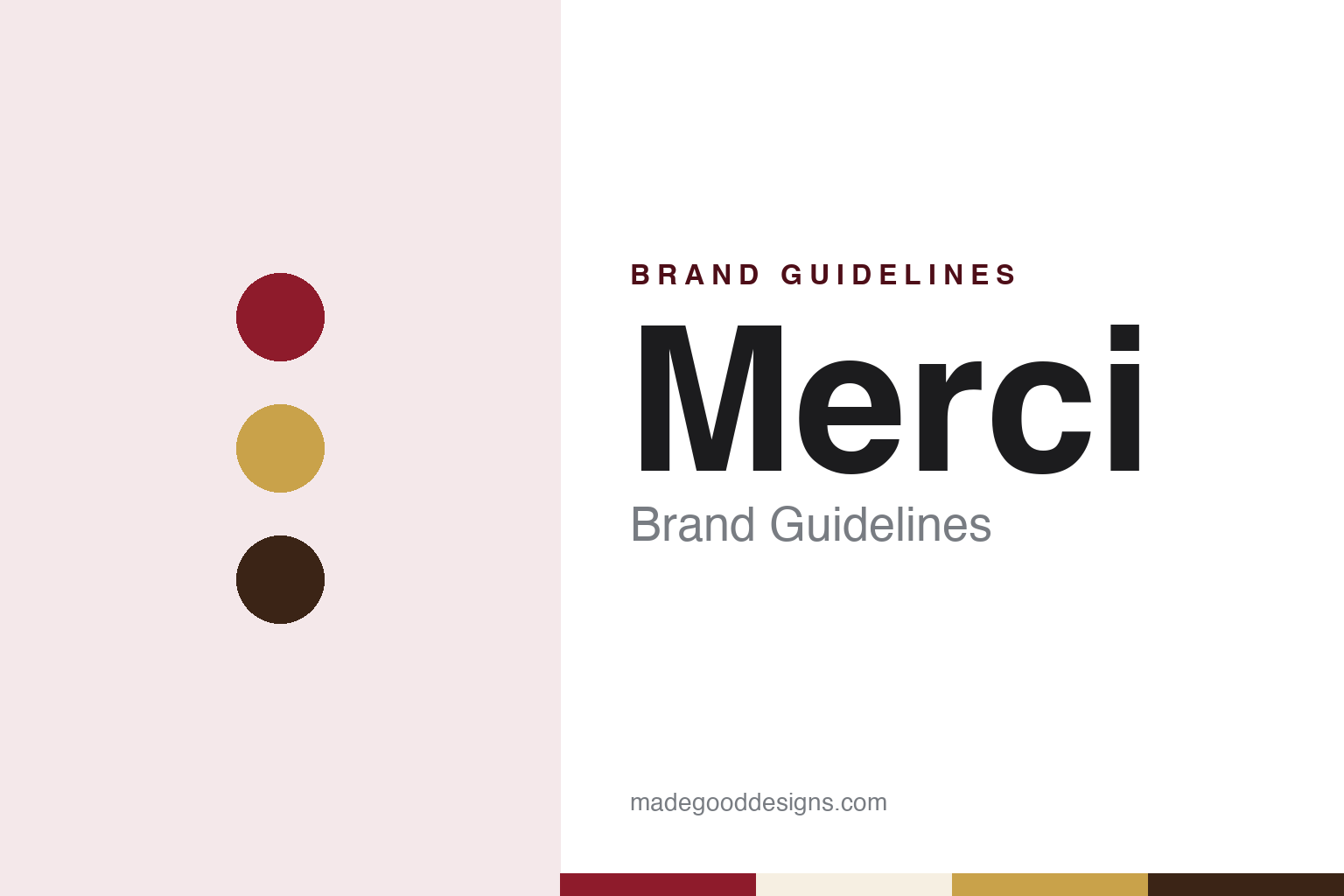
Merci Brand Guidelines
Storck’s gold-wrapped chocolate named for “thank you”.
Aa
Two constants: a gift red, wrapper gold and cream palette and a classic gift serif register. Abstract homage — not a Merci product or mark; no pack, logo or chocolate is reproduced.
A sugar works in Werther
A dragée pan, a family name and a chocolate novelty.
Merci belongs to one of Germany’s best-known confectionery families, and its story starts with boiled sweets rather than chocolate. Storck’s own history says that in 1903 August Storck, known as Oberwelland, founded the Werther’sche Zuckerwarenfabrik in Werther, a small town in Westphalia, with three workers and a single dragée pan. English Wikipedia, citing WirtschaftsWoche, records that the founder later took the name August Oberwelland, and the family has run the business under that name ever since. The company says Hugo Oberwelland, the youngest of three sons, took over in 1921, and that its first big seller, the Storck 1 Pfennig RIESEN, followed in 1934. German Wikipedia says the business moved its main production to a new factory in nearby Halle (Westfalen) after the war, and describes Halle as the group’s main plant.
Chocolate came relatively late. Storck says it began making chocolate in 1954, a year after launching its second brand, Mamba. Ten years later it introduced the product that would become its flagship. The company’s timeline dates merci to 1964 and describes it as a chocolate novelty packed as individual bars; an archived version of the merci history page says Storck surprised the market with a completely new chocolate offer of small chocolate sticks, each one wrapped individually in gold. German and English Wikipedia, in their entries on the company and the brand, give 1965 as the launch year, and German Wikipedia adds that distribution was extended to Austria in 1966.
The name is the French word for “thank you,” as English Wikipedia notes, and Storck has built its slogans around that idea. Storck says it opened a second production site in Berlin in 1967, built exclusively for making fine chocolate. Over the next decade the group added more of the brands that now sit alongside it — German Wikipedia lists Campino in 1966, Werther’s Original in 1969 and Toffifee in 1973 — and Branding in Asia later described merci as Storck’s flagship brand.
Colour
One assortment, eight flavours and a slogan from 1988.
The core of the brand is the box German shoppers know as merci Große Vielfalt. German Wikipedia describes it as an assortment of individually wrapped chocolate bars in eight flavours, and Storck’s archived merci history says the range had reached eight varieties by the late 1980s. The same history dates the line “merci, dass es Dich gibt” — roughly, “thank you for being there” — to 1988, and the slogan has stayed with the brand in German-speaking markets.
Storck has extended the range in small steps. Its history page lists merci Crocant in 1994 and merci Pur in 1995; German Wikipedia says the latter was later sold as merci Petits and that Crocant was discontinued in 2018. The company’s timeline adds seasonal figures for Easter and Christmas from 2011, an almond assortment in 2013, a chocolate bar made up of small, individually gold-wrapped squares in 2015, a mousse au chocolat variety in 2018, Petits Collections in 2019, merci together in 2021 and merci lovelies in 2022.
The brand travels widely. German Wikipedia, citing Storck, says merci is sold under the same name in more than 100 countries, and Storck’s group site gives the same figure for its brands as a whole. When the brand entered China in 2015, the trade site Branding in Asia reported in December that year, Storck launched it with a campaign called “Say Thank You,” created by the Shanghai agency BSUR with Cornelius Keinemund, global creative director of the Berlin agency Phanke Markenmacherei, which the site described as Storck’s long-time creative partner. Marketing Interactive covered the same launch. English Wikipedia also cites the Dayton Daily News, which wrote about the brand in the United States in 2007.
The name has also been defended in court. Handelsblatt reported in January 2015 that Storck had taken action over a café in Bad Soden im Taunus that had traded as Café Merci since 2006, arguing that the use diluted its brand; German Wikipedia records a ruling in the dispute by the Higher Regional Court in Frankfurt in May 2012. The Frankfurter Rundschau reported in February 2015 that the café could keep its name with Storck’s consent. In Switzerland, the consumer magazine Beobachter reported in May 2019 that Storck had objected to a strawberry variety called ‘Merci’ bred by a nursery in Egnach, and that the Federal Supreme Court ruled in the breeder’s favour, finding no likelihood of confusion.
Typography
Design and documentation.
The seven brands in this group all make sweets or chocolate, and they come from four European countries — Germany, Britain, Spain and Finland: Maoam, Barratt, Walker’s Nonsuch, Toffifee, Merci, Fini and Panda. European confectionery brands in general sit at many different points in the trade, from family firms that still carry a founder’s surname to names that now belong to much larger food groups, and a single brand can be sold everywhere from a corner kiosk to a supermarket shelf.
A confectionery brand’s identity is usually carried less by a single sweet than by a pack, a name and the treat it promises, because the company behind the name may have changed hands, moved its factory or grown far beyond the town where it started. That makes the questions behind each name worth asking plainly: who started it, who owns it now, and where its sweets are actually made and packed.
Each guide separates what independent sources record from what the company says about itself — its founding story, its owners over time, where its sweets are made and how its packaging has changed — and marks plainly what rests only on the company’s own word.
Aa
A classic serif for a chocolate sold as a thank-you gift. (Specimen set in Cormorant Garamond, a serif STAND-IN; NOT the Merci logo.)
Merci
Family-owned, run from Berlin, made in Berlin.
Merci has never changed hands. It belongs to August Storck KG, which is still owned by the Oberwelland family. German Wikipedia says Klaus Oberwelland took over the company in 1971, that management moved from Halle to Berlin in 1998, and that Axel Oberwelland became chairman in 2003. Storck’s Berlin careers page, in a version archived in 2022, says the Berlin site has been the seat of the group’s management since 1998.
The centenary in 2003 brought the biggest change to how the brands look on the shelf. German Wikipedia, citing the trade paper Horizont and manager magazin, says Storck introduced a new corporate logo and the line “Part of Your World” for its 100th anniversary, and that the Storck name has appeared on every one of its brand packs since. The same entry, citing Lebensmittel Zeitung, says the separate sales companies Storck, Merci and Dickmann were merged in 2009.
Storck links merci to its Berlin factory. The company says the plant in Berlin-Reinickendorf, opened in 1967, makes mainly chocolate specialities such as merci, and its 2022 careers page put the site’s workforce at about 1,200 people and called merci Germany’s most popular gift chocolate. German Wikipedia lists the group’s German plants as Halle, Ohrdruf in Thuringia and Berlin, citing the company’s own locations page; English Wikipedia also lists a site at Skanderborg in Denmark.
For a design guide, Merci shows how one simple idea — a chocolate named after the act of saying thank you — can carry a brand for six decades, through new formats, seasonal packs and a parent company’s name added to every box. Compare Werther’s Original, the caramel from the same family firm, and Ritter Sport, another family-owned German chocolate maker. For this guide we use a gift red, a wrapper gold and cream with a serif, an unofficial interpretation; no product or logo is reproduced.
Explore & save
Keep Merci’s identity on hand — save it to a board in the Made Good inspiration library.
Merci identity set
Pin the Merci gift red, wrapper gold and cream palette and the classic gift serif register to your own board.