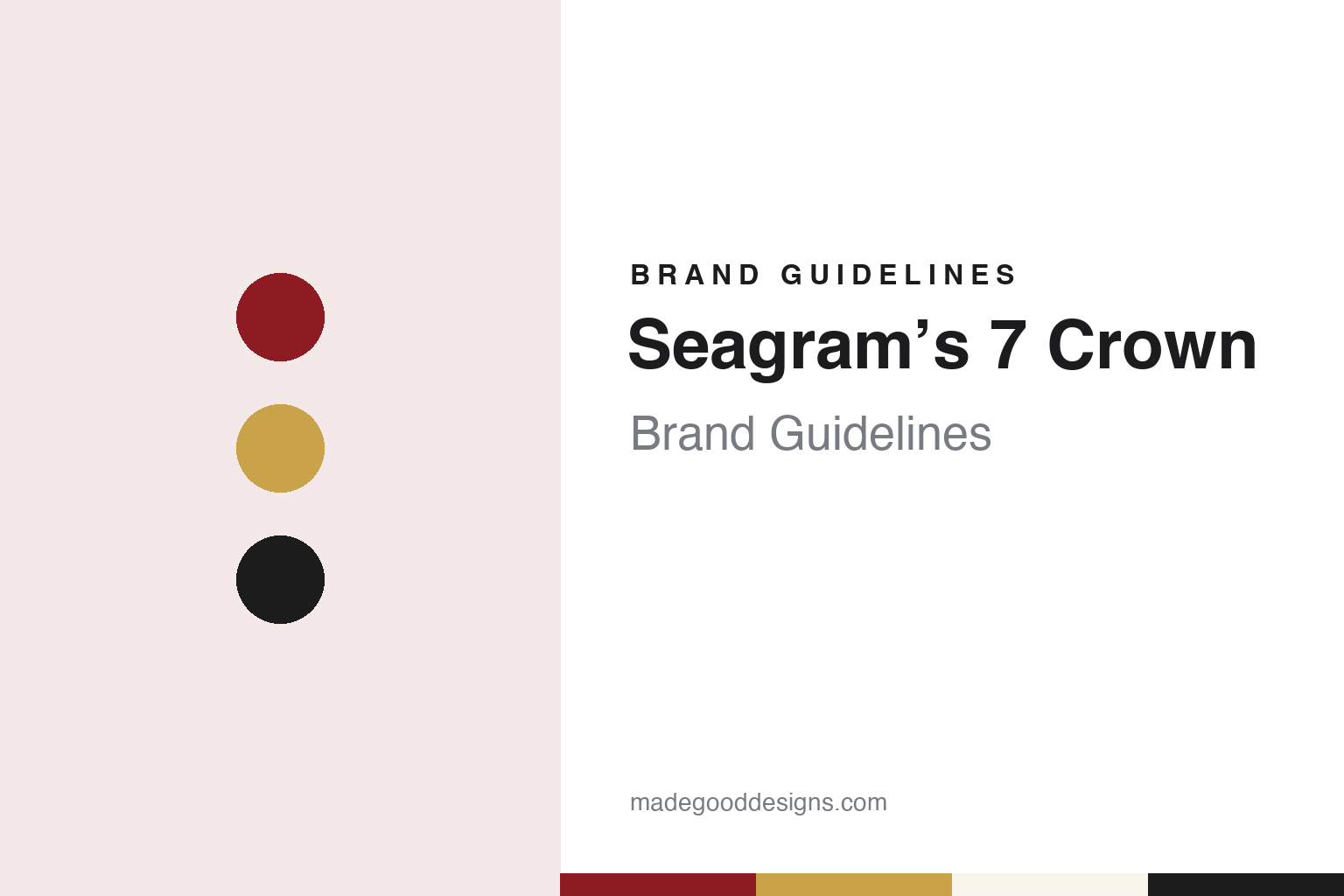
Seagram’s 7 Crown Brand Guidelines
Seagram’s post-Prohibition blend, and half of the 7 & 7.
Aa
Two constants: a crown red, crown gold and bar-top black palette and a Roman capital serif register. Abstract homage — not a Seagram’s 7 Crown product or mark; no label, logo or bottle is reproduced.
After Prohibition
A Canadian distiller builds an American whiskey.
Seagram’s 7 Crown is an American whiskey with a Canadian family tree. The Seagram name goes back to Joseph E. Seagram, whose distillery in Waterloo, Ontario, he took over in the nineteenth century; in 1928 the Montreal company Distillers Corporation, founded by Samuel Bronfman and his brothers, bought Joseph E. Seagram & Sons and kept the Seagram name, English Wikipedia says. Citing Daniel Okrent’s history Last Call (2010), it adds that the company was ready for the end of American Prohibition in 1933 with a large stock of aged whisky.
Seven Crown was one of the brands Seagram built for that reopened market. The drinks-business blog Booze Business, written with help from former Seagram staff, said in 2018 that after Prohibition and before the Second World War Seagram introduced two blended American whiskies, Five Crown and Seven Crown. The blog repeated a story that Bronfman picked the blend he liked best from a line-up of samples, and that it was the seventh, but it called that story apocryphal.
The brand became one of the company’s pillars. English Wikipedia, citing Nicholas Faith’s 2006 book on the Bronfmans, names Seven Crown, VO and Crown Royal as the three most popular Seagram spirits from the 1960s to the 1990s. MediaPost reported in 2018 that the brand sold more than nine million cases a year in the 1970s, was the first spirits brand to reach a million cases, and had sold 300 million cases in total by 1983.
That peak did not last. English Wikipedia says the brand lost ground in the 1980s and 1990s, along with most whiskeys, as drinkers moved to vodka and rum.
Colour
A crown, a number and a highball.
The brand’s best-known use is in a glass with another brand. English Wikipedia describes the Seven and Seven, or 7 & 7, as a highball of Seagram’s Seven Crown and 7 Up served over ice, and says it was one of the most popular drinks in the United States during the 1970s. The pairing of two sevens has kept the number at the centre of the brand; the whiskey is often called simply Seagram’s 7.
The serve is still how the owner sells it. Diageo’s product page for the whiskey in 2026 calls it “perfect for a signature 7 & 7 cocktail” and gives a recipe of whiskey, lemon-lime soda and a lime wedge in a highball glass. The same page says the whiskey is aged in oak barrels and “proudly blended and bottled in the US,” and describes it as the “#1 American Blended Whiskey,” Diageo’s own claim. The label names The 7 Crown Distilling Company as the bottler.
Where the whiskey in the blend comes from is less public. English Wikipedia says the former Seagram distillery at Lawrenceburg, Indiana, now MGP of Indiana, continues to supply components of Seven Crown, citing a 2011 release from MGP Ingredients.
The brand has also been extended into flavours. Its website in 2018 listed Dark Honey and Orchard Apple alongside the original blended whiskey.
Typography
Design and documentation.
The seven brands in this group are all whisky, schnapps and rum names: Black Velvet, Seagram’s 7 Crown, Alberta Premium, Lot No. 40, Rumple Minze, Dr. McGillicuddy’s and Bumbu. Whisky, schnapps and rum brands in general sit at many different points in the trade, from names that still carry a founder’s or a distillery’s story to labels that now belong to much larger drinks groups, and a single brand can be sold everywhere from a corner shop to a bar rail.
A spirits brand’s identity is usually carried less by a single bottle than by a label, a name and the place it promises, because the company behind the name may have changed hands, moved its production or grown far beyond the place where it started. That makes the questions behind each name worth asking plainly: who started it, who owns it now, and where its spirit is actually distilled and bottled.
Each guide separates what independent sources record from what the company says about itself — its founding story, its owners over time, where its spirit is made and how its labels have changed — and marks plainly what rests only on the company’s own word.
Aa
A Roman capital serif for a crowned whiskey name. (Specimen set in Cinzel, a serif STAND-IN; NOT the Seagram’s 7 Crown logo.)
Seagram’s 7 Crown
The whiskey Diageo kept.
Seagram’s drinks business was broken up at the start of the century. English Wikipedia says Seagram’s beverage assets were divided among Diageo, Pernod Ricard and others in 2000, and that Seven Crown went to Diageo. The Seagram name was split with it: English Wikipedia notes that Seagram’s V.O. now belongs to Sazerac, Seagram’s Ginger Ale to The Coca-Cola Company and the Seagram’s Escapes coolers to Genesee Brewing in the United States.
The clearest line between the whiskies came in 2018. Reuters reported on 12 November 2018 that Diageo was selling 19 brands to Sazerac, including Seagram’s VO, Seagram’s 83 and Seagram’s Five Star, and that the deal did not include Seagram’s 7 Crown: Diageo was keeping the American whiskey while selling the Canadian Seagram’s whiskies. Diageo still owns the brand; its product page carries a 2026 Diageo copyright.
That same year Diageo set out to revive it. The brand’s website announced the first National Dive Bar Day on 7 July 2018 and support for the National Trust for Historic Preservation. Diageo said the date, the seventh day of the seventh month, was chosen to celebrate what it called “the quintessential Dive Bar drink, the 7&7.” MediaPost reported in October 2018 that this “Save the Dive Bar” push had included a package redesign, and that the brand had launched its first national campaign in more than a decade, “This Is Your Whiskey,” created by Forsman & Bodenfors in New York; the previous full campaign, it said, had been print only. The new work included videos shot by the director Ed David, with social and outdoor executions, and the magazine quoted Jason Sorley, the brand director, on the strategy.
For a design guide, Seagram’s 7 Crown shows how a number, a crown and a two-ingredient highball can hold a whiskey’s identity together across nine decades and two owners. Compare Captain Morgan, another former Seagram brand now owned by Diageo, and Dr. McGillicuddy’s, a liqueur Seagram sold to Sazerac in 1989. For this guide we use crown red, crown gold and bar-top black with a serif, an unofficial interpretation; no product or logo is reproduced.
Explore & save
Keep Seagram’s 7 Crown’s identity on hand — save it to a board in the Made Good inspiration library.
Seagram’s 7 Crown identity set
Pin the Seagram’s 7 Crown crown red, crown gold and bar-top black palette and the Roman capital serif register to your own board.