Liquid Paper Brand Guidelines
A typist’s paint pot, a brand for every slip.
Aa
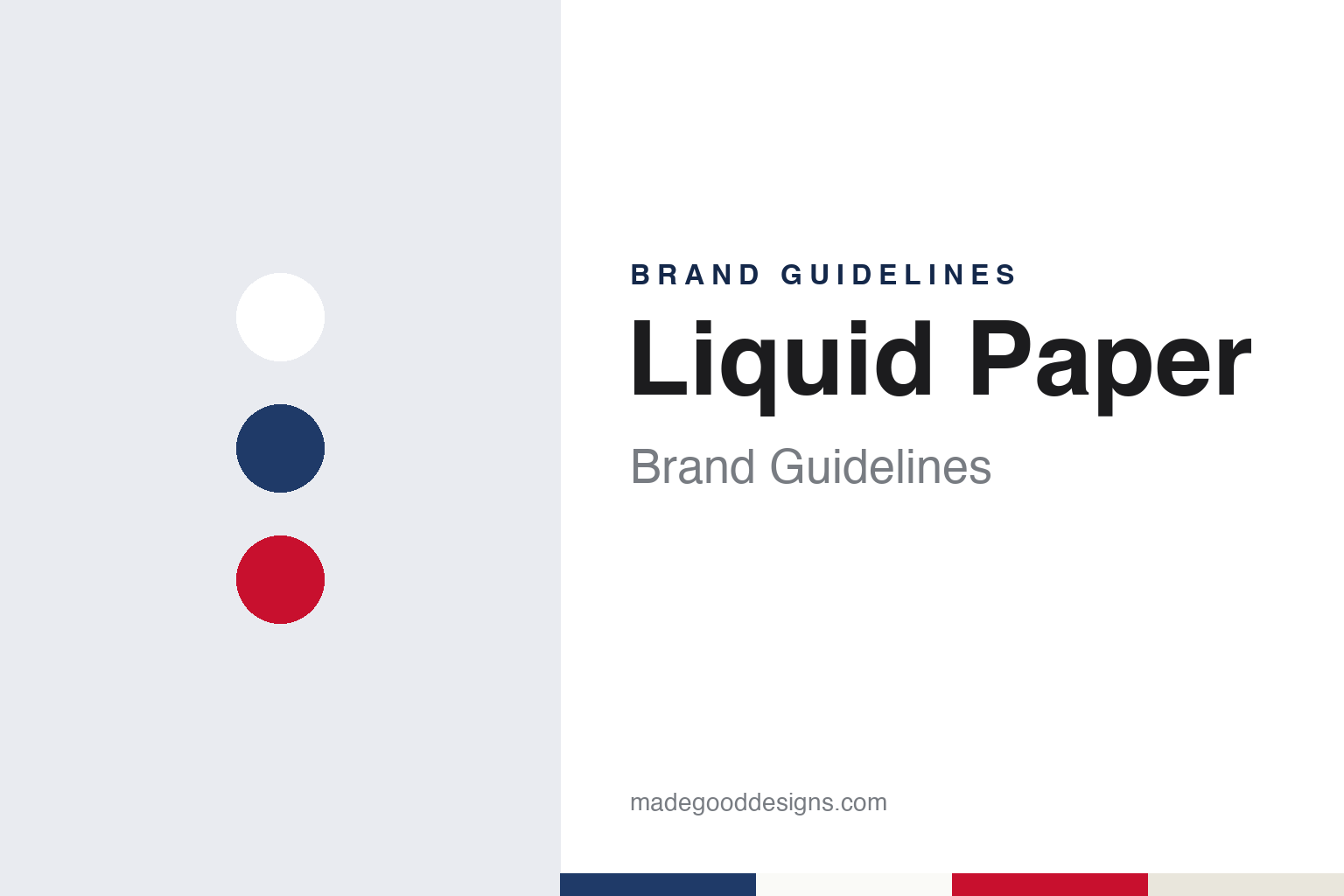
Two constants: a correction white, typist navy and proof red palette and a typewriter slab mono register. Abstract homage — not a Liquid Paper product or mark; no bottle, pen or logo is reproduced.
A secretary’s fix for the typewriter
It started with paint and a brush.
Liquid Paper began as a workaround at a Dallas desk. English Wikipedia’s article on Bette Nesmith Graham says that in 1951 she was executive secretary to W. W. Overton, chairman of the board of the Texas Bank and Trust, and worked on an IBM electric typewriter, a machine on which typing errors were hard to fix, so that a small slip could mean retyping a whole page. Citing the Chicago Tribune in 1988, the article says she also painted the bank’s holiday window display for extra money, and that painting over a mistake in a design gave her the idea for her earliest correction-fluid prototypes.
The early product was close to an artist’s material. Wikipedia says she mixed white water-based tempera paint to match the colour of her office stationery and applied it over errors with a watercolour brush. Its article on the brand says she worked on the mixture in her kitchen, using a kitchen blender, and that she called the fluid “Mistake Out”, handing small bottles bearing that name to colleagues. Citing the National Women’s History Museum in 2013, Wikipedia credits Graham with inventing correction fluid in 1956, and, citing Forbes in April 2020, says she formed the Mistake Out Company that year.
She kept refining it. Wikipedia says she developed alternative formulas that dried more quickly and better brushes for applying them, and that orders grew after the fluid appeared in The Office magazine, which led to a corporate order from General Electric; it cites a 1980 report in The News for that account.
Colour
From Mistake Out to Liquid Paper.
The side business soon became the main one. Wikipedia says Graham lost her typing job after she accidentally typed her own company’s name on a sheet of her employer’s letterhead, and afterwards gave all her time to Mistake Out. In 1958, citing The New York Times in its 2018 “Overlooked No More” obituary series, Wikipedia says she renamed the business the Liquid Paper Company and applied for a patent and a trademark. The new name described the product rather than the problem: a fluid that stood in for the paper itself.
The company grew in modest premises at first. Wikipedia’s article on Graham says that in 1962 she married Robert Graham, who joined her in running the business as it expanded, that headquarters moved to a work shed in 1964, and that in 1965 the company moved into a single-family home. By 1968, quoting Forbes, Wikipedia says the company was breaking ground on a business and manufacturing facility in Dallas, and that it went on to open offices and manufacturing plants in Canada, England, Belgium and Australia.
Graham also set out how she wanted the company to behave. Wikipedia, citing the reference work Notable American Women (2004), says her “Statement of Policy” covered subjects from her religious beliefs to decentralised decision-making and an emphasis on product quality, and that at the Liquid Paper headquarters she built a green belt with a fish pond, an employee library and a childcare centre. Citing Forbes, it adds that the company offered employees a retirement programme, a continuing-education programme and an employee-owned credit union. The same article notes that her son, Michael Nesmith, became the guitarist of The Monkees.
By the mid-1970s the category had filled up. Citing The New York Times, Wikipedia says that by 1975 Liquid Paper faced several competitors, among them Wite-Out.
Typography
Design and documentation.
Glue and correction products are among the most ordinary things in an office, a classroom or a craft drawer, and the brands behind them usually reach people through a tube, a stick, a bottle or a small dispenser rather than through anything grander. Many of these names began with a single product made to solve a particular, everyday problem, and some have since become shorthand for the whole kind of product they sell.
A brand in this category is often carried more by its name, its packaging colours and the shape of its container than by any single advertisement, and the company behind the name may have changed hands several times, been folded into a larger stationery or household group, or moved where its products are made. That makes the plain questions worth asking: who started it, who owns it now, and how its packaging and name have changed.
Each guide separates what independent sources record from what the company says about itself — its founding story, its owners over time and the way its labels have developed — and marks plainly what rests only on the company’s own word.
Aa
A typewriter-style slab monospace. (Specimen set in Courier Prime, a typewriter-mono STAND-IN; NOT the Liquid Paper logo.)
Liquid Paper
From Gillette to Newell Brands.
Ownership left the founder’s hands at the end of the 1970s. Citing The New York Times, English Wikipedia says Graham sold Liquid Paper to the Gillette company in 1979. In the years that followed she set up two foundations, which the Times, as quoted by Wikipedia, describes as the Gihon Foundation, supporting women in the arts, and the Bette Clair McMurray Foundation, doing the same for women in business.
The brand changed hands again in 2000. Wikipedia’s article on Liquid Paper says the product and brand name were acquired that year by Newell Rubbermaid, later Newell Brands. Newell has owned Liquid Paper since 2000. Wikipedia today describes Liquid Paper as an American brand of Newell Brands, marketed internationally, that sells correction fluid, correction pens and correction tape — a range that has moved some way beyond the bottle and brush of the Mistake Out years.
The name has kept its story attached. The National Women’s History Museum included it in a 2013 article on everyday items it credits to women, and the Liquid Paper article on Wikipedia illustrates the brand with products displayed at The Women’s Museum in Dallas, the city where the business began.
For a design guide, Liquid Paper shows how a product named for what it does can carry an origin story as part of its identity: a typist’s mixture of paint and brush turned into a trademark, then a range inside a larger stationery group. Compare a Newell stablemate in our Sharpie brand guidelines and a European correction brand in our Tipp-Ex brand guidelines. For this guide we use correction white, typist navy and proof red with a typewriter-style slab mono, an unofficial interpretation; no product or logo is reproduced.
Explore & save
Keep Liquid Paper’s identity on hand — save it to a board in the Made Good inspiration library.
Liquid Paper identity set
Pin the Liquid Paper correction white, typist navy and proof red palette and the typewriter slab mono register to your own board.