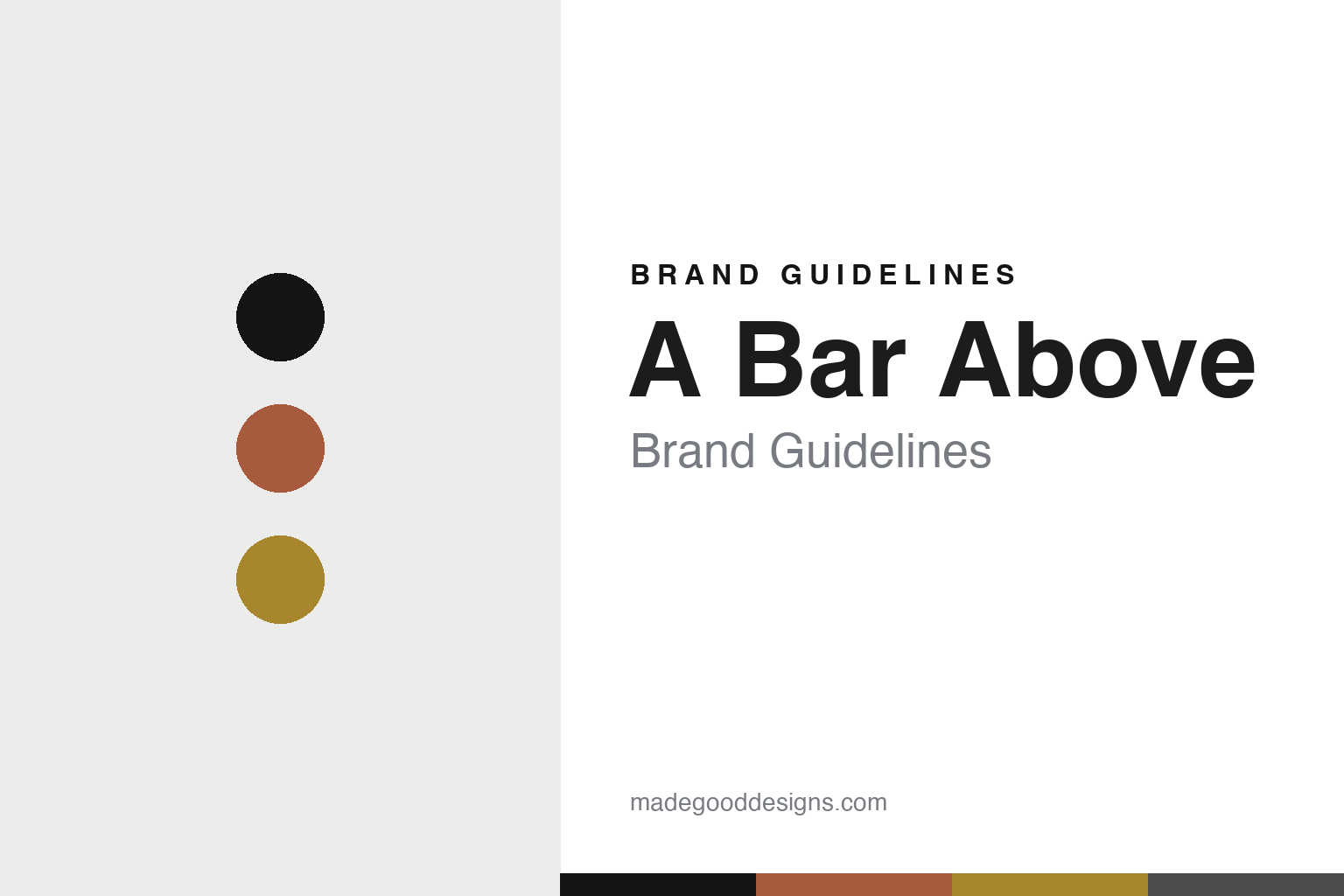
A Bar Above Brand Guidelines
The bartender-made tool.
Aa
Two constants: a copper-and-brass palette and a craft sans register. Abstract homage — not the A Bar Above products or packaging.
The bartender-made tool
A Bar Above teaches first, then makes the tools.
A Bar Above is a lesson in audience before product. Founded in 2013 by Julia and Chris Tunstall — a husband-and-wife pair of cocktail obsessives — it started, in their own telling, in their dining room in Carlsbad, California.
Its identity is bartender-made cocktail tools. Tellingly, the content came first: A Bar Above began as a cocktail-education platform — courses, recipes, a podcast, a community — and only then, around 2016, began designing and making its own tools. “Made By Bartenders” is the whole pitch: high-performance, lasts-a-lifetime shakers, strainers, precision jiggers and mixing glasses “designed to solve real problems bartenders face.” Teach the craft; then build the kit.
(Honest notes: the founders and story come from the brand’s own account (external sources were blocked), so we attribute them to the company. “Made By Bartenders” describes design and curation, not a manufacturing origin — nothing states the tools are US-made, so we don’t imply it. Named products we cite (the Complete Craft Mixology bar set, the Bartender Fundamentals course) are the confirmed ones. There’s no official brand hex, so these tones are an unofficial interpretation. This is design commentary and does not promote any product.)
Colour
A Bar Above lives in a copper-and-brass palette. Click a swatch to copy the hex.
A Bar Above’s identity is crafted, warm and pro — a copper, an ink, a brass, a charcoal, and a chalk. The palette pairs a copper with a brass — the register of warm cocktail metal. It signals craft and performance rather than novelty. The honest caveat: with no published brand hex, these tones are an original, unofficial interpretation, not first-party values.
The lesson is a copper with a brass signals a craft-cocktail tools brand. A Bar Above’s world is a well-equipped home bar, taught and tooled. For designers, it is a reminder that building an audience first — with content — can be the strongest foundation for a product. The takeaways: build the audience first; design from real problems; keep the tools durable; and treat any single hex as unofficial.
Typography
The register is a craft sans — crafted, warm, pro.
A Bar Above’s identity carries a crafted, warm, pro spirit — a taught, tooled home bar. A distinctive craft-leaning sans captures the mood: it is modern and confident, the register of craft cocktails. Set in a copper-and-brass palette, the craft sans feels crafted and warm — exactly the personality A Bar Above carries. It is characterful rather than plain, mirroring performance tools. (A Bar Above’s real products and wordmark are works we describe but do not reproduce, and the exact typeface is not ours to use.) Because it is not ours to use, the honest description is “a craft sans spirit,” shown here in a stand-in. The type behaves like the brand: crafted, warm and pro.
Aa
A craft sans spirit — crafted and warm. (Specimen set in Space Grotesk, a distinctive modern sans STAND-IN; NOT the A Bar Above packaging.)
Audience before product
A Bar Above stands for bartender-made cocktail tools.
A Bar Above is a lesson in building the audience first. A copper-and-brass palette, a craft sans and a taught, tooled home bar make “Made By Bartenders” the whole brand — crafted, warm, pro. The audience is the differentiator. The differentiator is content that came before the hardware.
For designers and brand-builders, A Bar Above offers a clear takeaway: earn an audience, then make the product they need. The lessons: build the audience first; design from real problems; keep it durable; and be honest about the story. It is also a reminder to stay accurate: it’s a 2013 California brand founded by Julia and Chris Tunstall (per the company), with tools that arrived around 2016 and a manufacturing origin left unstated. A Bar Above made its audience the brand — proof that content-first can be the difference.
Explore & save
Keep A Bar Above’s identity on hand — save it to a board in the Made Good inspiration library.
A Bar Above identity set
Pin the copper-and-brass palette and the craft-sans register to your own board.