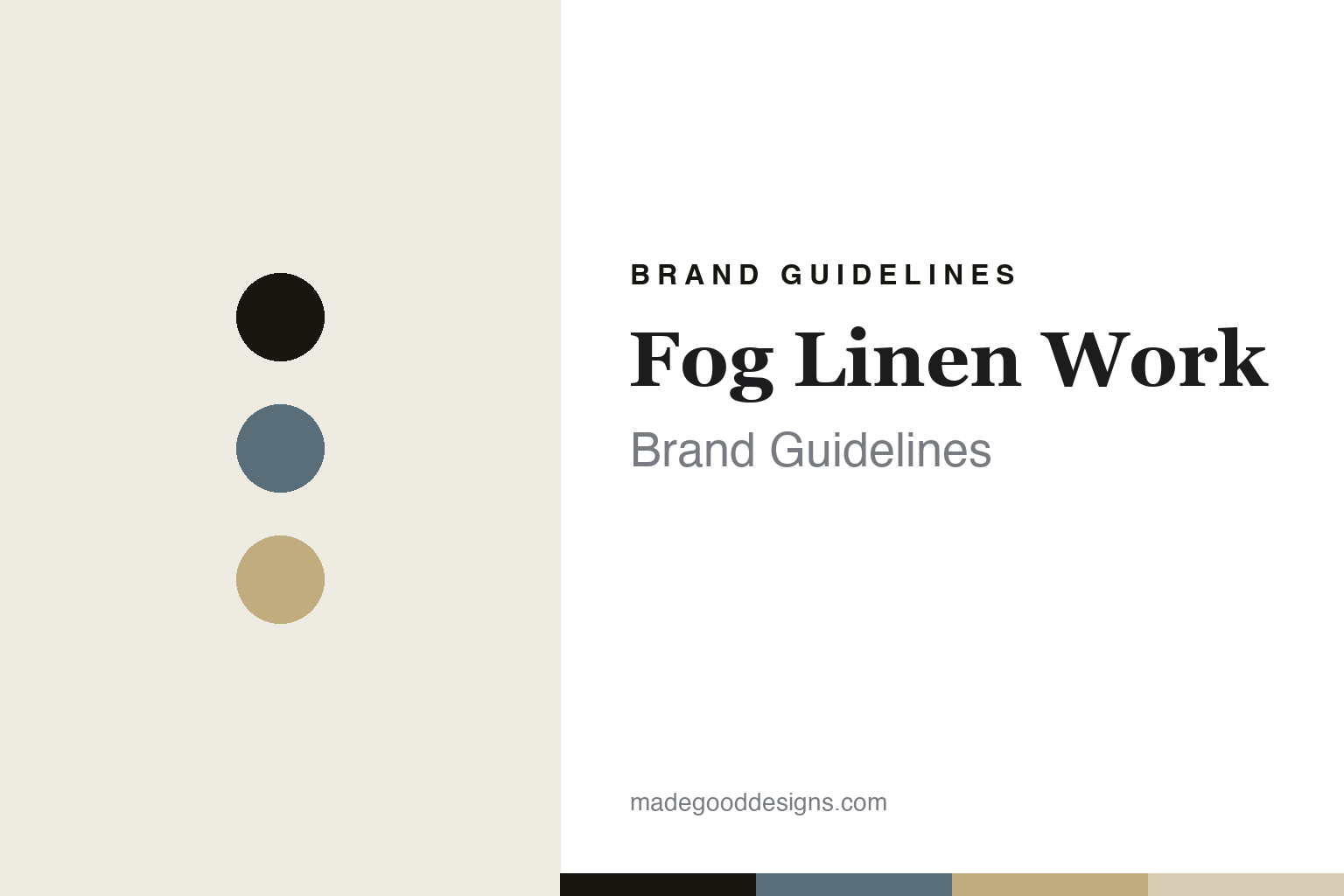
Fog Linen Work Brand Guidelines
The everyday linen.
Aa
Two constants: a grey-blue-and-flax palette and a quiet serif register. Abstract homage — not the Fog Linen Work textiles or packaging.
The everyday linen
Fog Linen Work makes linen for daily life.
Fog Linen Work is a lesson in the everyday as the design. Founded by Yumiko Sekine in Tokyo — the business began in 1993 importing European housewares, and the linen line followed around 1999 after Sekine visited the flax country of Lithuania.
Its identity is simple, everyday linen. Made from Lithuanian linen, Fog’s bedding, kitchen cloths, table linens, aprons and towels are unfussy, natural and hard-working — “Live with linen. Every day.” It is a Japanese sensibility (quiet, simple, made for use) applied to a European material — beautiful, plain products meant to be used, not admired. Linen for the ordinary day.
(Honest notes: there are two dates — the business began in 1993, the linen line around 1999 — so we cite both rather than one loose “1990s.” The made-where is genuinely mixed: the linen is designed in Japan and produced in Lithuania, while Fog’s non-linen “fog et cetera” wares (brass, baskets) and its cotton “miiThaaii” line are made in India — not a single answer. We don’t assert a meaning for “fog.” There’s no official brand hex — its natural, undyed palette informs an unofficial interpretation. This is design commentary and does not promote any product.)
Colour
Fog Linen Work lives in a grey-blue-and-flax palette. Click a swatch to copy the hex.
Fog Linen Work’s identity is natural, plain and quiet — a grey blue, an ink, a flax, an oatmeal, and a chalk. The palette pairs a grey-blue with a flax — the register of undyed, everyday linen. It signals use and simplicity rather than novelty. The honest caveat: with no published brand hex, these tones are an original, unofficial interpretation, not first-party values.
The lesson is a grey-blue with a flax signals an everyday-linen house. Fog’s world is a plain, useful cloth. For designers, it is a reminder that designing for the ordinary day — simple, natural, hard-working — can be the whole identity. The takeaways: design for daily use; keep the material natural; stay plain; and treat any single hex as unofficial.
Typography
The register is a quiet serif — natural, plain, everyday.
Fog Linen Work’s identity carries a natural, plain, everyday spirit — a useful, undyed linen. A soft, quiet serif captures the mood: it is gentle and unassuming, the register of everyday craft. Set in a grey-blue-and-flax palette, the quiet serif feels natural and plain — exactly the personality Fog carries. It is understated rather than decorative, mirroring everyday linen. (Fog Linen Work’s real textiles and lowercase wordmark are works we describe but do not reproduce, and the exact typeface is not ours to use.) Because it is not ours to use, the honest description is “a quiet serif spirit,” shown here in a stand-in. The type behaves like the brand: natural, plain and everyday.
Aa
A quiet serif spirit — natural and plain. (Specimen set in Newsreader, a soft editorial serif STAND-IN; NOT the Fog Linen Work packaging.)
The everyday as the design
Fog Linen Work stands for everyday Lithuanian linen.
Fog Linen Work is a lesson in making the everyday the identity. A grey-blue-and-flax palette, a quiet serif and a plain, useful cloth make everyday linen the whole brand — natural, plain, quiet. The everyday is the differentiator. The differentiator is linen made for daily life.
For designers and brand-builders, Fog offers a clear takeaway: design for the ordinary day. The lessons: design for daily use; keep the material natural; stay plain; and be honest about the story. It is also a reminder to stay accurate: it’s a Tokyo brand (linen line 1999) using Lithuanian linen, with wares made in India, and the palette here is an unofficial interpretation. Fog Linen Work made the everyday the brand — proof that plain, useful linen can be the difference.
Explore & save
Keep Fog Linen Work’s identity on hand — save it to a board in the Made Good inspiration library.
Fog Linen Work identity set
Pin the grey-blue-and-flax palette and the quiet-serif register to your own board.