Abraham Moon Brand Guidelines
The Yorkshire mill.
Aa
Two constants: a lovat-and-russet palette and a mill sans register. Abstract homage — not the Abraham Moon checks, tweeds or packaging.
The Yorkshire mill
Abraham Moon weaves it all in one place.
Abraham Moon is a lesson in the mill as identity. Founded in 1837 by Abraham Moon in Guiseley, West Yorkshire, it is one of the rare remaining vertical woollen mills in Britain — running the whole process under one roof.
Its identity is the Yorkshire mill. Abraham Moon dyes, blends, cards, spins, weaves and finishes its own woollen and worsted cloth at its Guiseley mill — tweeds, checks and plaids for fashion and interiors, plus accessories under the “Bronte by Moon” name. From raw wool to finished cloth, in one place. Provenance you can point to.
(Honest notes: Abraham Moon was founded in 1837 in Guiseley, West Yorkshire (its Netherfield mill), and it is genuinely a vertical woollen mill — but it is described as “one of the last / rare remaining,” not “the last,” so we hedge that. It is owned by the Walsh family, who have run it since 1920 — it is family-owned, not private-equity-owned, and the only acquisition runs the other way (Moon bought Bronte Tweeds in 2009). Its cloth is woven in Yorkshire (“British cloth”); we don’t quote “Made in England” as a verbatim slogan. Client names such as Burberry, Paul Smith and Ralph Lauren are reported by the press, so we attribute rather than assert them. There’s no official brand hex, and we reproduce no actual check or tweed — these tones are an unofficial interpretation. This is design commentary and does not promote any product.)
Colour
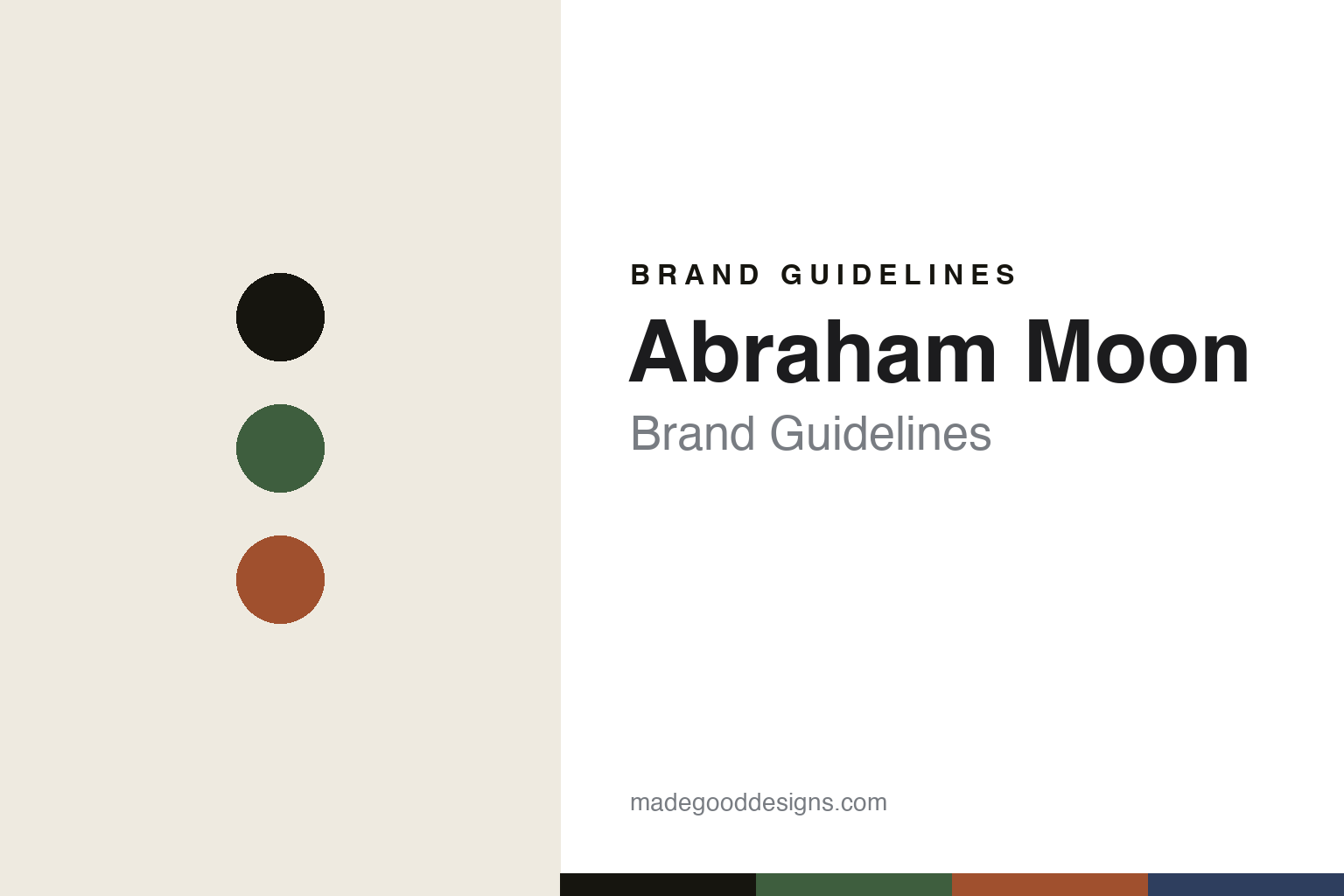
Abraham Moon lives in a lovat-and-russet palette. Click a swatch to copy the hex.
Abraham Moon’s identity is woven, earthy and British — a lovat, an ink, a russet, a navy, and an oatmeal. The palette pairs a lovat with a russet — the register of a Yorkshire tweed. It signals wool and place rather than novelty. The honest caveat: with no published brand hex, these tones are an original, unofficial interpretation, not first-party values.
The lesson is a lovat with a russet signals a woollen mill. Abraham Moon’s world is a woven, dyed-in-the-wool cloth. For designers, it is a reminder that owning the whole process — dye to finish — can itself be the identity. Because a mid lovat can fail as small text, keep type dark and let the colour live in the accents, palette and band. The takeaways: own the process; weave in place; tell the provenance; and treat any single hex as unofficial.
Typography
The register is a mill sans — sturdy, honest, British.
Abraham Moon’s identity carries a sturdy, honest, British spirit — a woven, hard-wearing cloth. A robust grotesque sans captures the mood: it is grounded and industrious, the register of a working mill. Set in a lovat-and-russet palette, the mill sans feels sturdy and honest — exactly the personality Abraham Moon carries. It is workmanlike rather than delicate, mirroring a woven tweed. (Abraham Moon’s real checks, tweeds and wordmark are works we describe but do not reproduce, and the exact typeface is not ours to use.) Because it is not ours to use, the honest description is “a mill sans spirit,” shown here in a stand-in. The type behaves like the brand: sturdy, honest and British.
Aa
A mill sans spirit — sturdy and honest. (Specimen set in Archivo, a robust grotesque sans STAND-IN; NOT the Abraham Moon packaging.)
The mill as identity
Abraham Moon stands for the Yorkshire mill.
Abraham Moon is a lesson in making the mill the identity. A lovat-and-russet palette, a mill sans and a woven tweed make the mill the whole brand — sturdy, honest, British. The mill is the differentiator. The differentiator is owning the whole process, dye to finish, in one Yorkshire place.
For designers and brand-builders, Abraham Moon offers a clear takeaway: own the making. The lessons: own the process; weave in place; tell the provenance; and be honest about the story. It is also a reminder to stay accurate: it was founded in 1837 in Guiseley, it is Walsh-family-owned and one of the last vertical woollen mills, and its cloth is woven in Yorkshire — the palette here is an unofficial interpretation. Abraham Moon made the mill the brand — proof that the making can be the difference.
In application, provenance is the point. The lovat-and-russet palette reads like dyed-in-the-wool cloth, the ink carries the text, the mill sans stays sturdy and honest, and the check is evoked through weave-texture rather than a reproduced pattern. A designer working in this spirit would foreground process and place: earthy, blended colours; a workmanlike type; imagery that shows the making rather than only the product. The lesson Abraham Moon teaches is that owning the whole process — dye to finish, under one roof — can itself be the identity, and that provenance is a design asset when it is real. As you borrow the approach, keep the record straight: Abraham Moon was founded in 1837 in Guiseley, West Yorkshire, it is owned by the Walsh family (since 1920, not private equity), it is one of the last vertical woollen mills rather than the only one, and its cloth is woven in Yorkshire — while the palette here is an unofficial interpretation rather than first-party values.
Explore & save
Keep Abraham Moon’s identity on hand — save it to a board in the Made Good inspiration library.
Abraham Moon identity set
Pin the lovat-and-russet palette and the mill-sans register to your own board.