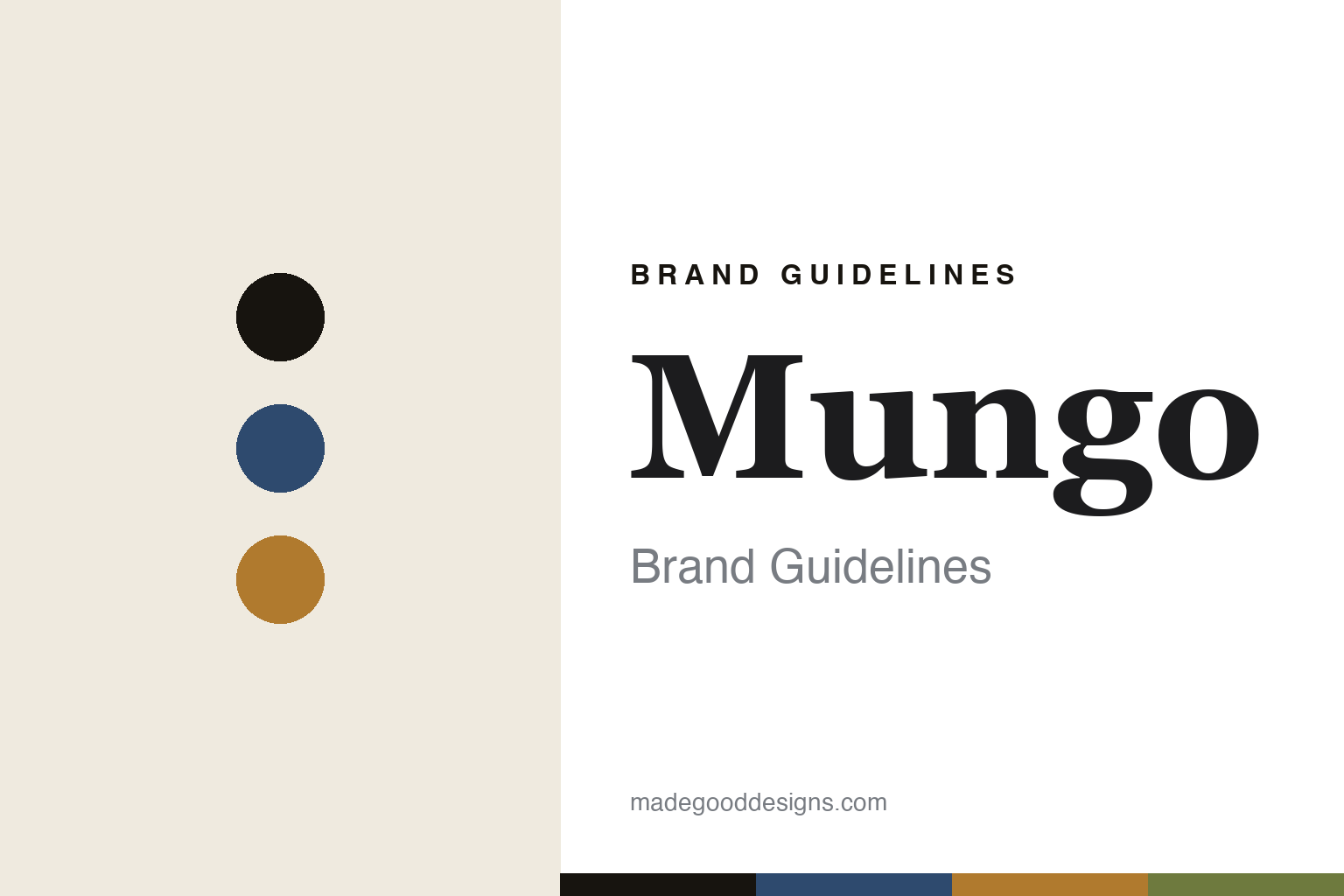
Mungo Brand Guidelines
The honest weave.
Aa
Two constants: an indigo-and-ochre palette and a mill slab register. Abstract homage — not the Mungo weaves, patterns or packaging.
The honest weave
Mungo weaves its own cloth in the open.
Mungo is a lesson in the transparent weave. Founded in 1998 by Stuart Holding — a Yorkshire-trained master weaver — in Plettenberg Bay, South Africa, it designs and weaves its own cloth on its own looms, in a mill open to the public.
Its identity is the honest weave. Mungo makes woven textiles — towels, throws, blankets, table linen, scarves — in cotton, linen, mohair and wool, on looms ranging from restored antique Lancashire shuttle looms to modern machines at its purpose-built Plettenberg Bay mill. Its watchword is “quality with a conscience.” A cloth you can watch being woven. Provenance, in the open.
(Honest notes: Mungo was founded in 1998 by Stuart Holding, a master weaver trained in Yorkshire, in Plettenberg Bay, South Africa; it designs and weaves its own cloth on its own looms — including restored Lancashire shuttle looms (roughly 1890s, an age we hedge) — at a mill purpose-built in 2017 and open to the public seven days a week. It is family-run, now led by Stuart’s children Tessa and Dax Holding. It is woven in South Africa, though some yarn is imported (linen from Belgium, organic cotton from Turkey) while mohair, wool and most cotton are South African — so we don’t claim all-local fibre. It is South Africa’s first GOTS-certified textile weaving mill (around 2020; some sources say 2019). Its tagline is “quality with a conscience.” There’s no official brand hex, and we reproduce no actual pattern — these tones are an unofficial interpretation. This is design commentary and does not promote any product.)
Colour
Mungo lives in an indigo-and-ochre palette. Click a swatch to copy the hex.
Mungo’s identity is woven, earthy and honest — a Karoo indigo, an ink, an ochre, an olive, and a sand. The palette pairs an indigo with an ochre — the register of a design-led woven cloth. It signals weave and transparency rather than novelty. The honest caveat: with no published brand hex, these tones are an original, unofficial interpretation, not first-party values.
The lesson is an indigo with an ochre signals an own-mill weaver. Mungo’s world is a durable, honest cloth. For designers, it is a reminder that owning and opening the loom — showing exactly how the cloth is made — can be the whole identity. Because a mid indigo can fail as small text, keep type dark and let the colour live in the accents, palette and band. The takeaways: own the loom; open the process; weave to last; and treat any single hex as unofficial.
Typography
The register is a mill slab — sturdy, honest, grounded.
Mungo’s identity carries a sturdy, honest, grounded spirit — a durable, woven cloth. A robust slab serif captures the mood: it is solid and forthright, the register of a working mill. Set in an indigo-and-ochre palette, the mill slab feels sturdy and honest — exactly the personality Mungo carries. It is grounded rather than delicate, mirroring a hard-wearing weave. (Mungo’s real weaves, patterns and wordmark are works we describe but do not reproduce, and the exact typeface is not ours to use.) Because it is not ours to use, the honest description is “a mill slab spirit,” shown here in a stand-in. The type behaves like the brand: sturdy, honest and grounded.
Aa
A mill slab spirit — sturdy and honest. (Specimen set in Bitter, a robust slab serif STAND-IN; NOT the Mungo packaging.)
The transparent weave
Mungo stands for the honest weave.
Mungo is a lesson in making the loom the identity. An indigo-and-ochre palette, a mill slab and a durable cloth make the honest weave the whole brand — sturdy, honest, grounded. The weave is the differentiator. The differentiator is owning the looms and opening the process for anyone to watch.
For designers and brand-builders, Mungo offers a clear takeaway: own and open the making. The lessons: own the loom; open the process; weave to last; and be honest about the story. It is also a reminder to stay accurate: it was founded in 1998 by Stuart Holding in Plettenberg Bay, it weaves its own cloth on its own looms, and it is South Africa’s first GOTS-certified weaving mill — the palette here is an unofficial interpretation. Mungo made the honest weave the brand — proof that transparency can be the difference.
Put to work, transparency is the story. The indigo-and-ochre palette reads earthy and woven, the ink carries the text, the mill slab stays sturdy and forthright, and the weave is evoked as texture rather than a reproduced pattern. A designer working in this spirit would show the making: honest, durable colour; a solid, grounded type; imagery of the loom and the process rather than only the finished cloth. The lesson Mungo teaches is that owning and opening the loom — letting anyone watch how the cloth is made — can be an entire identity, and that transparency is a design position, not just an ethic. As you borrow the approach, keep the record straight: Mungo was founded in 1998 by Stuart Holding in Plettenberg Bay, it designs and weaves its own cloth on its own looms, it is South Africa’s first GOTS-certified textile weaving mill, and while it is woven in South Africa some of its yarn is imported — so the palette here is an unofficial interpretation rather than first-party values.
Explore & save
Keep Mungo’s identity on hand — save it to a board in the Made Good inspiration library.
Mungo identity set
Pin the indigo-and-ochre palette and the mill-slab register to your own board.