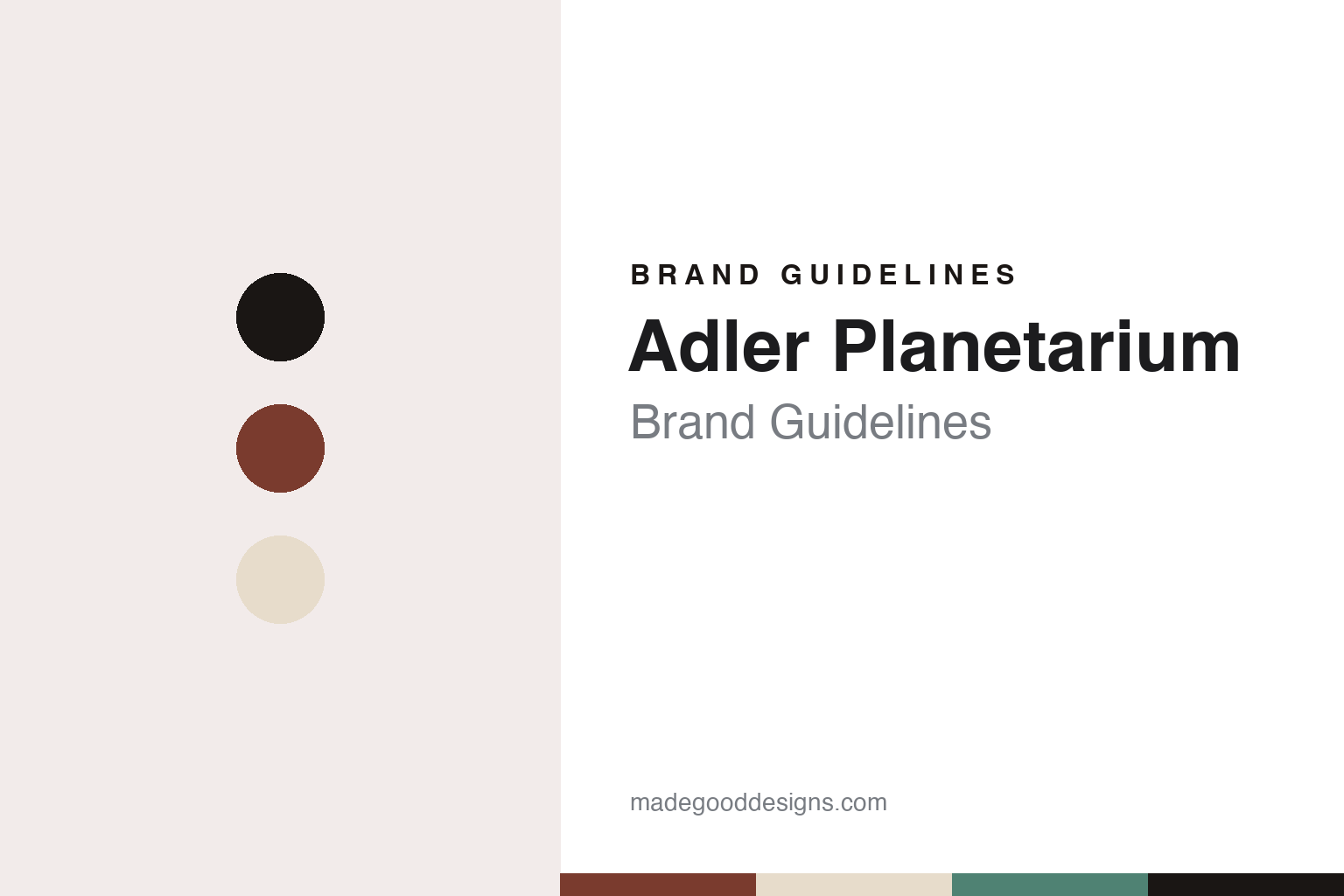
Adler Planetarium Brand Guidelines
The twelve-sided lakefront planetarium opened in 1930.
Aa
Two constants: a granite red, copper green and gold palette and a geometric sans register. Abstract homage — not an Adler Planetarium asset; no logo, plaque or building image is reproduced.
Northerly Island, 1930
A projector seen in Germany, a building on the lake.
The Adler Planetarium opened in Chicago on 12 May 1930, the birthday of its founder, Max Adler. APS News, the newsletter of the American Physical Society, recounted the story in April 2023: Adler, retired from Sears, Roebuck and Co., saw a new Zeiss projection planetarium in Munich and set out to bring the technology to the United States, giving the funds for the building in 1928. Projection planetariums were then new in Europe; English Wikipedia says the Zeiss projector, developed in Jena, made its debut in 1923, and that by 1929 there were fifteen planetariums in Germany alone.
Adler travelled to Germany with his cousin, the architect Ernest A. Grunsfeld Jr., whom he commissioned to design the Chicago building. English Wikipedia says the planetarium was at first considered as part of the Museum of Science and Industry, then being set up in the former Palace of Fine Arts of the 1893 exposition, but that delays there led Adler to choose a new site: Northerly Island, a strip of made land on the Lake Michigan shore that the South Park Commissioners, forerunners of the Chicago Park District, had just completed. The National Park Service landmark nomination of October 1985 describes the island as a peninsula joined to the mainland by a causeway, with views of the downtown skyline to the west and open water to the east.
The institution opened as the Adler Planetarium and Astronomical Museum. Alongside the projector, Adler bought a collection of historic astronomical instruments from a dealer in Amsterdam, APS News says, and the National Park Service records that he gave the building, the projector and the collection to the people of Chicago. The APS News article and the planetarium’s own site describe it as the first planetarium in the Western Hemisphere; Astronomy magazine calls it the first modern planetarium in America.
Colour
Twelve sides, three rings and a copper dome.
The National Park Service nomination describes the building closely. Its outer walls are clad in polished rainbow granite, reddish with dark green veins, and form three concentric twelve-sided rings that step back in tiers, the largest 160 feet across. The twelve sides stand for the months of the year and the signs of the zodiac. The terraces on top of the rings were designed for observing the sky, and above them rises a hemispherical dome roofed in copper. The nomination reads the two shapes as a plan of the interior: the lower, many-sided part holds the museum, classrooms and offices, while the inside of the dome is the screen for the projector.
Decoration is spare and astronomical. Bands of fluting run along the top of the lowest level and up the twelve corners, and the upper corners carry bronze plaques of the zodiac by the sculptor Alfonso Iannelli, with the stars placed according to second-century Greek descriptions of the constellations. Iannelli also made a marble dedication panel inside with metal symbols of the planets. The nomination, written in 1985, describes the interiors as a dark cinnamon with gold ceilings in the exhibition areas.
The planetarium has grown around that core. A reflecting pool decorated in terrazzo with the twelve months was added in 1933 for the Century of Progress exposition and later removed. In 1973 an underground addition opened, which the National Park Service says more than doubled the floor space, entered through a glass structure on the forecourt. The Doane Observatory followed in 1977 on the lakefront side. In 1999 the glass-walled Sky Pavilion, designed by the Chicago firm Lohan Associates, added four exhibition galleries, English Wikipedia says; the dome theatre was renamed the Grainger Sky Theater when it reopened in May 2011, and the Clark Family Welcome Gallery was designed by Thomas Roszak Architecture.
Today the planetarium has three theatres, two of them domed, according to English Wikipedia, which gives the Grainger Sky Theater’s dome as 21 metres across; APS News describes three planetarium domes, a public observatory and a collection of more than 6,000 artifacts, books and manuscripts on astronomy. Astronomy magazine lists permanent galleries on exoplanets, the Mars rovers and historic instruments, and says the museum sees about half a million visitors a year, a figure the planetarium also gives.
Typography
Science centres and their buildings.
Science centres and planetariums tend to present themselves through a small set of parts. Many trace their origins to a founding body: a learned society or academy, a city, a state agency or a non-profit formed to build a museum. That origin often stays in the name, in words such as “academy,” “institute” or “center,” even when the institution itself has changed a great deal since its founding.
The building often carries much of the identity. A geodesic dome, a tower, a set of arches or a planted roof can become the outline by which a centre is recognised in photographs, on signs and in its own publicity. A dome that began as a film theatre may later become a digital planetarium without any change to its shape, so the silhouette outlasts the technology inside it.
Inside, the offer is broadly similar from one centre to the next: hands-on galleries arranged by theme, a planetarium or dome theatre, and sometimes an aquarium, live animals or a living collection of plants. Around these sit programmes for schools and families, such as field trips, workshops, summer camps and training for teachers, along with evening events for adults. An institution that also does research, such as a natural history academy, adds collections and laboratories that visitors rarely see.
A name may change with a new building, a merger or a sponsor, and an older name may later return. For a designer, the useful constants are the founding story, the shape of the building and the plain description of what visitors find inside; the palettes and typefaces in these guides are our own unofficial interpretations, not the institutions’ own.
Aa
A geometric sans for a building drawn with a compass. (Specimen set in Jost, a sans STAND-IN; NOT the Adler Planetarium logo.)
A landmark on the campus
A city site, a private building and a museum campus.
The planetarium sits at the northern end of Chicago’s Museum Campus. The National Park Service nomination describes it, with its neighbours the Field Museum and the Shedd Aquarium, as a cultural complex covering the sky, the earth and water, and notes that these buildings, with Soldier Field, are the main structures surviving on site from A Century of Progress, the Chicago exposition of 1933 and 1934. The building was designated a National Historic Landmark in 1987, and the American Physical Society named it an APS Historic Site in 2019.
Its management has changed over time. English Wikipedia says a board of trustees was created in 1967 to share responsibility with the Chicago Park District, and that in 1976 the board took over full management, with continued support from the park district. In 1985 the National Park Service recorded that the park district owned the land and the planetarium owned the building. The planetarium describes itself today as a non-profit organisation.
Research and programmes sit alongside the shows. English Wikipedia describes a collections department that grew out of the Webster Institute for the History of Astronomy, an astronomy department, a Space Visualization Laboratory opened in 2007, the United States base of the Zooniverse citizen science platform, the Far Horizons high-altitude balloon programme and summer camps for children aged five to fourteen. The planetarium’s own site mentions youth programmes, neighbourhood skywatching and online participatory science.
In its own name the institution has shortened “Adler Planetarium and Astronomical Museum” to Adler Planetarium, and its site often calls it simply “the Adler.” The building does much of the identity work: a twelve-sided granite drum under a copper dome, with zodiac plaques at its corners.
For a design guide, the Adler Planetarium shows how a building’s geometry, twelve sides for twelve months, can tell visitors what happens inside. Compare the Museum of Science and Industry, another Chicago museum, and The Franklin Institute, whose Fels Planetarium followed a few years later in Philadelphia. For this guide we use a granite red, a copper green and a gold with a sans, an unofficial interpretation; no product or logo is reproduced.
Explore & save
Keep Adler Planetarium’s identity on hand — save it to a board in the Made Good inspiration library.
Adler Planetarium identity set
Pin the Adler granite red, copper green and gold palette and the geometric sans register to your own board.
Source & notes
Frequently Asked Questions
What font can I use to match the Adler Planetarium look?
This guide describes Adler Planetarium’s type as “A geometric sans for a building drawn with a compass”. Its type specimen is set in Jost from Google Fonts as a stand-in; Jost is not Adler Planetarium’s own lettering.
What colours are in the Adler Planetarium palette?
This guide’s Adler Planetarium palette is Rainbow granite #7A3B2E, Night sky #1A1614, Copper verdigris #4F8273, Gilded ceiling #C9A04E and Paper #F8F5EF. The tones are the guide’s own unofficial interpretation, not official Adler Planetarium hex codes.
When did Adler Planetarium open?
Adler Planetarium opened on 12 May 1930, in Northerly Island, Chicago.
Who founded Adler Planetarium?
Adler Planetarium was founded by Max Adler on 12 May 1930.