Al Baraka Brand Guidelines
One partner-bank name across banks in many countries.
Aa
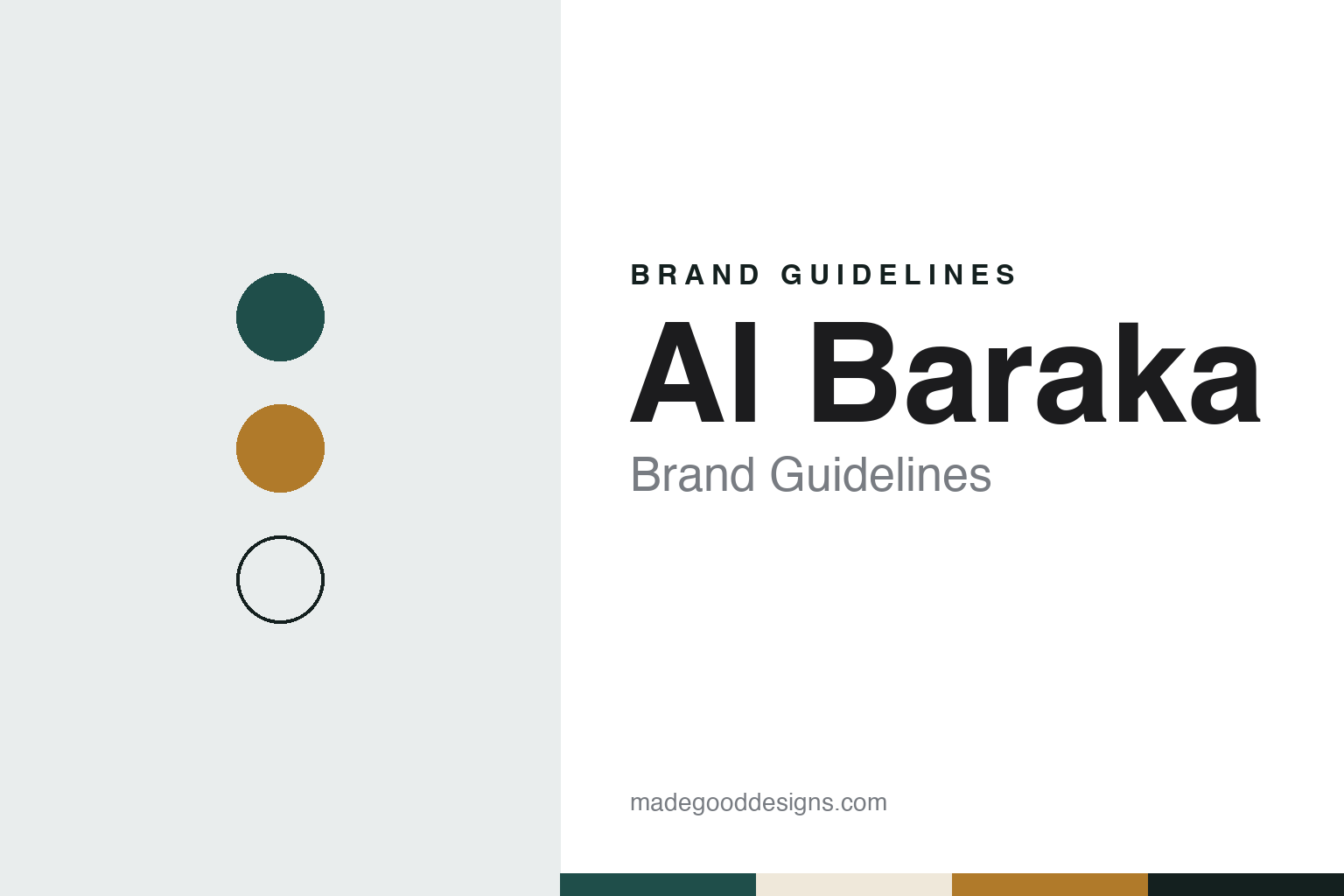
Two constants: a deep teal, sand and ochre palette and a calm serif register. Abstract homage — not an Al Baraka product or mark; no logo, card or signage is reproduced.
Al Baraka
A 2002 group built on banks from 1978.
Al Baraka is the brand of Al Baraka Group B.S.C., an Islamic financial group headquartered in Manama, Bahrain. English Wikipedia says the holding company was established and registered on 27 June 2002 under a licence from the Central Bank of Bahrain. The banks it gathered together are older. The group’s own table of its network lists Jordan Islamic Bank as founded in 1978, followed by Al Baraka Bank Egypt in 1980, Al Baraka Bank Tunisia in 1983 and units in Sudan and Bahrain in 1984. So 1978 is the date of the oldest bank in the network, and 2002 is the date of the group itself.
The group calls Shaikh Saleh Kamel its founder and describes him as “a pioneer of Islamic banking.” English Wikipedia describes Saleh Abdullah Kamel as the founder and chairman of the Dallah Al Baraka Group, a private conglomerate based in Jeddah, Saudi Arabia, with holdings across the Middle East, North Africa, the Far East and Europe. In June 2020 the founder’s son, Abdullah Saleh Kamel, was appointed chairman of Al Baraka, Wikipedia says.
The group went public four years after it was registered. Wikipedia says it held an initial public offering in 2006 and listed its shares on the Bahrain Bourse and Nasdaq Dubai, with trading on both markets from September that year. In 2017, it adds, the group issued a Tier-1 sukuk that was listed on the Irish Stock Exchange. Sukuk are Islamic certificates used in place of conventional bonds, and the group’s Sharia pages explain its products through Islamic finance principles rather than through interest.
Colour
One name, many local banks.
The Al Baraka name covers banks in many countries rather than one bank. The group’s website says it works through banking subsidiaries in 13 countries, with operations in Jordan, Egypt, Tunisia, Bahrain, Sudan, Turkey, South Africa, Algeria, Pakistan, Lebanon and Syria, branches in Iraq and a representative office in Libya, and more than 600 branches in all. Its network table dates Al Baraka Turk Participation Bank to 1985, Al Baraka Bank Limited in South Africa to 1989, Banque Al Baraka D’Algérie and Al Baraka Bank Lebanon to 1991, an associate bank in Syria to 2009, Al Baraka Bank (Pakistan) Limited to 2010 and the Libya office to 2011. English Wikipedia gives some different years — 1985 for Sudan, 1992 for Lebanon and 2007 for Syria — so the two sources do not always agree.
The names are not uniform either. Jordan Islamic Bank keeps its own name; the Turkish bank writes the brand as one word, Albaraka Türk; and Wikipedia notes that the Egyptian bank was once called Al Ahram Bank and the Egyptian Saudi Finance Bank, while the Tunisian bank was the Saudi Tunisian Finance Bank until 2009. The group’s own website, meanwhile, uses “Al Baraka” as two words, which is the spelling used in this guide.
The group sets out its thinking on a Sharia philosophy page. It describes a ban on usury, the principle of musharaka, or participation, in which returns and losses are shared, and moral and social values drawn from the Qur’an. Its tagline is “Your Partner Bank,” which the group says signifies a long-term relationship “between equals who share in the rewards.” It lists five core values — partnership, agility, innovation, trust and development — and names a Unified Sharia Supervisory Board among its leadership. It also backs the Al Baraka Islamic Economics Symposium, or Nadwa, which it says grew out of scholarly discussions on Islamic jurisprudence and is now run by a waqf, or endowment, through Al Baraka Forum.
Typography
How Islamic banks present themselves.
Islamic banks present themselves through a small set of recurring signals. Green, gold and deep blue appear often in their wordmarks and branch signs, and many write their names in two scripts side by side: Arabic, or Jawi in Malaysia, next to Latin letters. Geometric patterns, drawn from the long tradition of Islamic ornament, turn up on cards, reports and branch interiors, usually as a background rather than as a logo.
Their names tend to say what they are. Words such as “Islamic,” “Islam” and “Syariah” sit in the name itself, alongside the country or city, so that the banking model is part of the brand. Product names follow the same logic: accounts and financing are often labelled with the Arabic name of the contract behind them, such as murabaha, a cost-plus sale; ijara, a lease; mudharabah, a profit-sharing arrangement; or wakalah, an agency.
Their websites have a common structure. Alongside the usual pages on savings, cards and home and business financing, most carry a page on the bank’s Sharia supervisory board or council, the panel of scholars that reviews its products, and many add pages on sukuk, the Sharia-compliant certificates used in place of conventional bonds, on takaful, the cooperative form of insurance, and on zakat and charitable giving. Newer banking apps add prayer times and the qibla direction next to transfers and payments.
Annual and sustainability reports are where much of the identity is set out at length, with the Sharia board’s statement printed beside the auditors’ report. This guide follows what dated sources say about each bank — when it was founded, how it was merged, renamed or listed, and how it describes its own products — and treats the palette and type shown here as an unofficial interpretation rather than any bank’s own.
Aa
A calm serif for a group name used in many countries. (Specimen set in Source Serif 4, a serif STAND-IN; NOT the Al Baraka logo.)
Al Baraka Group
A new licence, a delisting and local units.
The group’s structure has changed in recent years. In July 2022 it changed its name from Al Baraka Banking Group B.S.C. to Al Baraka Group B.S.C., after receiving regulatory approval to convert its licence from a wholesale bank to an investment firm, English Wikipedia says; its website now describes it as an Investment Business Firm – Category 1 (Islamic Principles), licensed by the Central Bank of Bahrain. In November 2023 shareholders approved delisting the company and converting it into a closed shareholding company, and the shares left the Bahrain Bourse in July 2024, Wikipedia says. The website now gives the name with a “(C)”, for closed.
Two country units show how local the business is. In Lebanon, Wikipedia says, the central bank took control of Al Baraka Bank Lebanon on 19 November 2022, removing the powers of its board and executive management. In Tunisia, the business site WebManagerCenter reported in July 2023 that Al Baraka Bank Tunisia, acting with Al Baraka SICAR, had opened a mandatory public offer for the rest of the shares in the insurer El Amana Takaful, of which the two held 48.92 per cent. After the offer closed in August 2023 they held 80.83 per cent, according to a notice published by the same site, a step the earlier report linked to the group’s plan to widen its range of services.
For a design guide, Al Baraka shows how one group name can sit across banks of different ages, countries and scripts while its oldest member keeps its own name. Compare Kuwait Finance House, whose network also includes a Turkish participation bank, and Al Rajhi Bank, a Saudi Islamic bank. For this guide we use a deep teal, ink, sand and a warm ochre with a serif, an unofficial interpretation; no product or logo is reproduced.
Explore & save
Keep Al Baraka’s identity on hand — save it to a board in the Made Good inspiration library.
Al Baraka identity set
Pin the Al Baraka deep teal, sand and ochre palette and the calm serif register to your own board.