Alexander Ivanov is a painter you learn from through his process. Behind one enormous picture lie hundreds of studies of heads, drapery, olive trees, stones and water, each solving one problem in isolation. For designers working on large layouts, campaigns or illustrations, that method of breaking a big image into a library of tested parts is directly transferable.
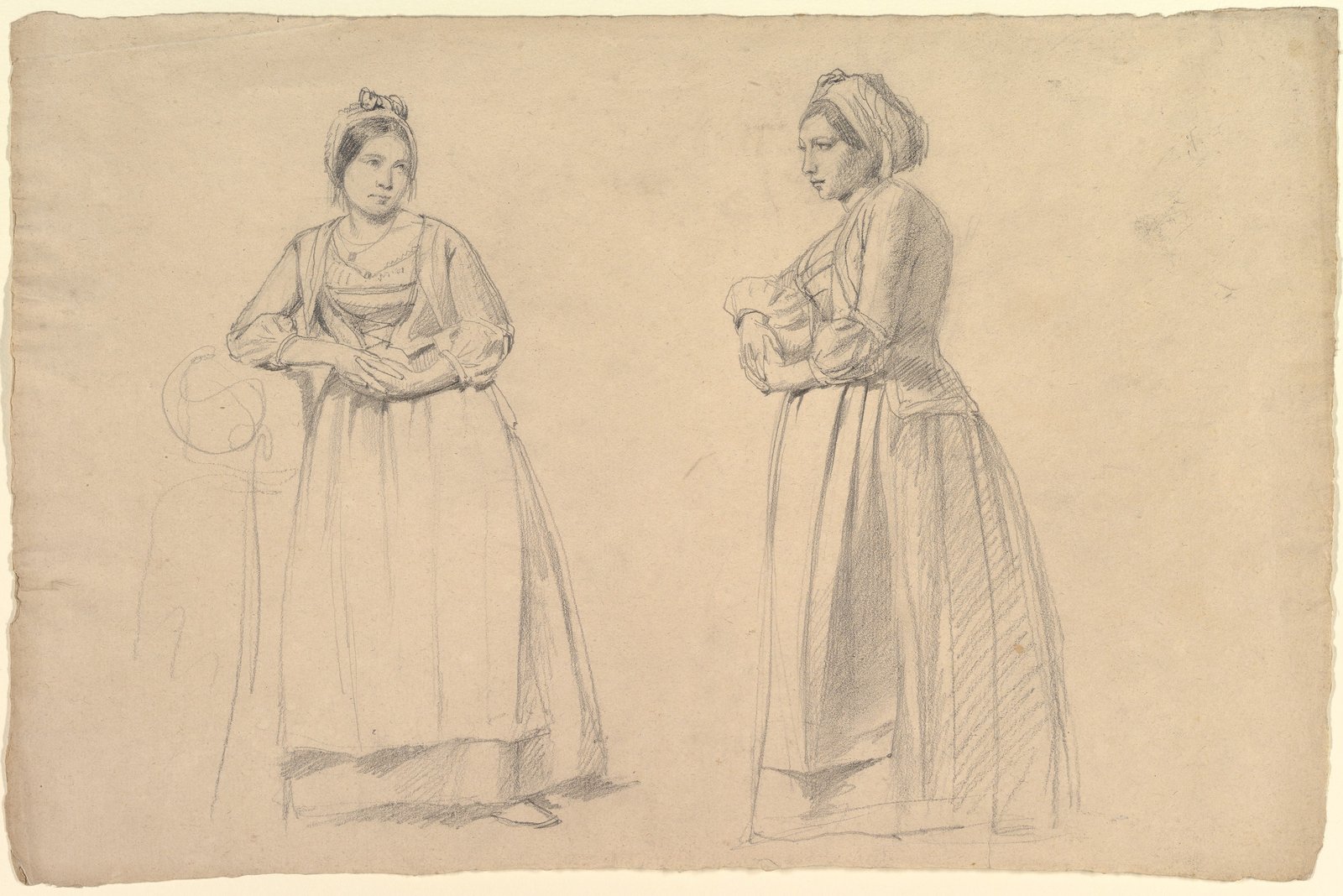
Ivanov died in 1858, and the Metropolitan Museum of Art flags its drawing by him as public domain, so one sheet is reproduced below. More public-domain drawings and prints are in the MGD museum inspiration collection.
Who was Alexander Ivanov?
Alexander Andreyevich Ivanov was born in St Petersburg in 1806 and died there in 1858, according to the State Russian Museum and the Met, which gives his dates as 1806–1858. The Tretyakov Gallery Magazine dates his birth to 16 July 1806 in the old Russian calendar, 28 July in the modern one.
His father, Andrei Ivanov, was a professor of history painting at the Imperial Academy of Arts. The Russian Museum and the Tretyakov Gallery Magazine both record that Alexander trained there under his father and Alexei Yegorov, and both date his gold medal to 1827, awarded for Joseph Interpreting the Dreams of the Cupbearer and the Baker, now in the Russian Museum.
In 1830 he left for Italy as a fellow of the Society for the Encouragement of Artists. The Tretyakov Gallery Magazine says he reached Rome that October, and the Russian Museum gives his years in Italy as 1830 to 1858. He returned to St Petersburg only at the end of his life. The Tretyakov Gallery Magazine records that he died there on 3 July 1858, of cholera, while staying with the Botkin family.
Key works by Alexander Ivanov
Apollo, Hyacinth and Cyparissus
The Tretyakov Gallery Magazine dates this classical scene of music-making figures in a landscape to 1831–34 and places it in the Tretyakov Gallery; the Russian Museum lists a related work under 1831. It shows his early, Academy-trained interest in clear contours and a frieze of figures.
Christ’s Appearance to Mary Magdalene after the Resurrection
Dated 1835 by the Russian Museum, which holds it, this oil measures 242 by 321 cm. The Tretyakov Gallery Magazine says it was shown in Rome in early 1836 and sent to St Petersburg that May. It earned him the title of academician: the Russian Museum gives 1835, while the Tretyakov Gallery Magazine gives September 1836.
The Appearance of Christ to the People
The Tretyakov Gallery’s own record, published through Google Arts & Culture, dates the painting to 1837–57 and gives its size as 540 by 750 cm, figures confirmed by the Tretyakov Gallery Magazine. The Russian Museum, which holds a preliminary version dated 1834, describes the project as begun in 1836 and completed after 1855. In a crowd gathered by the river Jordan, John the Baptist gestures toward the small, distant figure of Christ walking toward them.
The studies are the real archive. The Tretyakov Gallery Magazine counts more than 300 related studies at the Tretyakov and 77 at the Russian Museum; the Russian Museum puts the total at about 400.
Landscape studies
Many of those studies are landscapes painted outdoors. Water and Stones near Palazzuola, dated to the early 1850s by the Russian Museum and Google Arts & Culture, is oil on paper mounted on canvas, 45 by 61.2 cm, according to the museum. The Russian Museum describes Ivanov as a landscape painter as well as a history painter and stresses his plein-air work.
Watercolours and a portrait of Gogol
Alongside the large commissions, Ivanov painted small scenes of Roman life in watercolour. The Tretyakov Gallery Magazine reproduces A Man Selecting a Ring for His Bride (1839, Russian Museum) and October Festival in Rome (1842, Tretyakov Gallery), both in watercolour and pencil. The same source records a small oval Portrait of Nikolai Gogol (1841, Russian Museum), just 14 by 12.5 cm, and describes the two men’s relationship as uneasy. These sheets show a lighter, more anecdotal side of an artist otherwise devoted to one vast canvas.
The Biblical sketches
In his last decade Ivanov made a large series of watercolour designs for murals in a church he hoped to see built. The Tretyakov Gallery, which holds almost all of them, dates the cycle from the late 1840s to early 1858. Captions in the Tretyakov Gallery Magazine list watercolour and white heightening on yellow, grey and brown papers.
Technique: building a picture from studies
Ivanov’s method was to solve each part separately. The Tretyakov Gallery catalogue lists drapery studies in chalk and Italian pencil on tinted paper, oil sketches of single heads, and oil studies of trees, such as A Tree at the Side of Lake Nemi, made for the large canvas. Each one isolates a single variable: a fold, a turn of the head, the light on a trunk.
The Met’s sheet shows the same approach on a small scale. It is a graphite drawing, 27.6 by 43.2 cm, with the same figure drawn twice: once facing us with hands clasped on a support, once turned in profile. The costume is described carefully and the faces lightly, and a ghosted chair back hovers at the left edge. It reads like a reference sheet for a pose and a garment rather than a portrait.
Measured from the Met’s scan of this impression, the paper reads as warm sand, about #E1C9A9, with lighter patches near #EFDEBF and the graphite-shaded areas near #B8A68F. These describe the scan, not the original paper.
What to look at in Ivanov’s work
Repetition as research. Two views of one figure on a single sheet let him compare silhouettes side by side. It is the painter’s version of a variant board.
Line weight hierarchy. On the Met sheet, the heaviest marks sit in the apron folds and skirt hem, and the lightest in the faces and the chair. The eye goes where the information is densest.
Distance as focus. In the large canvas, the key figure is small and far away. The crowd, the Baptist’s gesture and the open landscape all point toward it, so the composition does the emphasising instead of scale.
Toned grounds. His drapery studies and Biblical sketches use tinted papers, letting the sheet supply the mid-tone so that only shadows and highlights need drawing.
How designers can borrow from Alexander Ivanov
- Build a parts library. Before committing to a hero illustration or campaign image, solve hands, fabrics, textures and lighting on separate boards, then assemble.
- Draw a pose twice. Show a product or character from two angles on one artboard to test which silhouette reads faster.
- Use a warm toned ground. Start a layout on a sand or kraft tone, add only darks and lights, and sample the Met scan with the image colour picker for a ready-made neutral range.
- Lead the eye with gesture, not size. Place the focal element small and let lines, arms and paths aim at it, as he does with the distant figure.
For the traditions he worked between, see our guides to neoclassical art and landscape painting, and compare his contemporary Karl Bryullov.
Where to see his work
The Tretyakov Gallery in Moscow holds The Appearance of Christ to the People, Apollo, Hyacinth and Cyparissus, most of the studies and the Biblical sketches; according to the Tretyakov Gallery Magazine, its holdings run to some 330 paintings and more than 1,000 drawings. The State Russian Museum in St Petersburg holds Christ’s Appearance to Mary Magdalene, the 1827 Joseph painting and Water and Stones near Palazzuola. In New York, the Met holds the drawing reproduced here.
Frequently asked questions
What is Alexander Ivanov’s most celebrated painting?
The Appearance of Christ to the People, dated 1837–57 and measuring 540 by 750 cm, is the work most closely tied to his name. It is in the Tretyakov Gallery in Moscow.
How long did Alexander Ivanov work on it?
The Tretyakov Gallery dates it 1837–57, about 20 years. The Russian Museum describes it as begun in 1836 and completed after 1855, and holds a preliminary version dated 1834.
Where did Alexander Ivanov live and work?
He trained in St Petersburg and lived in Italy, mainly in Rome, from 1830 until shortly before his death in St Petersburg in 1858.
Are Alexander Ivanov’s works in the public domain?
His works are old enough to be public domain in the US, and the Met flags its drawing by him as public domain. Photographs of works in other collections may carry their own terms, so check each museum’s rights information.