Anna Dorothea Therbusch is a good painter to study if you design with light. Born Anna Dorothea Lisiewska in Berlin in 1721, she spent much of her career painting portraits for courts and private sitters, and she also painted night scenes lit by a single candle. Those candlelit pictures are what make her useful to a designer today: they show how much an image can do with one light source, a dark ground and a tightly limited palette of warm earths.
What to look at in Anna Dorothea Therbusch’s work
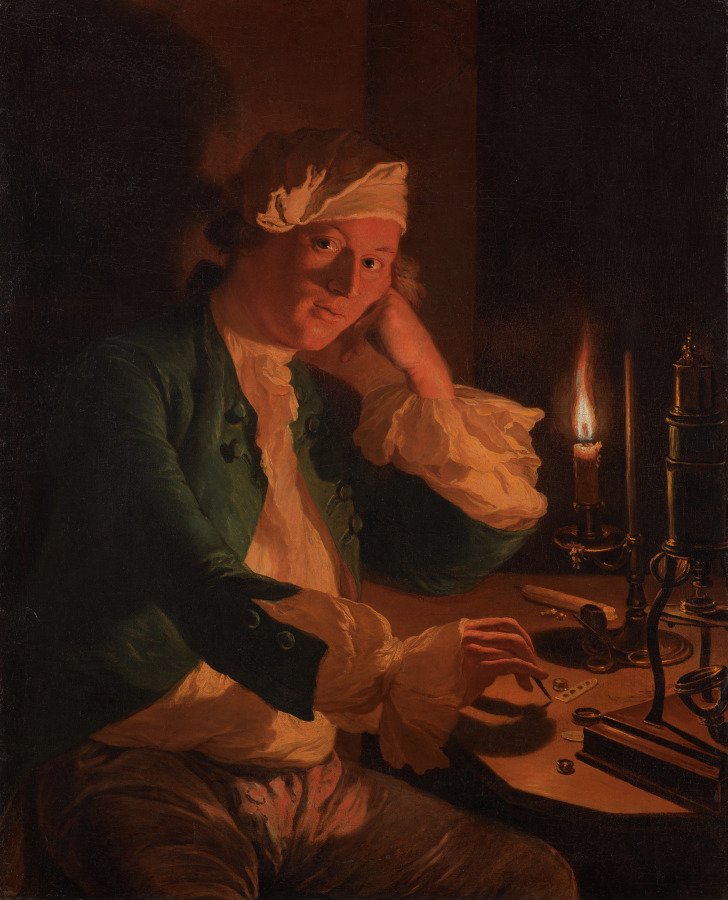
Start with the light. In A Scientist Seated at a Desk by Candlelight, painted in 1755 and now in the Cleveland Museum of Art, the only visible source is a candle at the right edge of the table. Everything else is arranged around that flame. The face, the white cap, the ruffled cuffs and the hand holding a fine tool catch the light; the coat, the wall and most of the corners fall away into darkness.
Next, look at the composition. The sitter leans his head on one hand, and his body forms a diagonal that runs from the lower left up to his face, then down his arm to the desk and the candle. The eye follows that loop and returns to the face. On the right, a tall brass instrument and the candlestick make a vertical counterweight to the figure.
Then look at the edges. Where light falls, the paint describes fabric closely: the soft folds of the shirt, the frill at the wrist, the band of the cap. Where shadow falls, forms dissolve. That contrast between crisp lit edges and lost dark edges is what makes the picture read as lit from within rather than evenly illuminated.
Finally, look at the signature. The Cleveland Museum of Art records an inscription in black paint on the reverse of the original canvas: “Peint par Anna Dorothea Therbusch Lisiewski 1755.” She signed with both her married name and her family name, a reminder that she came from a family of painters.
A palette measured from the Cleveland scan
The colours below were measured from the museum’s scan of this painting with an image-quantising script, not from the original pigments.
- Shadow brown-black #19100f: the dominant value, covering the wall and most of the background.
- Jacket green-black #201c19: the coat in shadow, a cool dark that only just separates from the ground.
- Warm umber #4e2715: the half-tones where light starts to fade.
- Burnt sienna #8c4623: the table top and the warmer passages of the figure.
- Candlelit copper #bb672b: the lit sleeve and cuff as they appear in the scan.
- Flame tan #bd926f: the pale glow around the candle flame.
The lesson is the proportion. Most of the frame sits in the darkest two values, and the bright warm tones occupy a small area near the centre and the candle. You can sample your own references with the image colour picker and test ratios like this before committing to a scheme.
Career outline and key works
Therbusch was born in Berlin in 1721, according to both the Staatliche Museen zu Berlin and the biographical encyclopedia Women in World History; the Cleveland Museum of Art gives her birth year as 1721/22. She was the daughter of the court painter Georg Lisiewsky, who trained his children, as the Gemäldegalerie in Berlin and the AWARE women artists archive both record. AWARE adds that she studied Dutch seventeenth-century painting and French Rococo painters such as Watteau and Lancret in the royal collections, and the Gemäldegalerie names Watteau and the Berlin court painter Antoine Pesne as influences.
In the 1740s she married the Berlin innkeeper Ernst Friedrich Therbusch, and for roughly the next two decades she raised a family. Both the Gemäldegalerie and AWARE describe this long interruption, and both place her return to professional painting around 1761. The 1755 Cleveland canvas shows that she had not stopped painting altogether during those years.
From about 1761 she worked for the courts of Stuttgart and Mannheim, which Women in World History and AWARE both date to 1761–64. The Gemäldegalerie and AWARE record that she became a member of the academies in Stuttgart, Bologna and Vienna.
She then went to Paris. The Gemäldegalerie dates her stay from the summer of 1766 to the autumn of 1768, while Women in World History places her arrival in 1765. In 1767 she was admitted to the Académie royale de peinture et de sculpture, one of very few women to be accepted. The Cleveland Museum of Art recounts that she submitted a candlelight subject, a genre then out of fashion in Paris, and was at first refused on the grounds that a woman could not have painted so accomplished a work; she agreed to be watched painting by the committee and was admitted at her second attempt. The Gemäldegalerie also notes that her admission came “not without resistance.” The critic Denis Diderot wrote about her in his account of the Salon of 1767, and AWARE notes that his early support later turned to a falling-out.
Back in Berlin around 1770 (the Gemäldegalerie says 1769, AWARE 1770), she became, in the Gemäldegalerie’s words, a highly sought-after portrait painter. Key works from these years include the Portrait of Henriette Herz, 1778, in the Alte Nationalgalerie, Berlin, and the large Self-Portrait of about 1782 in the Gemäldegalerie, in which she wears an eyeglass and holds a book. AWARE describes that late self-portrait as unfinished. She died in 1782.
Technique: precise light, quick handling
Therbusch painted mainly in oil on canvas. AWARE describes her manner as a combination of precise rendering of textures with loose, quick brushwork, and notes her strong red and pink tones, especially in flesh. Both qualities are visible in the Cleveland painting: the lace and shirt are described closely where the candle catches them, while the shadows of the coat and wall are handled broadly.
Her candlelight scenes belong to an older tradition. The Gemäldegalerie describes the painting she used for admission to the Paris academy as a candlelight picture in the Netherlandish manner, and the Cleveland Museum of Art notes that such subjects were unfashionable in Paris at the time. A Berlin research project at the Gemäldegalerie, run from 2022 to 2024, has examined her materials and working methods with X-radiography, infrared reflectography and pigment analysis.
How designers can borrow Therbusch’s ideas today
Use one light source. In product photography, editorial illustration or a hero image, decide where the single light is and let everything else fall off from it. A clear source makes a composition easy to read at a glance.
Give darkness most of the frame. Therbusch lets dark values take up the bulk of the canvas. On screen, a deep warm brown-black rather than a neutral black keeps a dark interface or poster from feeling cold, and makes a small bright area glow.
Keep the warm range narrow. Work in a band of related earth tones (umber, sienna, copper, tan) and add one cool dark, like the green-black coat, for separation. The colour palette generator helps when you need to extend a narrow range into usable steps.
Sharpen only what is lit. Keep detail and contrast where the light falls and let shadowed edges soften.
Therbusch in context: Rococo and academy women
Her early training sits within the court art of eighteenth-century Berlin, which drew on French painting; the guide to Rococo art covers that wider style without repeating it here. For another woman admitted to the Paris academy nearly a century earlier, see the guide to Elisabeth-Sophie Chéron. The MGD museum collection gathers public-domain works for reference.
The Cleveland painting is the only work by Therbusch that the Art Institute of Chicago, the Cleveland Museum of Art and the Metropolitan Museum of Art flag as free to reuse through their collection APIs, so it is the one image reproduced in this guide. Her other works named here are described in text with the collections that hold them.
Frequently asked questions
Who was Anna Dorothea Therbusch?
She was a German painter, born Anna Dorothea Lisiewska in Berlin in 1721, who died in 1782. Trained by her father, the court painter Georg Lisiewsky, she worked for the courts of Stuttgart and Mannheim, was admitted to the Paris Académie royale in 1767 and became a sought-after portrait painter in Berlin.
What is Anna Dorothea Therbusch known for?
She is known for portraits, including the Portrait of Henriette Herz, 1778, and a large self-portrait of about 1782 in Berlin, and for candlelit scenes such as A Scientist Seated at a Desk by Candlelight, 1755, in the Cleveland Museum of Art.
Where can I see Therbusch’s paintings?
The Staatliche Museen zu Berlin hold a large group, including the self-portrait in the Gemäldegalerie and the Henriette Herz portrait in the Alte Nationalgalerie. In the United States, the Cleveland Museum of Art acquired her 1755 candlelight painting in 2023.
Can I use images of Therbusch’s work in my designs?
The Cleveland Museum of Art releases its image of A Scientist Seated at a Desk by Candlelight under CC0, its open-access licence. For other works, check the holding museum’s terms before reuse. Her lighting and colour principles are free to apply in original work.